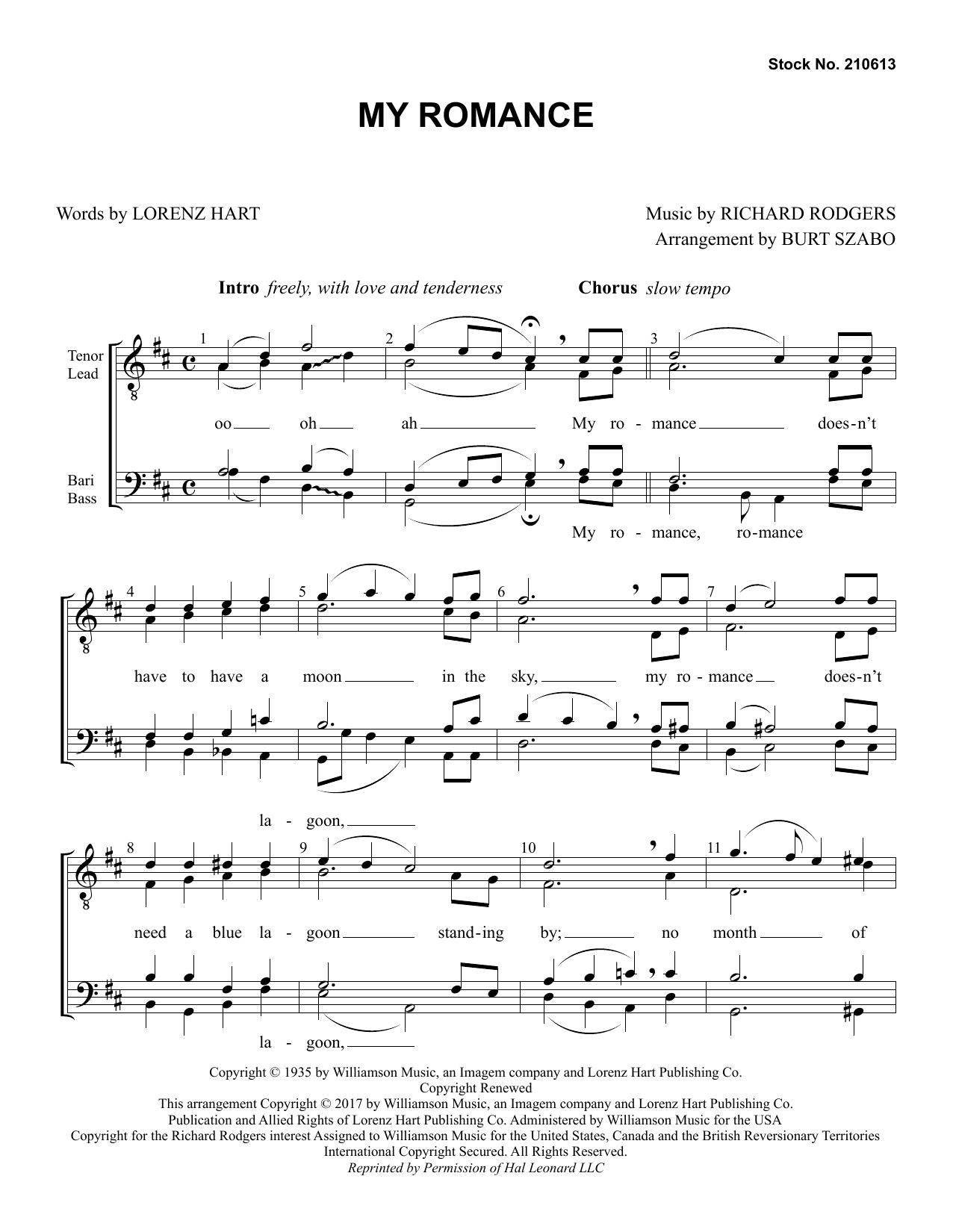
My Romance (arr. Burt Szabo) Sheet Music Preview

My Romance (arr. Burt Szabo): TTBB Choral Octavo

As performed by Rodgers Hart / Arranged by Burt Szabo

Item: 35-DS00427463

Digital Download
$3.20
Description

My Romance (arr. Burt Szabo): TTBB Choral Octavo isn't in MakeMusic Cloud just yet...but it could be. Let us know you'd like to see it, and you'll help shape what comes next. In the meantime, start a free trial and dive into thousands of interactive titles your students can play along with today.

Sample Audio
No sample audio found.
Sample Video
Additional Details
Publisher: Hal Leonard
Page Count: 4
SKU: 35-DS00427463

More about this title

About the Artist: Rodgers Hart

Richard Rodgers and Lorenz Hart stand as one of American musical theater's most prolific songwriting partnerships. Together they crafted the melodic vocabulary of the American songbook, with Rodgers composing elegant, singable lines while Hart provided witty, sophisticated lyrics. Their collaboration from the 1920s through the early 1940s produced standards that remain central to jazz and choral repertoire.

For music educators, Rodgers and Hart's output offers an invaluable resource: songs with strong harmonic foundations, memorable melodies that sit well across voice types, and lyrics that engage singers intellectually. "My Romance" exemplifies their gift for creating deeply hummable tunes within harmonically rich contexts, making it ideal for both concert and educational settings.

Why we love this

Burt Szabo's arrangement takes a beloved standard and reshapes it for barbershop sensibilities, preserving the song's sophisticated harmonic language while creating opportunities for blend, vowel unity, and the rich sonorities barbershop voicing demands. This is a piece that teaches musicianship without feeling like a teaching piece; singers come away with better ears and better ensemble instincts.

What to expect

Tender and conversational, "My Romance" exhales warmth without losing elegance. Szabo's arrangement sits comfortably in the male voice while maintaining the song's inherent lyricism, creating moments of genuine tenderness within the structural clarity barbershop style provides. Singers feel the romantic sentiment of the text without ever sacrificing precision or blend.

Who it's for

This octavo serves TTBB ensembles with some harmonic literacy and experience blending in close voicings. It works equally well for high school barbershop groups looking for standard repertoire, college men's choirs wanting to expand beyond traditional classical writing, and masters-level ensembles seeking to teach younger singers how sophisticated pop songwriting translates to the barbershop idiom.

How to get the most out of it

  • Spend rehearsal time on vowel placement across the four parts, particularly in sustained chords where balance becomes transparent. Small adjustments to mouth shape create dramatic improvements in blend.
  • The barbershop voicing creates natural ring in certain harmonies; lean into those moments rather than fighting them. Let students hear where the overtones align.
  • Treat phrase endings with rhythmic precision. Barbershop style rewards crisp cutoffs that honor the harmonic structure rather than lingering sentimentality.
  • If your ensemble is unfamiliar with barbershop style, isolate the harmonic progressions by having singers hold them on a neutral syllable before adding text. This builds security and intuition about the arrangement's architecture.

How to use it

Open a concert with this if you want to establish sophisticated harmony and ensemble control early; its clarity sets a high bar and reassures the audience you mean business. Alternatively, program it as a palate cleanser between heavier classical or contemporary works, or use it as an encore that leaves audiences with a song they recognize and can hum on the way home.

Skills your students will build

  • Blend and balance in close four-part voicings
  • Vowel consistency across octave doublings
  • Barbershop harmonic tendencies and voice leading conventions
  • Phrase shaping within a straightforward harmonic framework
  • Sustaining ensemble cohesion in predominantly sustained harmonic texture

You May Also Like