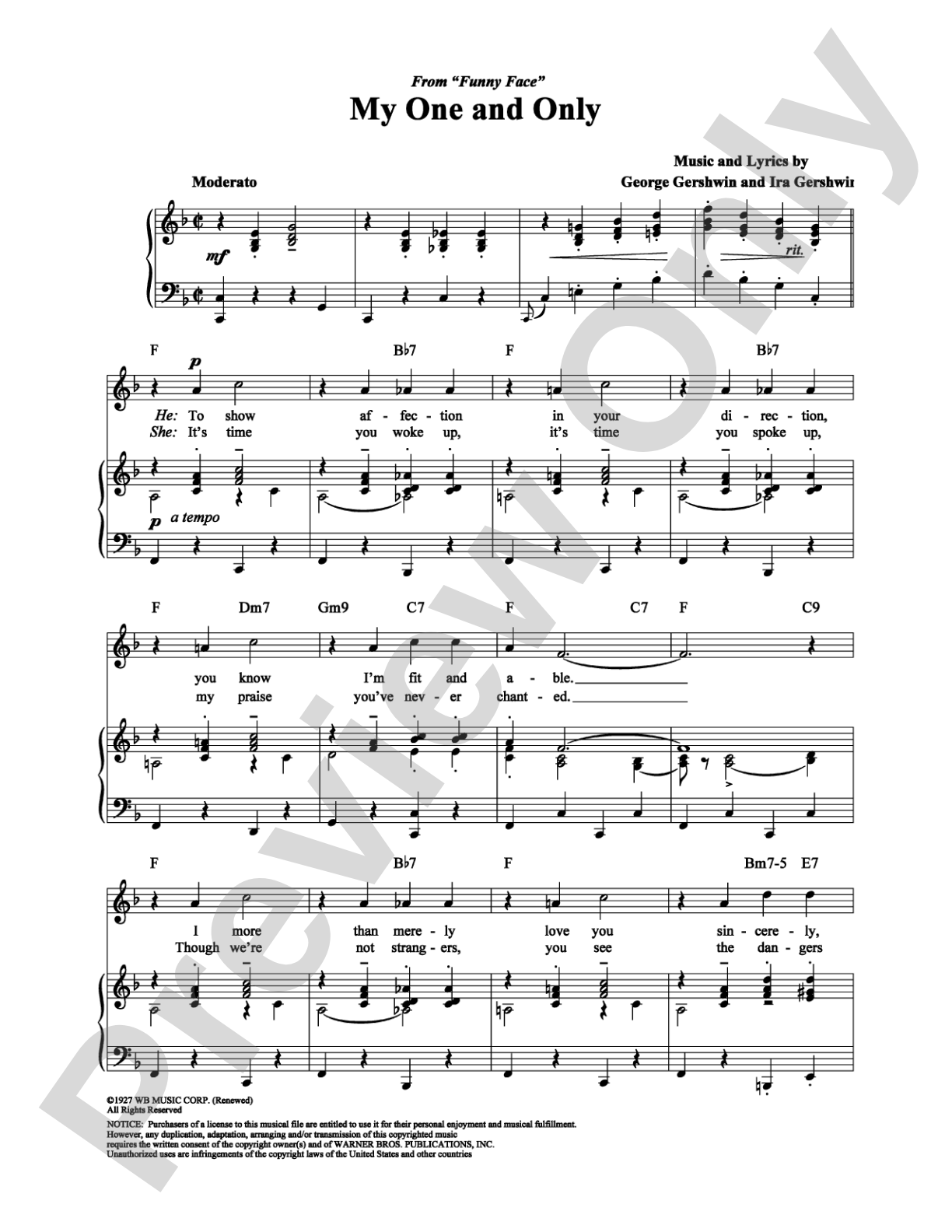
My One And Only: Piano/Vocal/Chords Digital Sheet Music

My One And Only: Piano/Vocal/Chords Digital Sheet Music

George Gershwin, Fred Astaire

Item: 00-PS-0005374

Digital Download
$3.99
Description

My One And Only: Piano/Vocal/Chords Digital Sheet Music isn't in MakeMusic Cloud just yet...but it could be. Let us know you'd like to see it, and you'll help shape what comes next. In the meantime, start a free trial and dive into thousands of interactive titles your students can play along with today.

Sample Audio
No sample audio found.
Sample Video
Additional Details
SKU: 00-PS-0005374

More about this title

About the Artist: Fred Astaire

Fred Astaire (1899-1987) was an American dancer, singer, and actor whose influence on music education extends far beyond the stage. His interpretations of standards from the Great American Songbook set the benchmark for vocal phrasing, rhythmic precision, and stylistic clarity that vocalists still study today. His recordings and film performances demonstrate how careful attention to lyrical meaning, dynamic control, and swing can transform a song from notation into narrative.

Why we love this

Astaire's recordings of standards offer vocalists a masterclass in interpretation without didacticism. The melody is graceful and singable, the harmonic language is sophisticated enough to hold the attention of trained musicians, and the song's structure rewards both straightforward performance and creative embellishment. Programming this alongside other Golden Age standards gives your students access to repertoire that connects classical vocal training with the idioms of American song.

What to expect

Elegant and uncluttered, with a melody that sits naturally in the voice and a harmonic language that hovers between major key brightness and subtle minor touches. The song moves with ease and grace, inviting both intimate delivery and moments of genuine warmth.

Who it's for

Vocalists studying the American Songbook, jazz singers building their standards repertoire, and music theater performers seeking touchstone interpretations of classic material. This digital lead sheet works equally well for accompanists learning the harmonic progressions or pianists arranging the piece for small ensemble.

How to get the most out of it

  • Treat the lyric as dialogue rather than decoration; Astaire's phrasing prioritizes the natural speech rhythm of the words, which should guide your tempo choices and breath placement.
  • Balance legit vocal production with the conversational quality of the melody; this is not operatic singing, but it is precise singing.
  • Use the chord changes as harmonic landmarks for expression; slight dynamic shaping around the turnarounds and key moments will prevent the performance from sounding flat.

How to use it

Pair this with other standards from the 1930s-1940s era to build a concert segment celebrating the Great American Songbook, or feature it in a music theater revue where students explore how the same song can be interpreted in different styles. It also serves as an excellent study score for jazz ensemble arrangers looking to understand how a classic melody can be reharmonized and reinterpreted.

Skills your students will build

  • Phrasing decisions in sung melody based on lyrical content and natural speech rhythms
  • Reading and interpreting chord symbols for improvisation or reharmonization
  • Stylistic understanding of Great American Songbook conventions
  • Vocal flexibility and articulation across a range of dynamic and tonal colors

You May Also Like