
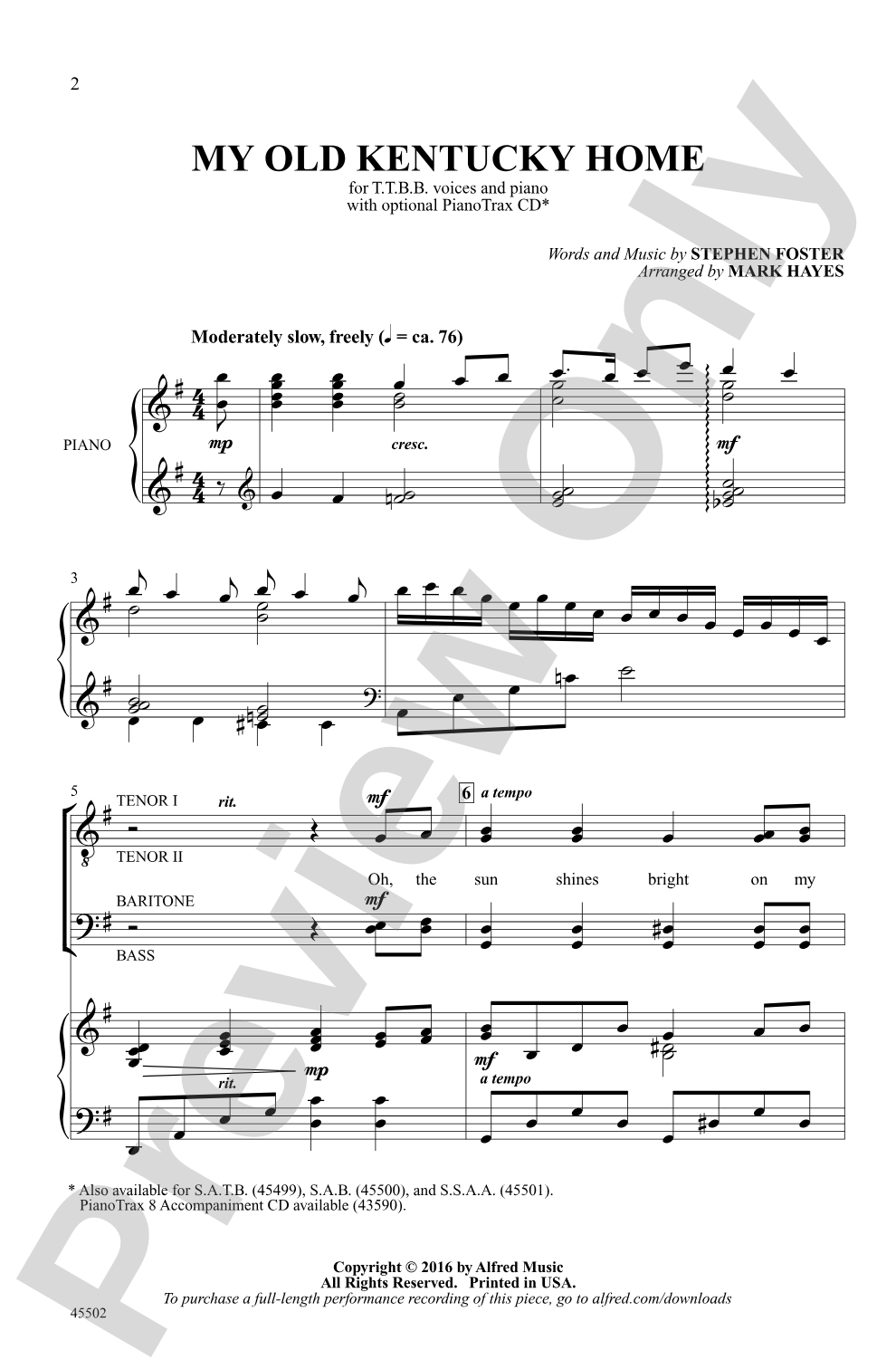
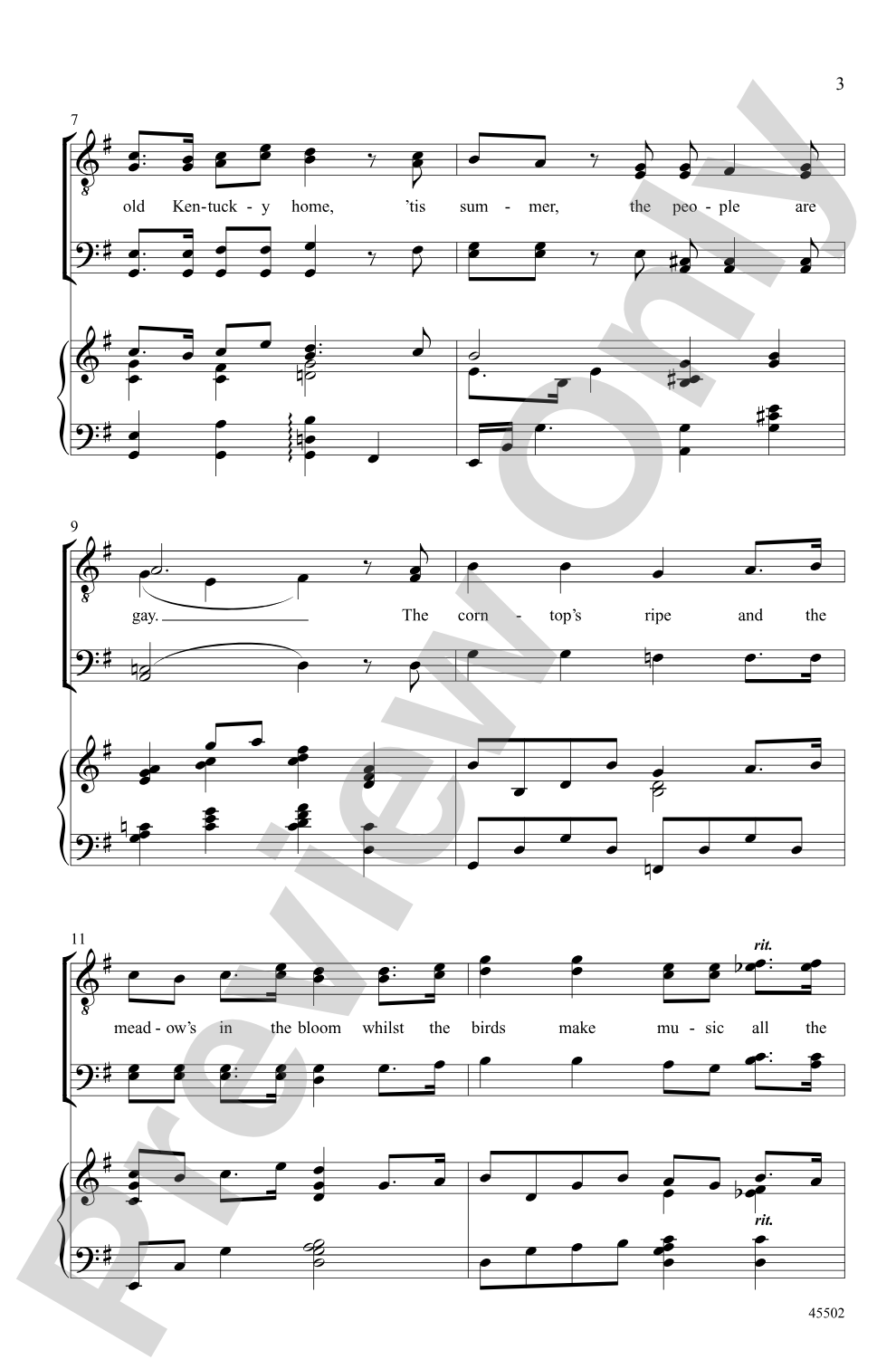

My Old Kentucky Home: TTBB Choral Octavo
Words and music by Stephen Foster / arr. Mark Hayes
Item: 00-PO-0003689
$1.90
Minimum order quantity: 20 copies
Pickup currently not available
Description
A shimmering a cappella refrain provides an especially memorable highlight at the end of Mark Hayes', otherwise accompanied, choral arrangement. Originally penned by the "Father of American Music," this beloved song has long been associated with the grand pageantry of the Kentucky Derby.


My Old Kentucky Home: TTBB Choral Octavo isn't in MakeMusic Cloud just yet...but it could be. Let us know you'd like to see it, and you'll help shape what comes next. In the meantime, start a free trial and dive into thousands of interactive titles your students can play along with today.
Request This Title
Tell us you want it.
Start Your Free Trial
Explore everything that's ready to play right now.
Sample Audio
1
Audio File
--:--
0:00
0:00
Sample Video
No sample videos found.
Additional Details
Series:
Alfred Choral Designs
Publisher:
Alfred Music
Page Count:
12
SKU:
00-PO-0003689
More about this title
About the Composer: Stephen Foster
Stephen Foster (1826-1864) created a body of work that defined American popular song in the nineteenth century. His melodies possessed an immediacy and emotional directness that made them accessible to amateur musicians while remaining sophisticated enough to sustain repeated hearings. Foster composed nearly 200 songs across his lifetime, many of which have become embedded in American culture as folk standards.
Foster's legacy extends far beyond the sheet music industry of his era. His songs captured the rhythms and sentiments of everyday American life, from work songs to parlor ballads, and they remain central to understanding how music shaped national identity during the Civil War period and beyond. Music educators return to Foster's catalog consistently because these melodies teach themselves while opening conversations about American history and the evolution of popular music.
Why we love this
Mark Hayes strips away arrangements of "My Old Kentucky Home" that can feel overwrought, anchoring this version in clear harmonic writing while reserving maximum impact for the stunning a cappella refrain. A director chooses this when you need a piece that commands attention through musical architecture rather than orchestration, and when your TTBB ensemble is ready to prove that four voices can command a room.
What to expect
The opening sections unfold with warmth and directness, the piano providing rhythmic grounding while the voices settle into Foster's enduring melody. Then comes the refrain: suddenly unaccompanied, the harmony shifts into focus, creating an intimacy that feels both reflective and powerfully unified.
Who it's for
TTBB choirs seeking repertoire that balances accessibility with musical substance. This arrangement works equally well for community choruses, college singers, and high school ensembles with solid intonation skills and comfort with a cappella singing.
How to get the most out of it
- Balance the accompanied verses carefully so the shift to a cappella lands with genuine surprise. The refrain's power depends entirely on the contrast.
- In the a cappella section, shape phrases through dynamic sculpting rather than tempo changes. Let the harmony itself breathe.
- Tune the final a cappella passage with precision. Even slight intonation issues magnify without accompaniment, so treat this as a dedicated rehearsal focus.
- Maintain textural clarity in the accompanied sections by allowing the piano to define harmonic context rather than doubling vocal lines unnecessarily.
How to use it
Pair this with other American-rooted repertoire for a concert exploring the folk idiom across different arrangements and eras. The piece works especially well in programs examining American songwriting or as a centerpiece for a set celebrating Kentucky or Southern musical traditions. Its moderate length (12 pages) makes it suitable as a substantial anchor piece without overwhelming a concert program.
Skills your students will build
- A cappella singing and ensemble intonation in an unaccompanied refrain
- Stylistic contrast between accompanied and unaccompanied sections
- Voice independence in TTBB four-part harmony
- Phrasing and dynamic shaping in Foster's nineteenth-century melodic style
- Choral balance when one or more voices carry the primary melody