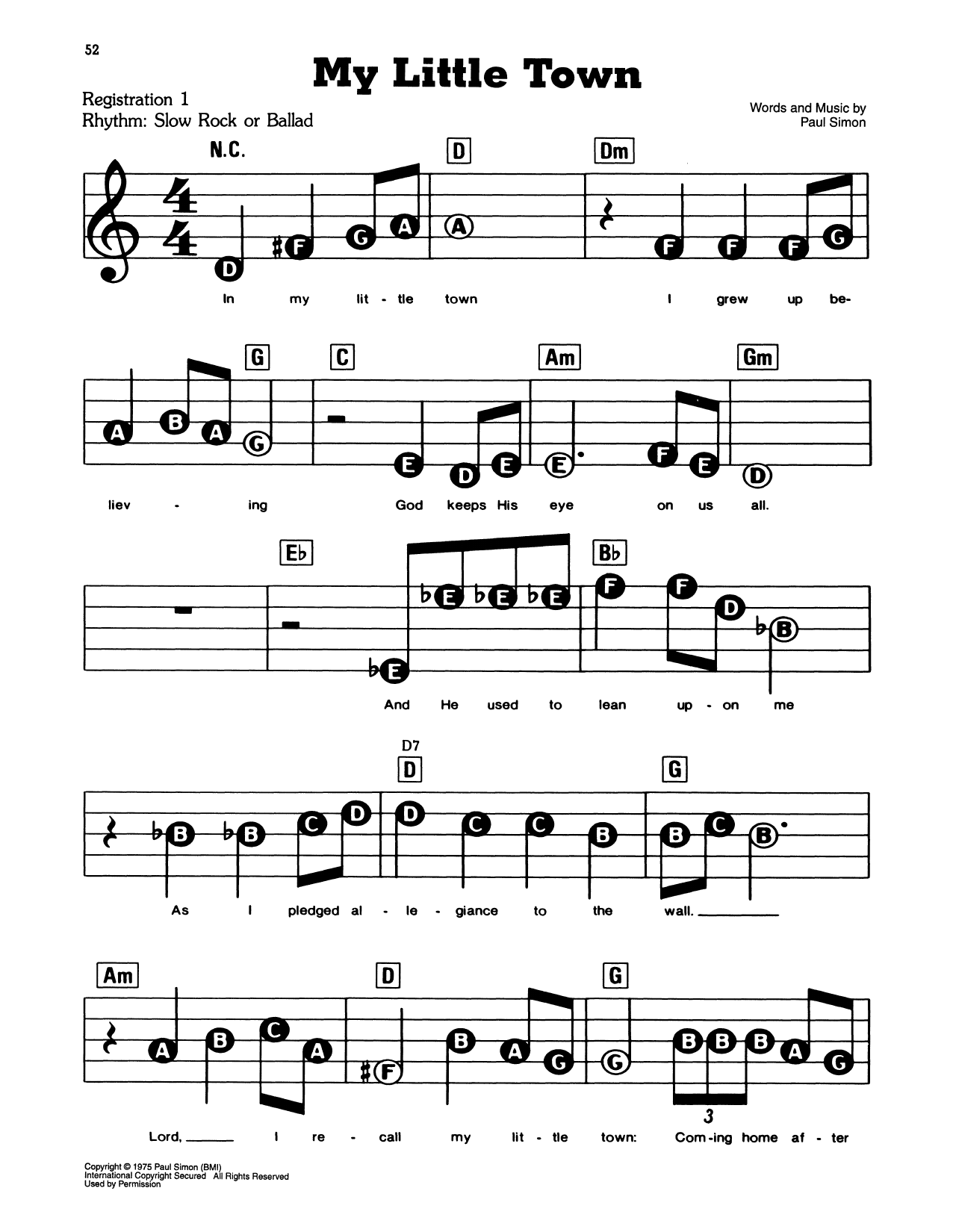
My Little Town Sheet Music Preview

My Little Town: E-Z Play Today

As performed by Paul Simon / As performed by Simon & Garfunkel

Item: 35-DS01320008

Digital Download
$4.99

One moment…

Description

My Little Town: E-Z Play Today isn't in MakeMusic Cloud just yet...but it could be. Let us know you'd like to see it, and you'll help shape what comes next. In the meantime, start a free trial and dive into thousands of interactive titles your students can play along with today.

Sample Audio
No sample audio found.
Sample Video
Additional Details
Publisher: Hal Leonard
Page Count: 4
SKU: 35-DS01320008

More about this title

About the Artist: Paul Simon

Paul Simon stands as one of America's most sophisticated songwriters, bringing literary language and harmonic complexity to popular music. His work with Art Garfunkel established the template for folk-rock harmony in the 1960s, while his solo career demonstrated an enduring curiosity about rhythm, world music, and narrative songwriting that continues to influence musicians across genres.

Why we love this

This arrangement strips the song down to its essential melodic and harmonic architecture, making it accessible for intermediate pianists while preserving the introspective quality that made the original resonate. The four-page format respects the song's modest scale rather than padding it, and the E-Z Play Today series transcription captures the folk-pop sensibility without demanding technical fireworks.

What to expect

Nostalgic yet grounded, the piece settles into a reflective space where specific urban detail meets universal memory. The arrangement invites performers to inhabit quiet introspection, finding musicality in restraint.

Who it's for

Pianists at the early-intermediate level who want to explore meaningful contemporary songwriting without technical barriers. This works equally well for voice and piano coaching, classroom ensemble work, or solo practice and recital programming.

How to get the most out of it

  • Approach the melody with a conversational tone rather than dramatic phrasing; this song works best when it sounds like someone reflecting quietly rather than performing for an audience.
  • Let the accompaniment sit back in the mix so the lyrical content and vocal melody remain the focal point of listener attention.
  • Pay attention to tempo consistency; the song's narrative quality depends on a steady, unhurried pace that gives each line room to breathe.

How to use it

Pair this with other singer-songwriter material from the 1970s to contextualize a program around narrative songwriting traditions. It also fits naturally in a general recital where pianists are exploring accessible arrangements of art songs and popular standards.

Skills your students will build

  • Interpreting accompaniment patterns that support rather than dominate the melody
  • Maintaining steady tempo and phrasing across a moderate form
  • Coordinating hand independence in simple but flowing textures

You May Also Like