My Little Demon: Piano/Vocal/Chords Digital Sheet Music

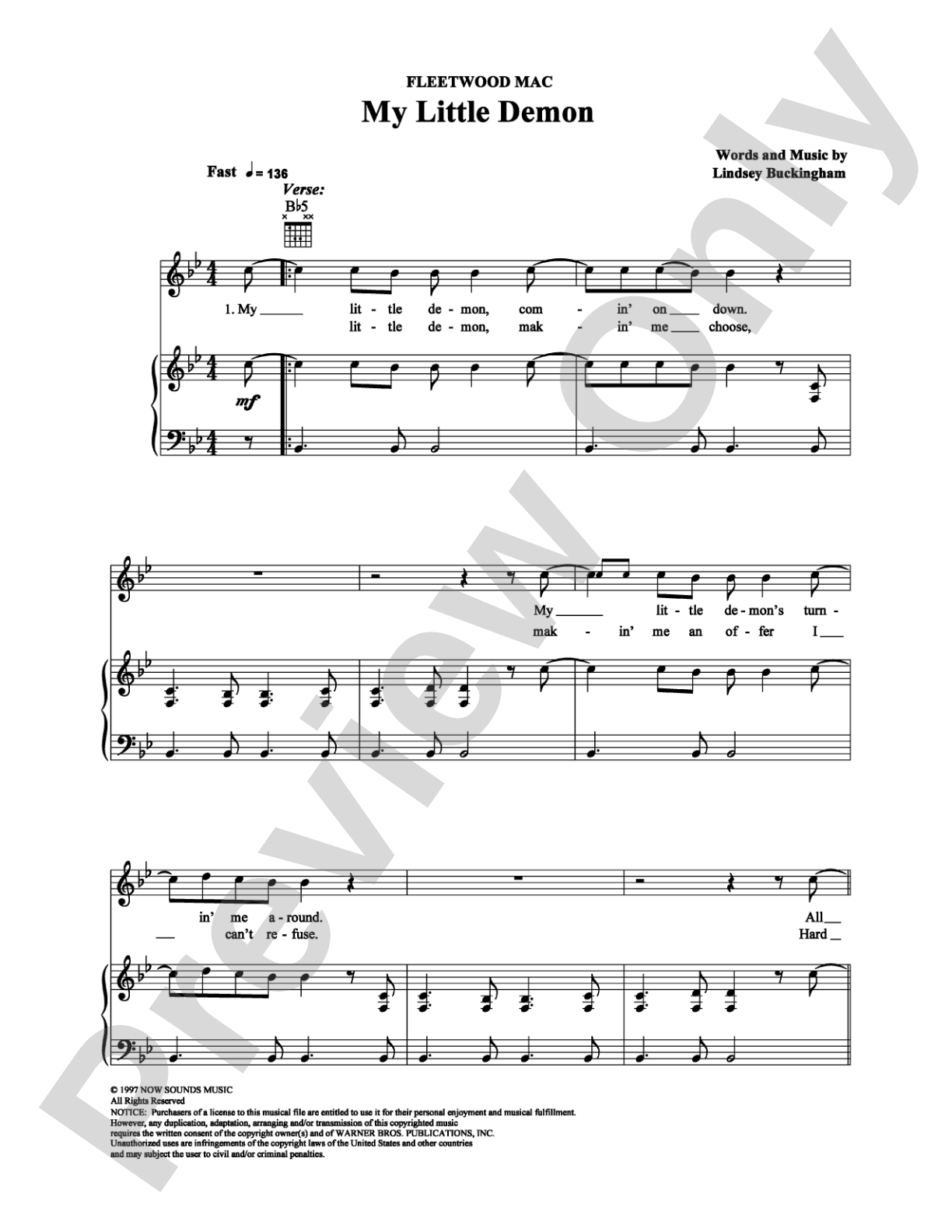
My Little Demon: Piano/Vocal/Chords Digital Sheet Music

Lindsey Buckingham, Fleetwood Mac

Item: 00-PS-0001374

Digital Download
$2.95
Description

My Little Demon: Piano/Vocal/Chords Digital Sheet Music isn't in MakeMusic Cloud just yet...but it could be. Let us know you'd like to see it, and you'll help shape what comes next. In the meantime, start a free trial and dive into thousands of interactive titles your students can play along with today.

Sample Audio
No sample audio found.
Sample Video
Additional Details
SKU: 00-PS-0001374

More about this title

About the Artist: Fleetwood Mac

Fleetwood Mac shaped the sound of rock and pop across five decades, moving from British blues rock to the sophisticated pop-rock sensibility that defined the 1970s and 1980s. The band's lineup evolved considerably over time, but their core strength lay in memorable melodies, intricate vocal harmonies, and songs that balanced polish with emotional authenticity. Their 1977 album Rumours remains one of the best-selling records of all time, a testament to their ability to craft songs that endure in both radio play and music education contexts.

For music students and singers, Fleetwood Mac's catalog offers accessible yet sophisticated material that teaches ensemble thinking and vocal precision. Their songs reward careful attention to lyrical phrasing, harmonic structure, and the interplay between lead and supporting vocal parts.

Why we love this

Fleetwood Mac's music strikes an ideal balance for rehearsal and performance: the songs are immediately recognizable and engaging for students, yet they demand real musicianship in terms of harmonic accuracy and vocal blend. This piece offers piano-driven pop-rock that sits comfortably in a singer's range while giving pianists rhythmic and harmonic content worth exploring.

What to expect

The song carries the polished, introspective quality characteristic of 1970s-80s rock, with enough melodic charm to feel immediate while the harmonic movement keeps it from becoming predictable. There's an undercurrent of sophistication beneath the accessible surface.

Who it's for

This arrangement suits singers with intermediate to advanced vocal control and pianists comfortable with pop-rock chord voicings and rhythmic accompaniment. It works equally well in solo recital settings, choral or jazz ensemble performance, and music theory or aural skills classes exploring harmonic function in popular music.

How to get the most out of it

  • Pay attention to the chord voicings in the piano part; they often define the harmonic color of the song. Resist the urge to simplify them, as they're central to the arrangement's character.
  • Balance the vocal line against the piano accompaniment so the melody reads clearly without the piano receding into mere support. Test this in rehearsal at performance tempo.
  • Lock the rhythm section feel between piano and vocal phrasing. Pop-rock songs like this one depend on pocket playing rather than metronomic precision.

How to use it

This piece works well in a concert built around classic rock repertoire or as a bridge between traditional art song and contemporary music. It also serves as an excellent teaching tool for students studying how popular songwriting uses harmonic language, melody, and arrangement to create emotional impact.

Skills your students will build

  • Singing over jazz-influenced chord changes in a pop-rock context
  • Reading and interpreting chord symbols with nuance and stylistic awareness
  • Balancing melody and accompaniment while maintaining rhythmic integrity
  • Understanding how harmonic movement in the piano part supports vocal phrasing

You May Also Like