
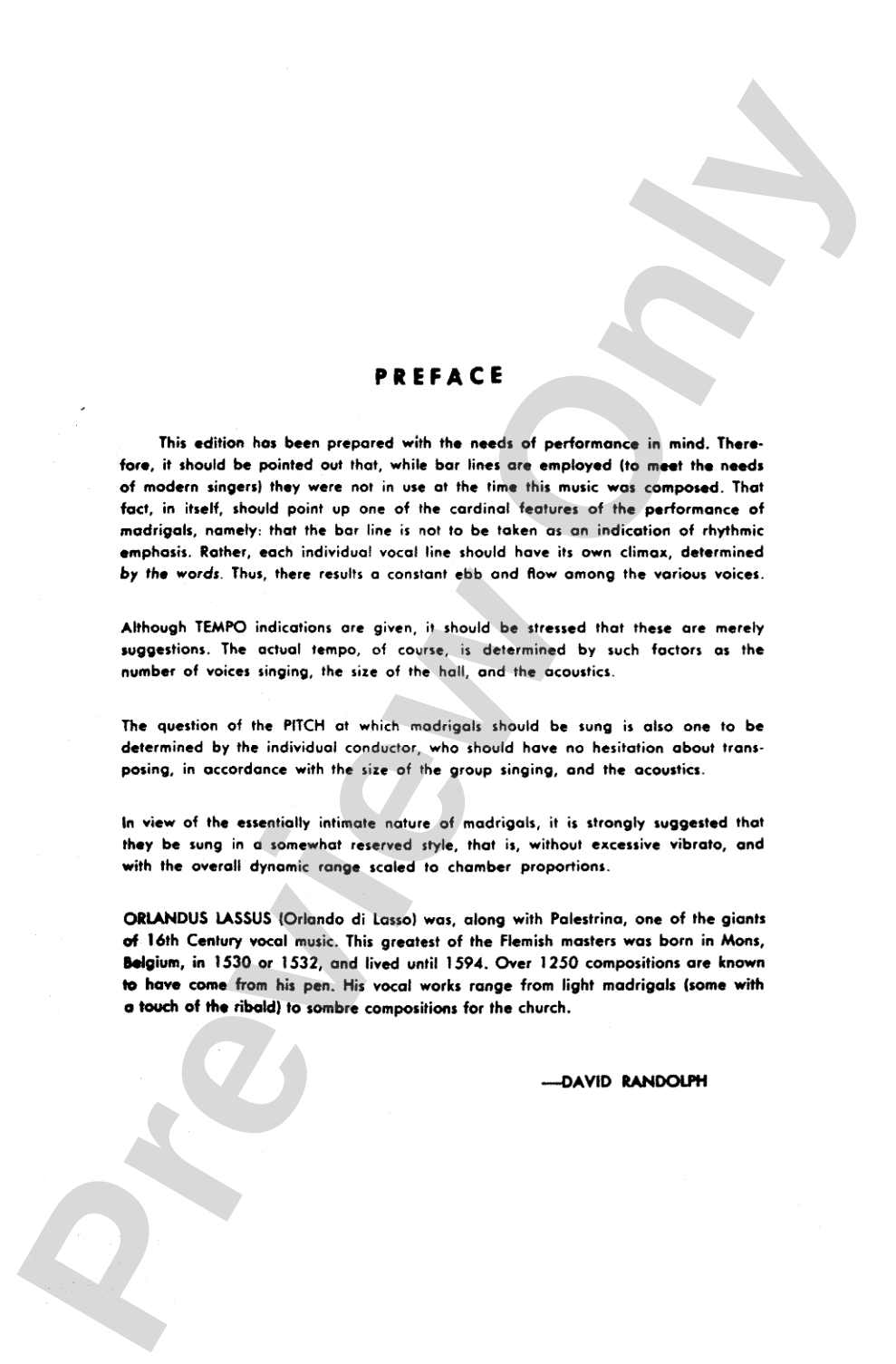

My Heart Is Offered Still to You: SATB Choral Octavo
By Orlandus Lassus / ed. David Randolph
Item: 00-PO-0002999
$2.25
Minimum order quantity: 20 copies
Pickup currently not available
Related Items
My Heart Is Offered Still to You: SATB Choral Octavo |
$2.25
|
View |
Description
This outstanding piece edited by David Randolph is designed to expose students to choral works from the 16th century; includes both French and English texts.


My Heart Is Offered Still to You: SATB Choral Octavo isn't in MakeMusic Cloud just yet...but it could be. Let us know you'd like to see it, and you'll help shape what comes next. In the meantime, start a free trial and dive into thousands of interactive titles your students can play along with today.
Request This Title
Tell us you want it.
Start Your Free Trial
Explore everything that's ready to play right now.
Sample Audio
1
Audio File
--:--
0:00
0:00
Sample Video
No sample videos found.
Additional Details
Series:
Alfred Archive Edition: Lawson-Gould Music Publishers
Publisher:
Alfred Music
Page Count:
8
SKU:
00-PO-0002999
More about this title
About the Composer: Orlandus Lassus
Orlandus Lassus (c. 1532-1594) was one of the Renaissance's most prolific and versatile composers, with over 2,000 works spanning motets, madrigals, chansons, and sacred music. His ability to write in multiple languages and styles made him a bridge between Italian, French, and German musical traditions, and his output shaped choral practice across Europe for generations.
For music educators, Lassus represents the height of Renaissance polyphonic craftsmanship. His secular works balance textural clarity with expressive counterpoint, making them ideal for students learning how composers shape language through music. His pieces remain central to understanding how Renaissance composers approached both sacred and worldly subjects with equal artistry.
Why we love this
This piece offers a genuine window into Renaissance secular writing without overwhelming singers with archaic performance practice questions. David Randolph's edition provides both French and English texts, giving your choir access to authentic language choices while maintaining clarity on the page. The eight-page length and SATB voicing make it substantial enough to matter musically but manageable within a rehearsal cycle.
What to expect
The piece exudes the graceful melancholy and refined elegance typical of Renaissance secular music. Voices weave in and out of focus, creating moments of harmonic richness that feel both timeless and intimate. There is no drama here, only the quiet certainty of well-crafted counterpoint expressing the heart's constancy.
Who it's for
High school and college choirs with at least one year of ensemble experience can access this work, though singers comfortable with sight-reading mixed clefs and Renaissance harmonic language will progress faster. It works equally well for advanced high school ensembles and college singers exploring the repertoire foundation.
How to get the most out of it
- Treat the text underlay as a guide to phrasing rather than a rigid rule. Renaissance composers often expected singers to shape phrases based on the natural breath points in the poetry, which may not align perfectly with modern notation.
- Balance the upper voices with lower voices during imitative passages. Lassus often threads melodies through all four parts, and clarity comes from singers hearing their own line as part of a continuous whole rather than leading from the top.
- Use your recorded accompaniment or piano reduction to lock harmonic progressions before full ensemble rehearsal. Renaissance harmony operates by different rules than Baroque or later music, and singers benefit from hearing the harmonic framework early.
- Shape the text expression subtly. Lassus's secular works are emotionally direct without being operatic. Encourage singers to communicate the meaning of the text through natural vocal inflection rather than dramatic gesture.
How to use it
Program this as part of a Renaissance-to-Baroque concert arc, pairing it with other secular works from the 16th century or with early Italian madrigals to show the stylistic range composers explored. It also serves as an excellent teaching piece within a unit on text expression across musical eras, where students can compare how Renaissance composers set language against later approaches.
Skills your students will build
- Reading Renaissance notation and clefs (including C clefs)
- Singing imitative counterpoint with four independent lines
- Shaping Renaissance harmonic progressions and cadence formulas
- Coordinating French and English text underlay with musical phrasing
- Distinguishing Renaissance secular style from sacred or Baroque conventions