
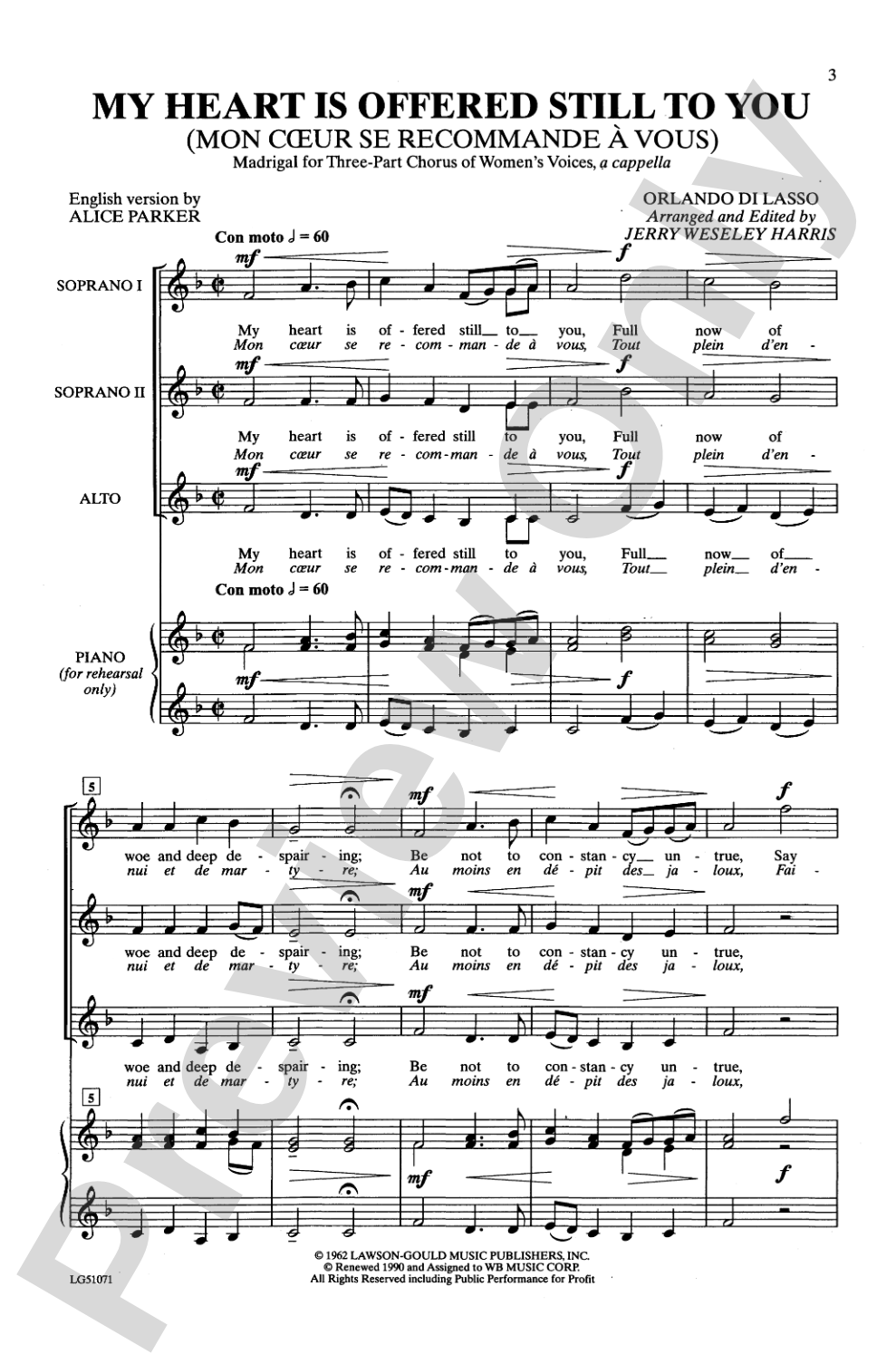

My Heart Is Offered Still to You: SSA Choral Octavo
By Orlando di Lasso / arr. Jerry Weseley Harris
Item: 00-PO-0002647
$2.25
Minimum order quantity: 20 copies
Pickup currently not available
Related Items
My Heart Is Offered Still to You: SSA Choral Octavo |
$2.25
|
View |
Description


My Heart Is Offered Still to You: SSA Choral Octavo isn't in MakeMusic Cloud just yet...but it could be. Let us know you'd like to see it, and you'll help shape what comes next. In the meantime, start a free trial and dive into thousands of interactive titles your students can play along with today.
Request This Title
Tell us you want it.
Start Your Free Trial
Explore everything that's ready to play right now.
Sample Audio
1
Audio File
--:--
0:00
0:00
Sample Video
No sample videos found.
Additional Details
Series:
Alfred Archive Edition: Lawson-Gould Music Publishers
Publisher:
Alfred Music
Page Count:
8
SKU:
00-PO-0002647
More about this title
About the Composer: Orlando di Lasso
Orlando di Lasso (1532-1594) stands as one of the Renaissance's most prolific and versatile composers, with over 2,000 works spanning nearly every musical genre of his era. He spent much of his career at the Bavarian court in Munich, where his output shaped the sound of late Renaissance sacred and secular music across Europe. His secular works are marked by their expressive text-setting, harmonic sophistication, and ability to capture the emotional nuance of Renaissance poetry.
For choral directors, di Lasso's secular works offer an accessible entry into Renaissance polyphony without requiring extensive early music training. His melodies are memorable and singable, his part-writing is transparent, and his approach to word-painting remains immediately compelling to modern ears. These qualities have made his secular madrigals and chansons staples of choral repertoire for centuries.
Why we love this
Jerry Weseley Harris's arrangement captures the lyrical elegance of di Lasso's original while tailoring it for SSA voices with natural voice leading that never feels compromised. This piece functions as both a genuine Renaissance masterwork and a strategic programming choice: it gives upper-voice choirs access to authentic Renaissance repertoire while maintaining the accessibility that makes SSA ensembles such vital teaching ensembles.
What to expect
The piece unfolds with the refined expressiveness characteristic of Renaissance courtly song; each voice enters with individuality but binds seamlessly into homophonic passages that shape the emotional arc of the text. There is intimacy here, a quality of address rather than proclamation, that draws the listener into the quiet devotion of the title.
Who it's for
This arrangement serves SSA choirs seeking substantive Renaissance repertoire that doesn't require the vocal range or part-writing complexity of full-voiced madrigals. It works equally well for upper-voice sections of mixed choirs and for developing sight-reading skills in treble ensembles, since di Lasso's clear melodic writing and balanced part relationships provide an ideal model for understanding polyphonic construction.
How to get the most out of it
- Approach the opening phrases with gentle legit-ness rather than floating airiness; this is courtly secular music that values clarity of text and melodic shape over atmospheric effects.
- Shape the harmonic rhythm by allowing the underlying pulse to breathe, particularly at cadences where Renaissance composers often expect slight temporal give.
- Attend to the vowel consistency across the parts, especially in moments where the voices move homophonically; blended tone matters far more than individual vibrato.
- Let the text guide your phrasing and dynamic choices. Renaissance poetry and its musical settings reward attention to the meaning of individual words and phrases.
How to use it
Program this alongside other secular Renaissance works to build a thematic set about love and courtship, or pair it with sacred di Lasso works to show how his compositional voice adapted across genres. It also serves well as a bridge piece in a program moving from earlier Renaissance to later Baroque repertoire, since it contains enough harmonic sophistication to prepare ears for the dramatic shifts that follow.
Skills your students will build
- Reading Renaissance-era clefs and notation conventions
- Identifying and balancing independent melodic lines within homophonic structures
- Text-declamation and word-stress alignment across multiple voice parts
- Tuning seventh chords and other Renaissance harmonic sonorities
- Understanding period-appropriate phrasing and cadential behavior