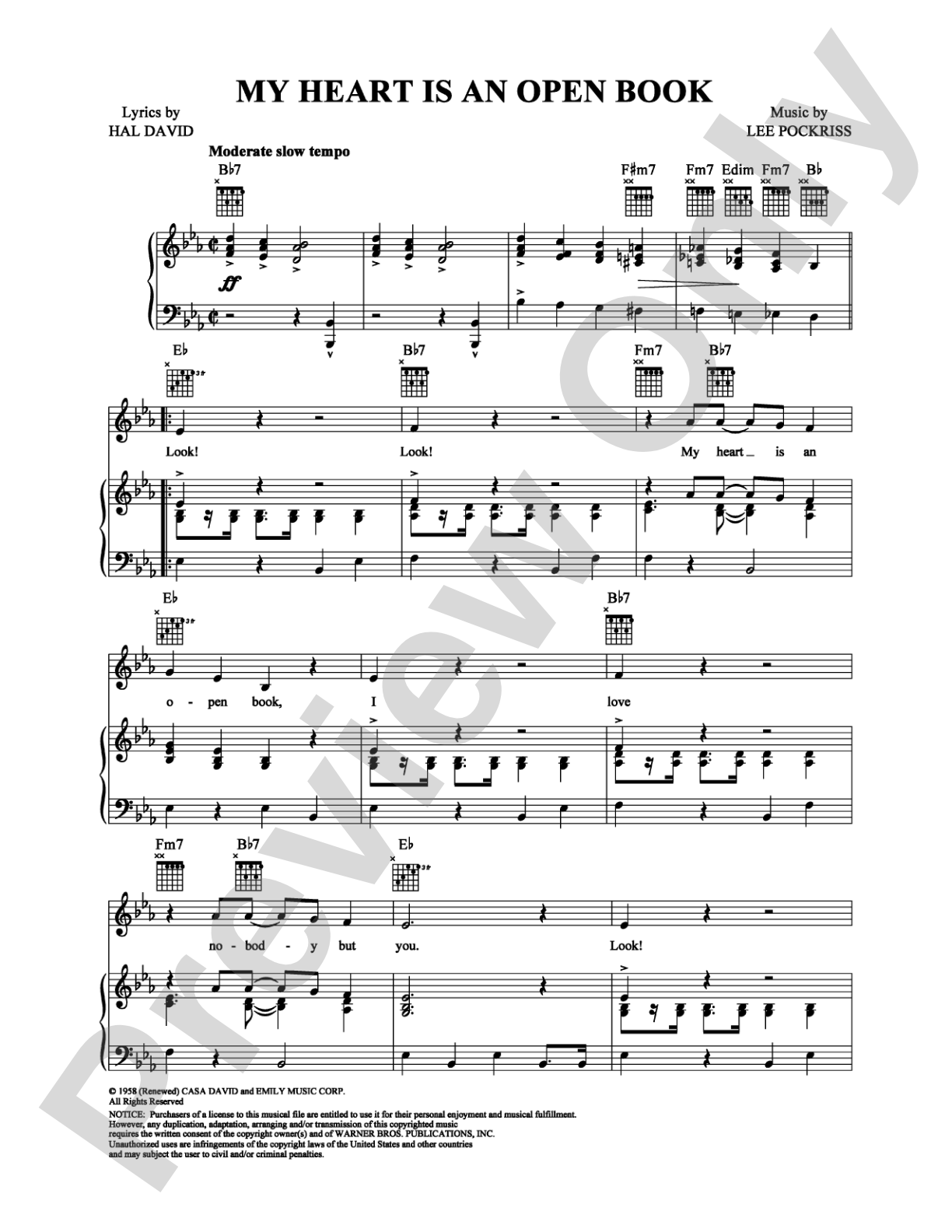
My Heart Is an Open Book: Piano/Vocal/Chords Digital Sheet Music

My Heart Is an Open Book: Piano/Vocal/Chords Digital Sheet Music

Lee Pockriss, Carl Dobkins, Jr.

Item: 00-PS-0010133

Digital Download
$3.99
Description

My Heart Is an Open Book: Piano/Vocal/Chords Digital Sheet Music isn't in MakeMusic Cloud just yet...but it could be. Let us know you'd like to see it, and you'll help shape what comes next. In the meantime, start a free trial and dive into thousands of interactive titles your students can play along with today.

Sample Audio
No sample audio found.
Sample Video
Additional Details
SKU: 00-PS-0010133

More about this title

About the Artist: Carl Dobkins

Carl Dobkins, Jr. was a singer and recording artist who found success in the late 1950s and early 1960s with his distinctive vocal delivery and interpretive style. "My Heart Is an Open Book," released in 1957, became one of his signature recordings and a standard of the pop vocal repertoire, showcasing his ability to convey emotional sincerity in a straightforward arrangement.

Why we love this

This arrangement captures the earnest charm of a mid-century pop standard while remaining accessible for singers and pianists working at intermediate levels. The song's straightforward melody and warm harmonic language make it an ideal choice for vocal recitals, jazz ensemble programs, or classroom exploration of pop standards from the Great American Songbook era.

What to expect

The song carries an open-hearted sincerity that defines mid-century pop balladry. Its uncomplicated melody and diatonic harmonies create an immediate sense of warmth and approachability, inviting singers to focus on emotional expression rather than technical fireworks.

Who it's for

Intermediate to advancing singers and pianists who are building their standard repertoire and want to explore accessible pop-vocal literature from the 1950s. This arrangement works equally well for solo recital preparation, classroom performance, or small ensemble study.

How to get the most out of it

  • Balance the vocal line so lyrics remain clear without overwhelming the piano part; the melody should sit comfortably above the accompaniment rather than competing with it.
  • Shape phrases with gentle dynamic swells rather than sudden changes; this song rewards a sustained, legato approach to both singing and playing.
  • Pay attention to chord voicings in the piano part; voices them naturally to avoid muddiness while keeping the harmonic texture warm and supportive.

How to use it

Program this as a vocal solo in a recital featuring American standards, or include it in a jazz or pop ensemble concert to anchor a thematic set of 1950s material. It also works well as a sight-singing or performance study in general music classes exploring popular song history.

Skills your students will build

  • Sustained phrasing and legato singing across longer melodic lines
  • Reading and performing chord symbols in a vocal-accompanied context
  • Interpreting dynamics and expression in pop-vocal style
  • Accompanying singers with tasteful, supportive piano voicings

You May Also Like