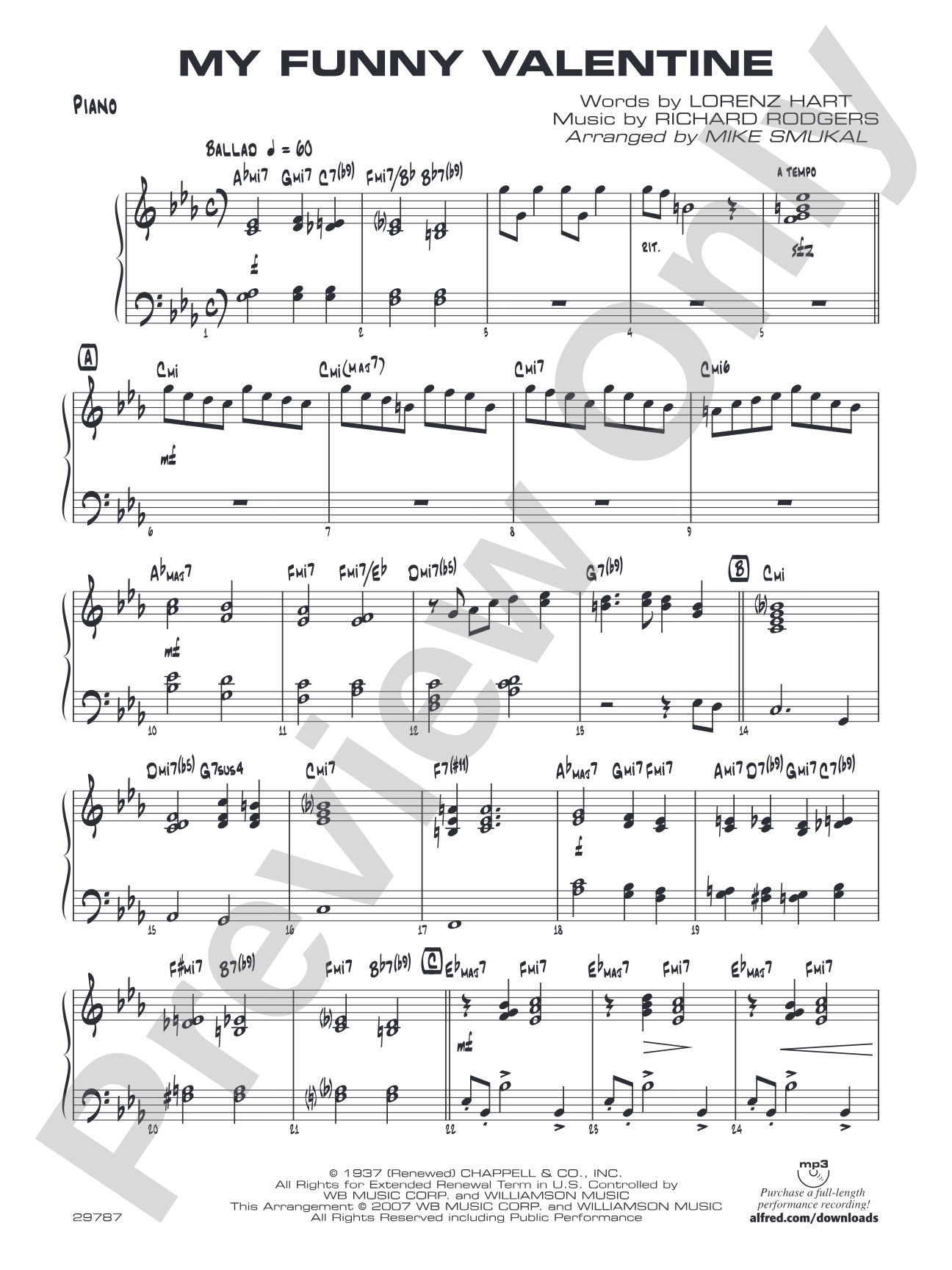
My Funny Valentine: Piano Accompaniment Sheet Music Preview

My Funny Valentine: Piano Accompaniment

Trumpet Solo

Words by Lorenz Hart, music by Richard Rodgers / arr. Mike Smukal

Grade: 2 (Medium Easy)

Item: 00-PC-0016182_K

Digital Download
$3.00
Description
A trumpet ballad feature with a double-time section with everything written out, easy ranges, some nice substitute chords and lush harmonies, and it's easy to put together. (3:49)

Don't just read it, hear it, play along with it, and watch your students grow with it. In MakeMusic Cloud, My Funny Valentine: Piano Accompaniment comes alive with professional accompaniment, adjustable tempo, and built-in practice tools that turn solo practice into real progress.

Sample Audio
0:00
0:00
Sample Video
Additional Details
Series: Young Jazz Ensemble
Publisher: Alfred Music
Page Count: 58
SKU: 00-PC-0016182_K

More about this title

About the Composer: Richard Rodgers

Richard Rodgers (1902-1979) shaped American musical theater across five decades, collaborating with lyricist Lorenz Hart and later Oscar Hammerstein II to create some of Broadway's most enduring scores. His melodic gift and harmonic sophistication made songs like "My Funny Valentine" standards that jazz musicians continue to reimagine, and his influence on jazz pedagogy runs deep through the repertoire educators choose for young ensembles.

Rodgers' melodies sit naturally in jazz contexts because they balance singability with harmonic depth. Many of his songs have become foundational charts for jazz education, offering students access to Broadway elegance without requiring advanced harmonic reading.

Why we love this

This arrangement gives young jazz ensembles the chance to play a genuinely sophisticated standard without getting bogged down in unnecessary complexity. The trumpet feature feels rewarding to perform, the written-out double-time section keeps everyone together, and the substitute chords and harmonies sound lush enough to impress audiences while staying within a Grade 2 technical reach.

What to expect

Tender and slightly wry, with the warmth of a classic ballad that swings gently through its opening before stepping into a more energetic groove. The lush harmonies and playful melody capture the bittersweet affection of the original song, while the written-out double-time section injects a moment of joy and momentum.

Who it's for

Jazz ensemble directors working with intermediate players who want a piece that sounds polished and professional without requiring advanced improvisation or complex reading. Trumpet players at this level will find a satisfying feature that sits well in the instrument's ballad range, and rhythm section players get solid foundational experience accompanying a solo over changes.

How to get the most out of it

  • Shape the trumpet solo's phrasing over the laid-back ballad tempo; work with your soloist on breath placement and letting the rhythm section space breathe rather than filling every moment.
  • Balance the fuller harmonic palette carefully so the ensemble doesn't overwhelm the lyrical quality of the melody, especially in the quieter passages before the double-time section.
  • Keep the double-time section crisp and locked in the rhythm section; this written-out section is your guide to energy and timing, so rehearse it as a unit before bringing in the solo voices.
  • Use dynamics to shape the arc from ballad to double-time and back; this three-and-a-half-minute chart rewards directors who think about narrative and pacing rather than just playing the notes.

How to use it

Pair this with a more uptempo blues or bebop-inflected piece to show range within the same concert set, or use it as the emotional centerpiece of a jazz showcase where young ensembles need a moment of sophistication and restraint. The moderate length and accessible instrumentation make it ideal for full-length jazz concerts or as a feature during a spring pops program.

Skills your students will build

  • Reading and playing comping figures with accuracy and light touch
  • Shaping a ballad solo with phrasing and dynamic control
  • Coordinating ensemble texture in a feature arrangement (staying supportive rather than prominent)
  • Executing written double-time sections with rhythmic precision and group cohesion
  • Interpreting jazz articulation and swing feel at a conversational volume

You May Also Like