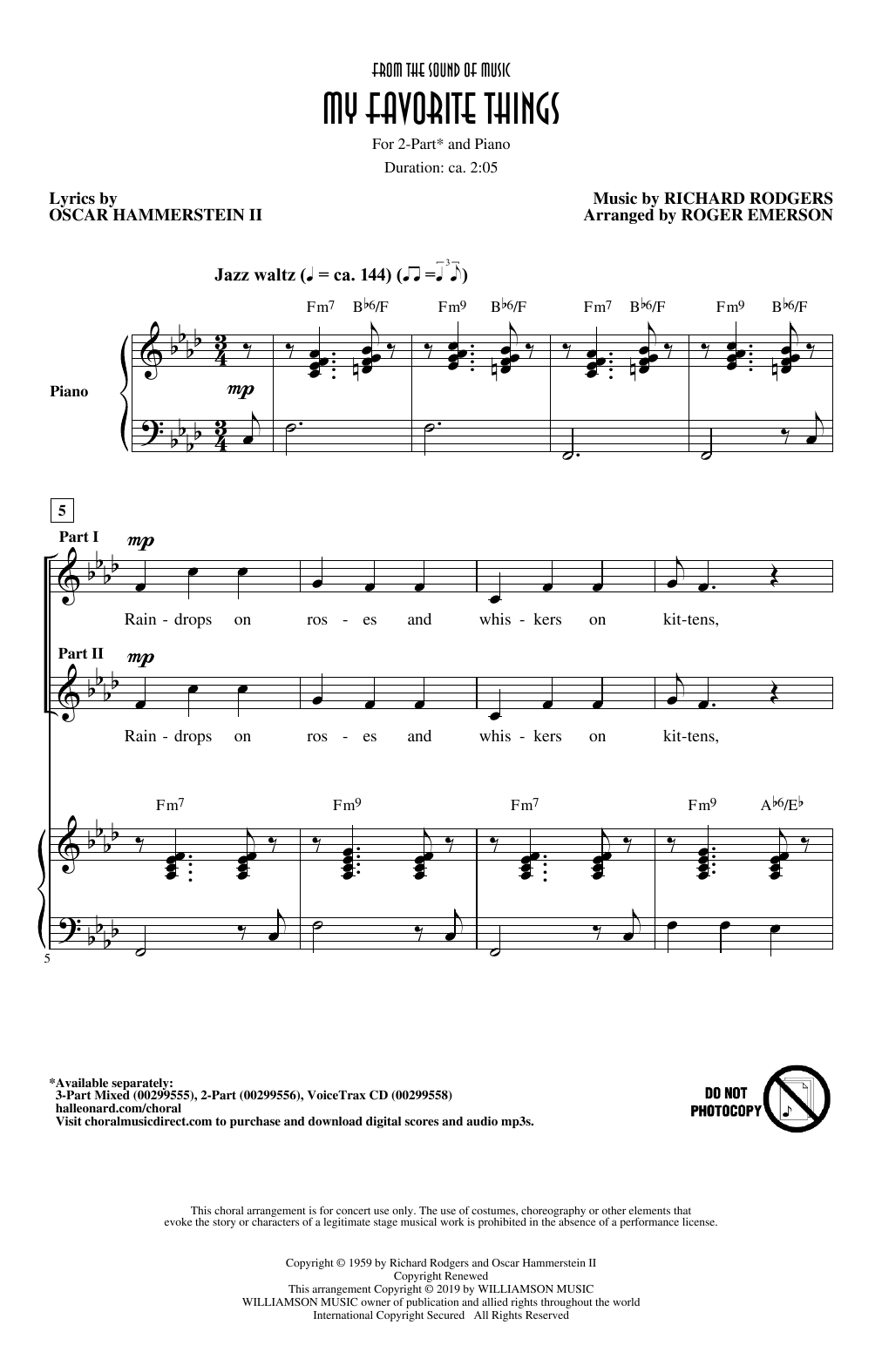
My Favorite Things (from The Sound Of Music) (arr. Roger Emerson) Sheet Music Preview

My Favorite Things (from The Sound Of Music) (arr. Roger Emerson): 2-Part Choral Octavo

Arranged by Roger Emerson

Item: 35-DS00449835

Digital Download
$2.99
Description

My Favorite Things (from The Sound Of Music) (arr. Roger Emerson): 2-Part Choral Octavo isn't in MakeMusic Cloud just yet...but it could be. Let us know you'd like to see it, and you'll help shape what comes next. In the meantime, start a free trial and dive into thousands of interactive titles your students can play along with today.

Sample Audio
No sample audio found.
Sample Video
Additional Details
Publisher: Hal Leonard
Page Count: 10
SKU: 35-DS00449835

More about this title

About the Arranger: Roger Emerson

Roger Emerson has shaped choral music education for decades through his prolific arranging work. His arrangements span every conceivable style and voicing level, making standard repertoire and popular songs accessible to student choirs of all abilities.

Why we love this

Emerson captures the wistful optimism of Rodgers and Hammerstein's melody while keeping the vocal writing lean and singable. A 2-part voicing means you can use this with developing singers, treble choirs, or any ensemble that needs a strong unison line with minimal harmonic complexity.

What to expect

The piece carries the gentle nostalgia of the original film moment. You get the famous melody intact but arranged with a contemporary vocal ease, making space for singers to connect emotionally with Hammerstein's clever, comfort-focused lyrics.

Who it's for

This works beautifully for middle school and high school choirs, particularly those pairing a December concert with movie or musical theater content. It also suits treble choirs and women's ensembles looking for accessible but genuine arrangements of familiar songs.

How to get the most out of it

  • Let the lyrics breathe. The text painting in phrases like 'cream colored ponies' and 'bright copper kettles' invites you to shape each image with gentle dynamic shaping.
  • Anchor the piece on the underlying jazz waltz feel rather than forcing it into a march. The accompaniment will support a relaxed, conversational tempo that lets the melody sing.
  • Balance any divisi passages carefully so the second part supports rather than competes with the melody line.

How to use it

Pair this with other Rodgers and Hammerstein selections for a musical theater program, or feature it as a holiday opener that feels sophisticated without demanding advanced vocal technique. Its moderate length makes it ideal for a concert set that needs variety in style and vocal weight.

Skills your students will build

  • Singing in jazz waltz time signatures
  • Maintaining melodic independence in 2-part textures
  • Interpreting lyrical text with emotional specificity
  • Balancing familiar melody recognition with arranged harmonic context

You May Also Like