

My Bonnie Lass: 3-Part Mixed, a cappella Choral Octavo
English Madrigal
Music by Thomas Morley, words by Michael Drayton / arr. Russell Robinson
Item: 00-PO-0002084
$2.25
Minimum order quantity: 20 copies
Pickup currently not available
Related Items
My Bonnie Lass: 3-Part Mixed, a cappella Choral Octavo |
$2.25
|
View |
Description
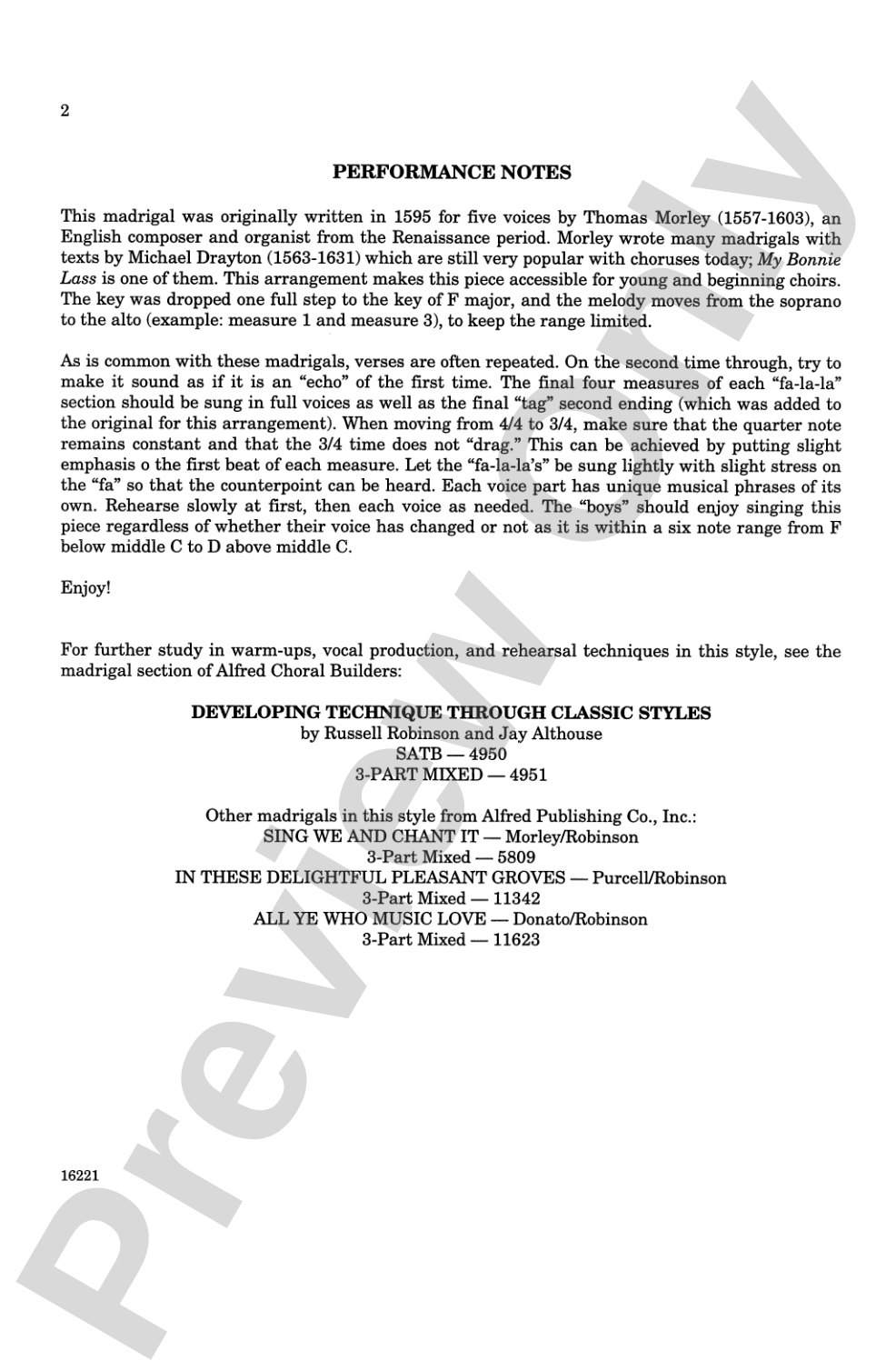
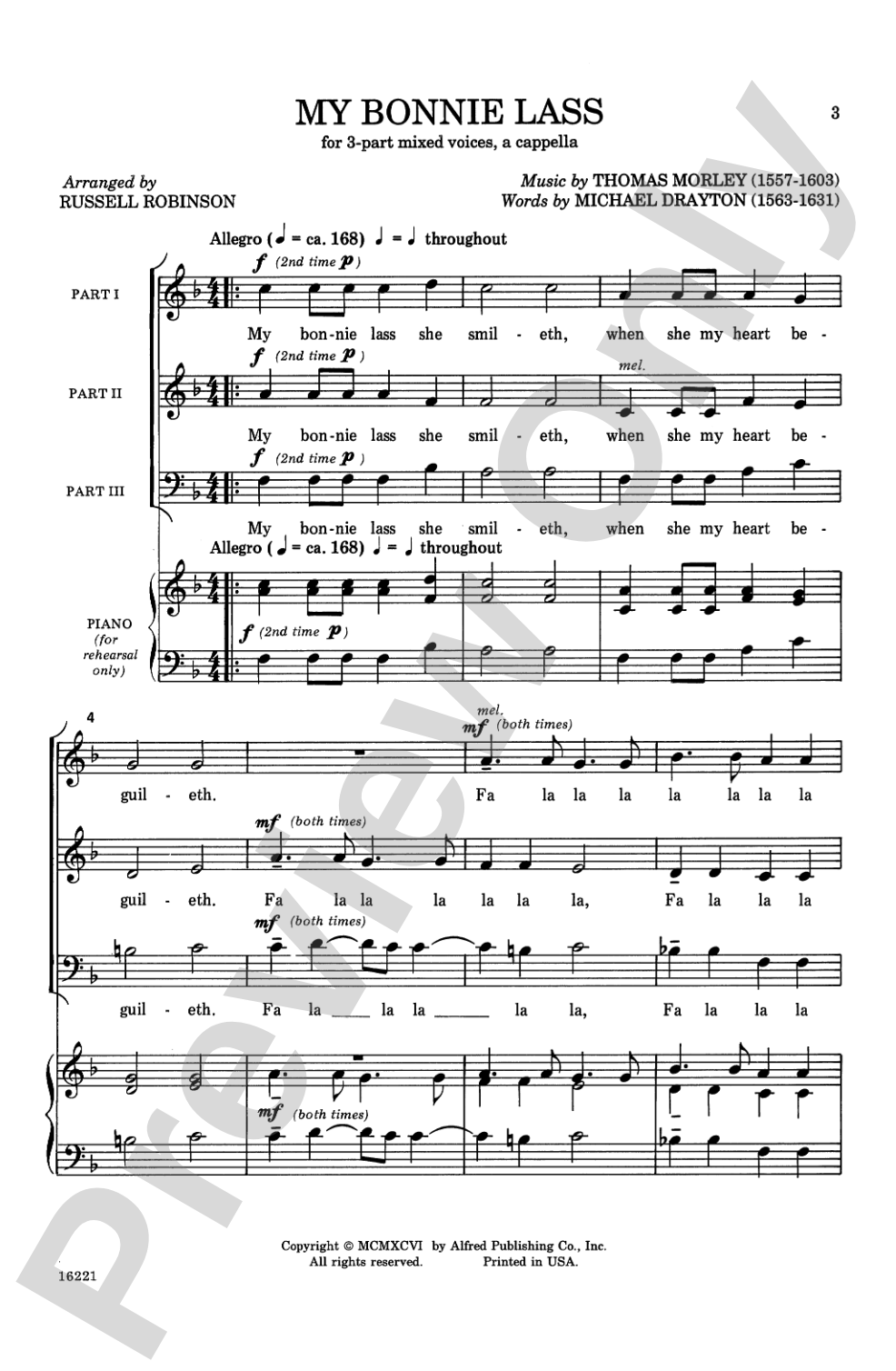
This arrangement of a favorite Thomas Morley madrigal, a popular choice in the 3-part voicing, is now available for SATB and TBB choirs. Bright tonalities and buoyant contrapuntal textures display the sound of Renaissance choral music. Another fine Robinson edition.


My Bonnie Lass: 3-Part Mixed, a cappella Choral Octavo isn't in MakeMusic Cloud just yet...but it could be. Let us know you'd like to see it, and you'll help shape what comes next. In the meantime, start a free trial and dive into thousands of interactive titles your students can play along with today.
Request This Title
Tell us you want it.
Start Your Free Trial
Explore everything that's ready to play right now.
Sample Audio
1
Audio File
--:--
0:00
0:00
Sample Video
No sample videos found.
Additional Details
Series:
Alfred Archive Edition: Alfred Choral Designs
Publisher:
Alfred Music
Page Count:
12
SKU:
00-PO-0002084
More about this title
About the Composer: Thomas Morley
Thomas Morley (1557-1602) stands as one of the most prolific and inventive English composers of the late Renaissance. A student of William Byrd and later a member of the Chapel Royal, Morley mastered every genre of his era, from sacred polyphony to keyboard works. His madrigals and lighter secular pieces earned him particular fame, blending Italian sophistication with English directness and wit.
Morely's gift for melody and his instinct for text-setting made his choral works beloved across centuries. His ability to craft singable lines without sacrificing harmonic interest or contrapuntal skill set a standard for the madrigal tradition. For modern choirs, his music remains immediate and theatrical, requiring only voices and attention to make a complete artistic statement.
Why we love this
Robinson's arrangement captures the liveliness and melodic charm of this Morley madrigal while opening it to three-part ensembles that might otherwise tackle only contemporary works. The Renaissance idiom feels fresh when sung a cappella, and the bright tonalities transcend the centuries without sounding academic or precious. This is genuinely fun to sing and teach, and it commands attention in any concert.
What to expect
Singing this madrigal feels like stepping into a Renaissance garden: bright, purposeful, and full of unexpected conversational turns. The buoyant rhythms and quick harmonic motion create energy without heaviness, and the lack of accompaniment puts the voices in complete command. There's a lightness and wit to the piece that rewards clear enunciation and infectious ensemble spirit.
Who it's for
This arrangement works beautifully for choirs with solid part-singing skills and enough voices in each section to sustain independent lines. Community choirs, chamber ensembles, school choirs beyond the beginner stage, and festival participants will all find rewarding material here. The madrigal's accessibility and appeal make it equally at home in a competition or a casual concert setting.
How to get the most out of it
- Shape the contrapuntal lines as independent melodic strands rather than harmonic blocks. Each voice should sing through its own arc, especially where voices overlap or trade phrases.
- Balance the three parts so that no single voice dominates the texture. In Renaissance music, clarity of line matters more than blending into a unified mass.
- Use the text as your rhythmic and expressive guide. The words drive phrasing and breath placement; let syllables fall naturally rather than forcing the melody into square patterns.
- Attend to intonation carefully in a cappella singing. Establish pitch stability through slow, deliberate sectional rehearsals, then gradually bring up tempo once parts lock securely.
How to use it
Use this to open a concert or bridge between heavier choral works and lighter contemporary fare. Its modest length and a cappella format make it ideal for competitions, community sings, or educational showcases where you want to demonstrate both musicianship and accessibility. Pair it with other Renaissance secular works or with modern arrangements of period music to show the lineage and evolution of the choral tradition.
Skills your students will build
- Reading three-part SAB/mixed voicing
- Sustaining independent melodic lines in polyphonic texture
- Singing a cappella with secure intonation
- Interpreting Renaissance text underlay and natural phrasing
- Balancing multiple simultaneous lines