
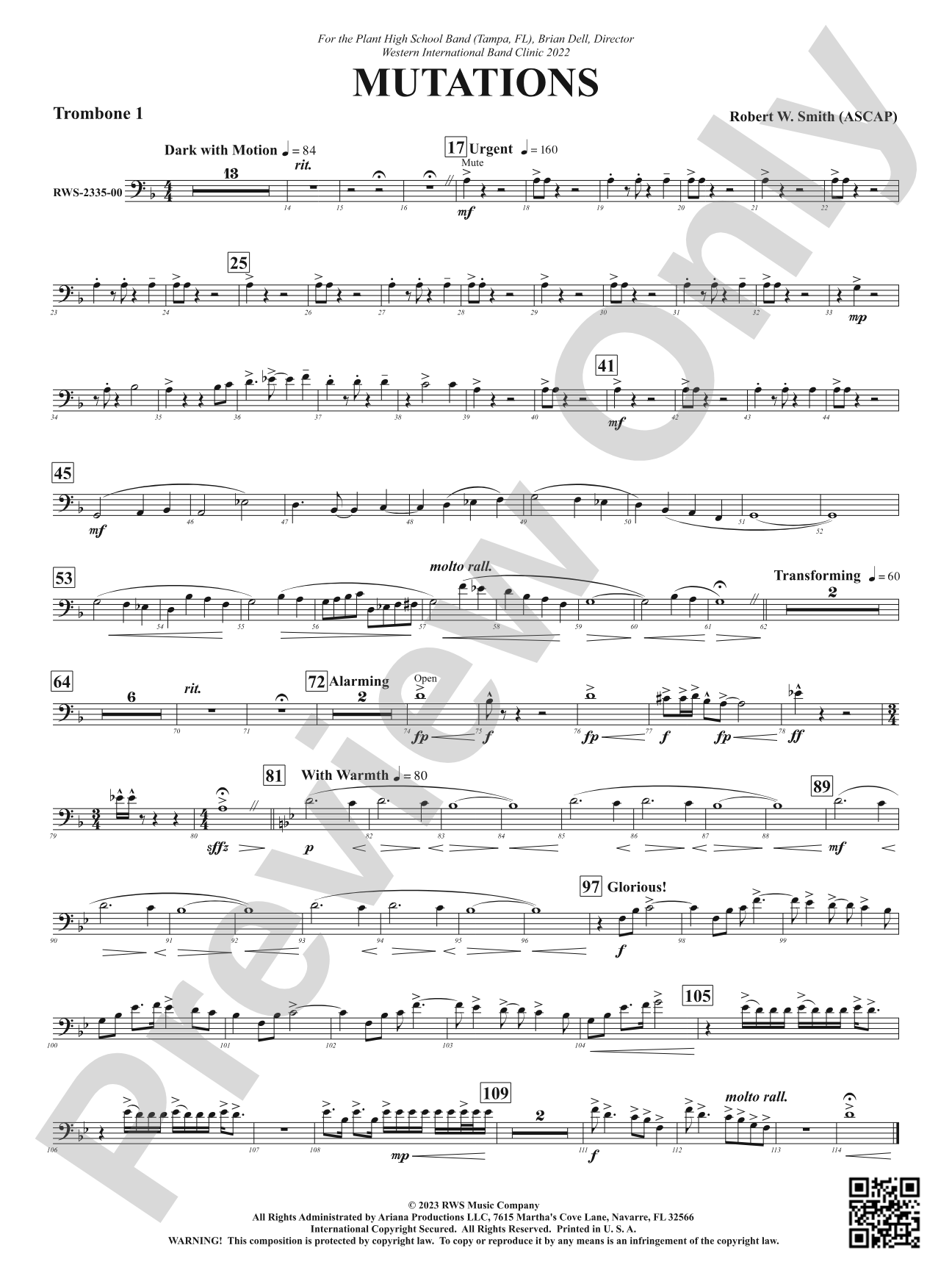

Mutations: 1st Trombone
By Robert W. Smith
Grade: 4.5
Item: 98-PC-RWS2335_TN1
$3.99
Pickup currently not available
Description
Featuring the concert band's brass section and an offstage trumpet ensemble, this contemporary work draws its inspiration from the mutation of sound and its transmission throughout the ensemble and performance environment. From a dark and mysterious beginning with muted sounds on all brass instruments, the timbre and sonority slowly mutates through various musical environments. As the brass section mutates to open sounds, the result is a stunning and glorious music statement that transforms the ensemble and audience alike.
Original Item#: RWS-2335-00


Original Item#: RWS-2335-00
Mutations: 1st Trombone isn't in MakeMusic Cloud just yet...but it could be. Let us know you'd like to see it, and you'll help shape what comes next. In the meantime, start a free trial and dive into thousands of interactive titles your students can play along with today.
Request This Title
Tell us you want it.
Start Your Free Trial
Explore everything that's ready to play right now.
Sample Audio
1
Audio File
--:--
0:00
0:00
Sample Video
No sample videos found.
Additional Details
Series:
RWS - Symphony Band
Publisher:
RWS Music Company
SKU:
98-PC-RWS2335_TN1
More about this title
About the Composer: Robert W. Smith

Robert W. Smith stands among America's most performed composers for concert band and orchestra, with over 400 published works to his name. His output spans symphonies (The Divine Comedy and The Odyssey among them), operas, and arrangements that have reached audiences across North America, Europe, Australia, and Asia. Smith holds degrees in music education from Troy State University and a master's degree from the University of Miami, and his work has appeared in everything from major television broadcasts to the opening ceremonies of the Olympic Games.
Beyond composition, Smith maintains an active career as conductor and clinician, traveling regularly across the United States, Canada, and internationally. His works for developing ensembles like The Tempest have become repertoire standards in bands worldwide. The breadth of his visibility (from Dodger Stadium to the Macy's Thanksgiving Day Parade) reflects both the quality and accessibility of his musical voice.
Why we love this
Smith captures something genuinely theatrical here: the journey from shadowed, muted vulnerability to radiant brass brilliance feels earned and transformative. The offstage trumpet ensemble adds spatial intrigue that contests and concert audiences find memorable, and the Grade 4½ technical demands never overwhelm the accessibility of the concept, making it realistic for bands serious about their sound but not necessarily advanced elite ensembles.
What to expect
Mutations begins in shadows: restrained, mysterious, all brass instruments wrapped in mutes that soften their natural power into something intimate and strange. As the work unfolds, that veiled sound gradually cracks open, brass tones expanding into brightness and fullness until the ensemble arrives at a culminating statement that feels genuinely glorious and earned.
Who it's for
This work suits concert bands at the Grade 4½ level who are ready to think beyond technical displays and explore sound design as a compositional idea. Directors preparing for festival concerts or contests will find a piece that engages both musicians and listeners through concept rather than complexity alone.
How to get the most out of it
- Balance the muted brass passages carefully during rehearsal; the mystery of the opening relies on controlled resonance rather than volume, so isolate the brass section and listen for evenness across all four parts before adding the rest of the ensemble.
- Position the offstage trumpet ensemble where it can hear a conductor or clear beat reference; they anchor the mutation moments when timbre shifts, so their coordination with the main band requires either a visible conductor or a reliable click track.
- Shape the transition from muted to open brass as a dramatic arc, not a switch. Encourage players to think of the shift as a gradual unveiling of tone quality rather than a sudden dynamic spike.
- Allow time in rehearsal for the ensemble to hear the full piece with all parts present; the mutation concept only resonates when students grasp how individual instrumental voices contribute to the overall sonic transformation.
How to use it
Program this in a concert slot where it can command attention as a standalone feature rather than one item among many; the spatial and sonic journey demands audience focus. It works equally well as a contest selection (the concept is clear and musically sophisticated without being gimmicky) or as part of a thematic concert exploring timbre and sound transformation in twentieth-century band literature.
Skills your students will build
- Mute technique and controlled tone production across the brass section
- Listening and blend in dynamic transition passages
- Spatial awareness and coordination with an offstage instrumental ensemble
- Interpretation of contemporary compositional concepts through performance
- Sustaining musical tension through gradual sonority changes rather than sudden shifts