
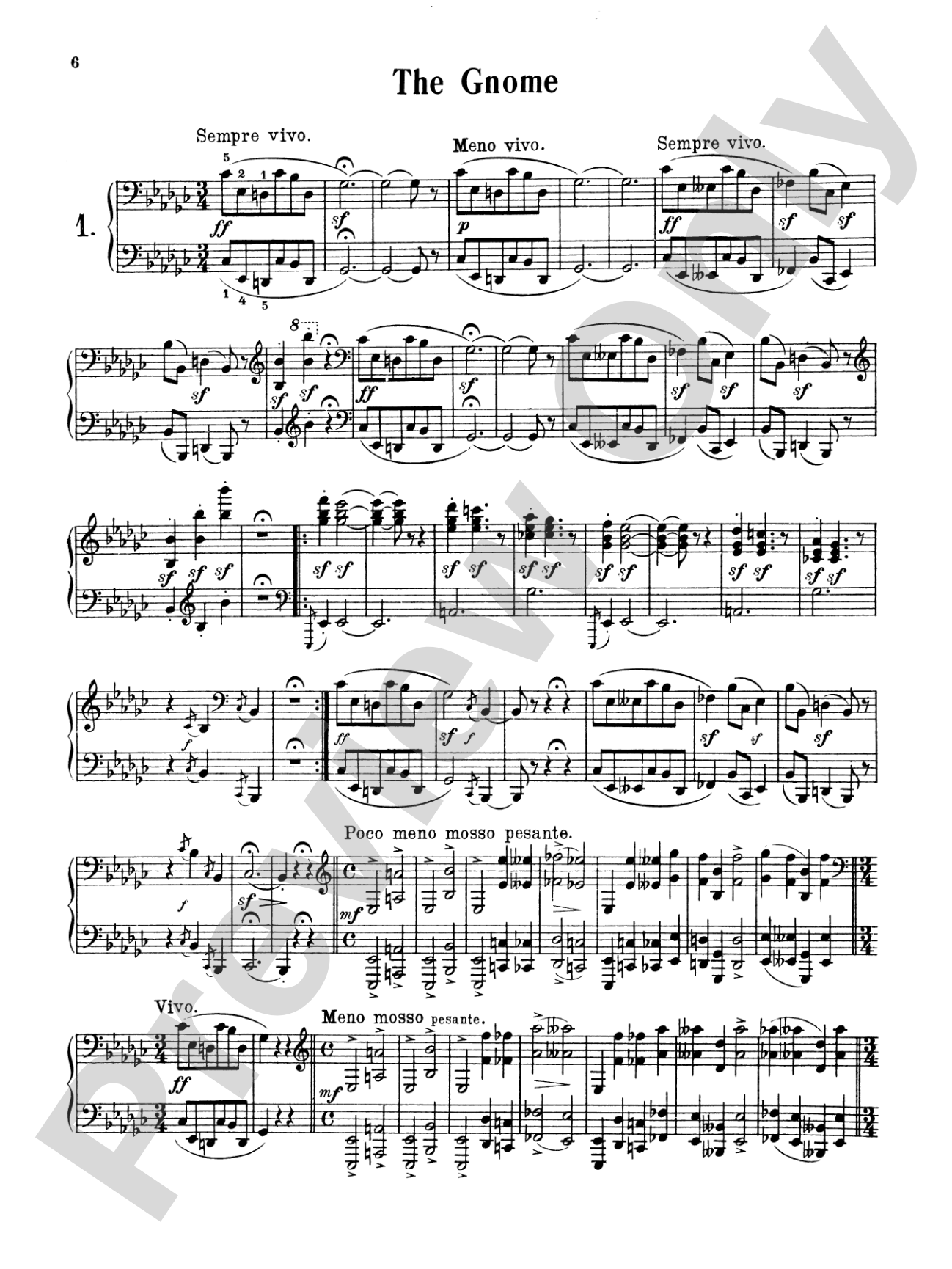

Mussorgsky: Pictures at an Exhibition
By Modest Mussorgsky
Level: Advanced
Item: 00-PC-0008571
$0.99
Pickup currently not available
Description
The inspiration for Mussorgsky's most famous work came from his friend Victor Hartmann, an artist and architect. When Hartmann died at the early age of 39, Mussorgsky and the rest of the Russian artistic community were stunned, so they organized a memorial exhibit of his work. From that showing came Mussorgsky's Pictures at an Exhibition, based on the sketches, watercolors, and architectural designs displayed at the exhibition, as well as a few private canvases that Mussorgsky had seen earlier. Each selection in this stunning masterpiece is connected by "Promenade" which moves between 5/4 and 6/4, representing the uneven gait of Mussorgsky walking to the next picture. Titles: Promenade * 1. The Gnome * Promenade * 2. The Old Castle * Promenade * 3. Tuileries: Children Quarreling at Play * 4. Bydlo * Promenade * 5. Ballet of Unhatched Chickens * 6. Samuel Goldenberg and Schmuyle * Promenade * 7. The Market Place at Limoges * 8. Catacombae * Lingua Mortua * 9. Hut of the Baba-Yaga * 10. The Great Gate of Kiev.


Don't just read it, hear it, play along with it, and watch your students grow with it. In MakeMusic Cloud, Mussorgsky: Pictures at an Exhibition comes alive with professional accompaniment, adjustable tempo, and built-in practice tools that turn solo practice into real progress.
Open in the Player
Jump straight in and assign it today.
Start Your Free Trial
Open this title and explore the full library in minutes.
Sample Audio
No sample audio found.
Sample Video
No sample videos found.
Additional Details
Series:
Kalmus Edition
Publisher:
Alfred Music
Page Count:
36
SKU:
00-PC-0008571
More about this title
About the Composer: Modest Mussorgsky
Modest Mussorgsky (1839-1881) was a Russian composer who fundamentally reshaped what piano music could express. Unlike his contemporaries who favored European forms and refinement, Mussorgsky drew directly from Russian folk music, speech patterns, and visual art, creating a distinctly national voice that prioritized raw musical character over technical polish.
Pictures at an Exhibition stands as his most enduring work, born from genuine grief and artistic community. When his friend Victor Hartmann died unexpectedly, Mussorgsky channeled that loss into a cycle of ten movements connected by a recurring Promenade theme. The work demands that pianists think like painters, translating architectural sketches and childhood scenes into sound. Its influence on twentieth-century composers was enormous, yet it remains rooted in the nineteenth-century piano tradition.
Why we love this
This work defies the "display piece" category entirely. While it requires advanced technical facility, what makes it matter is the compositional architecture and character work. Each movement presents a distinct harmonic language and pianistic challenge, so students don't coast through familiar patterns. The Promenade sections, shifting between 5/4 and 6/4, demand genuine rhythmic independence and musicianship. Programming this signals to audiences that your advanced students are serious musicians engaging with landmark repertoire, not just executing passage work.
What to expect
Walking through a memorial exhibition in a state of both reverence and discovery. The music swings between intimate character sketches and monumental architecture, childlike whimsy and existential darkness. Mussorgsky writes with orchestral ambition at the keyboard, layering textures and colors that feel simultaneously ancient and radically modern.
Who it's for
Advanced pianists ready to engage with a complete 36-page masterwork that demands both technical command and interpretive maturity. This suits conservatory students, recital performers preparing a full program, and pianists who want to work with a composition that reveals new layers through repeated study and performance.
How to get the most out of it
- Internalize the Promenade's asymmetrical meter not as a counting exercise, but as Mussorgsky's depiction of his own uneven walk. Let the phrase shape guide your navigation of the meter rather than fighting it metrically.
- Study each movement's harmonic palette separately before linking them. The Gnome lives in chromatic chaos; The Old Castle in modal stasis; Bydlo in heavy, grinding block chords. These contrasts matter more than technical speed.
- Use the recurring Promenade as an opportunity to reset your sound and posture between pictures. Each return should feel like stepping back into the gallery, not like returning to familiar material.
- Balance clarity in the dense passages (particularly Catacombae and The Great Gate of Kiev) with the transparency of the lighter movements. Avoid letting the piece become uniformly thick.
How to use it
This is a complete recital work in itself, requiring no padding or supplementary pieces. It also pairs productively with other Russian piano music from the nineteenth century, or with twentieth-century works influenced by it (Ravel's orchestration, for instance, makes a natural comparison for students studying both). Consider programming it as the centerpiece of a spring recital, where the listener's full attention can rest on its structural and emotional arc.
Skills your students will build
- Reading mixed meters (5/4 and 6/4) and maintaining rhythmic independence across asymmetrical phrase structures
- Harmonic analysis of modal, chromatic, and post-tonal language within a Romantic framework
- Pedal control and sonority palette in passages requiring dense orchestral textures versus transparent voicing
- Character differentiation and storytelling across contrasting movements without sacrificing structural coherence
- Technical facility across wide dynamic range, from delicate passagework to powerful octave writing and multi-note chords