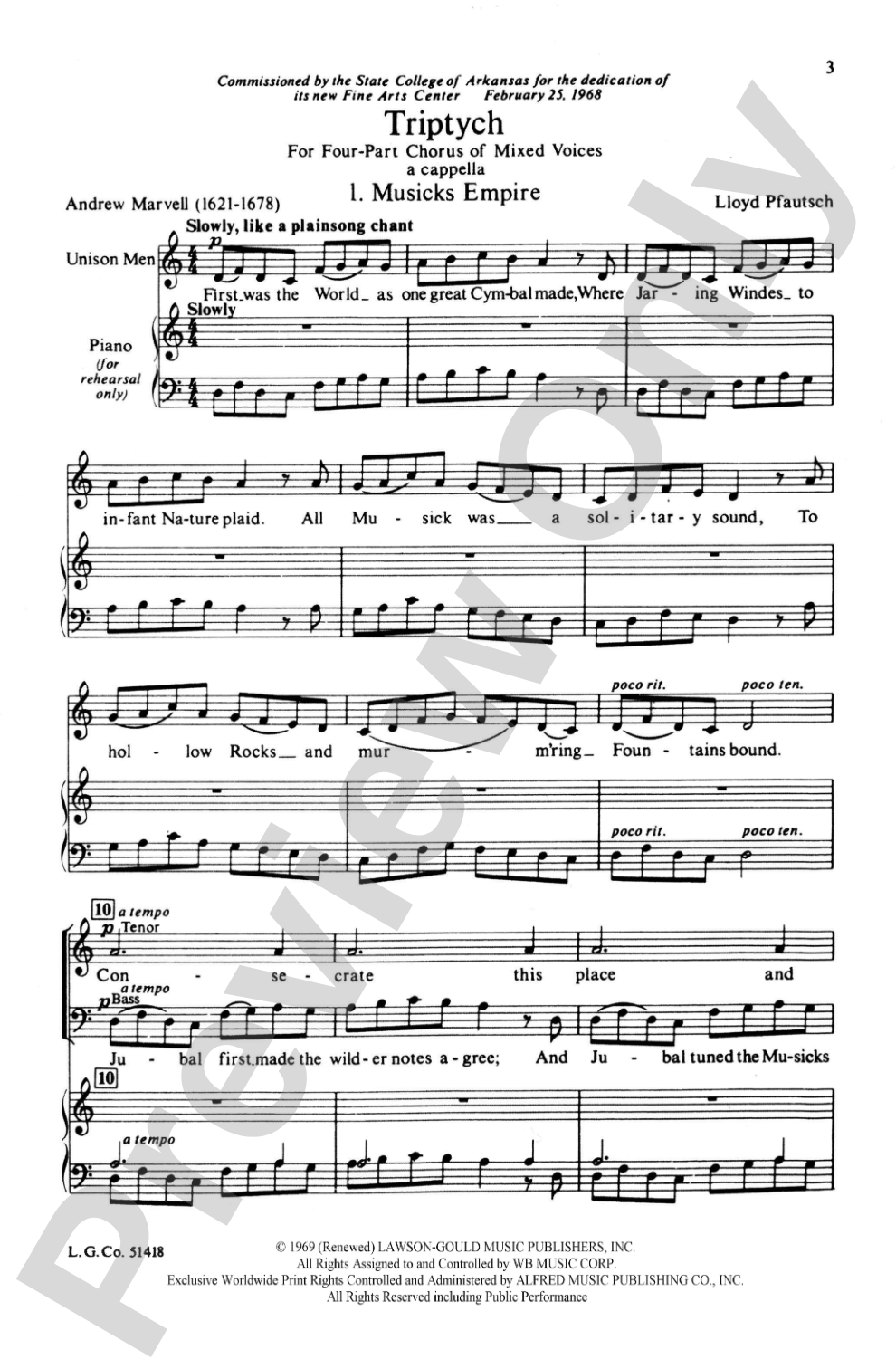
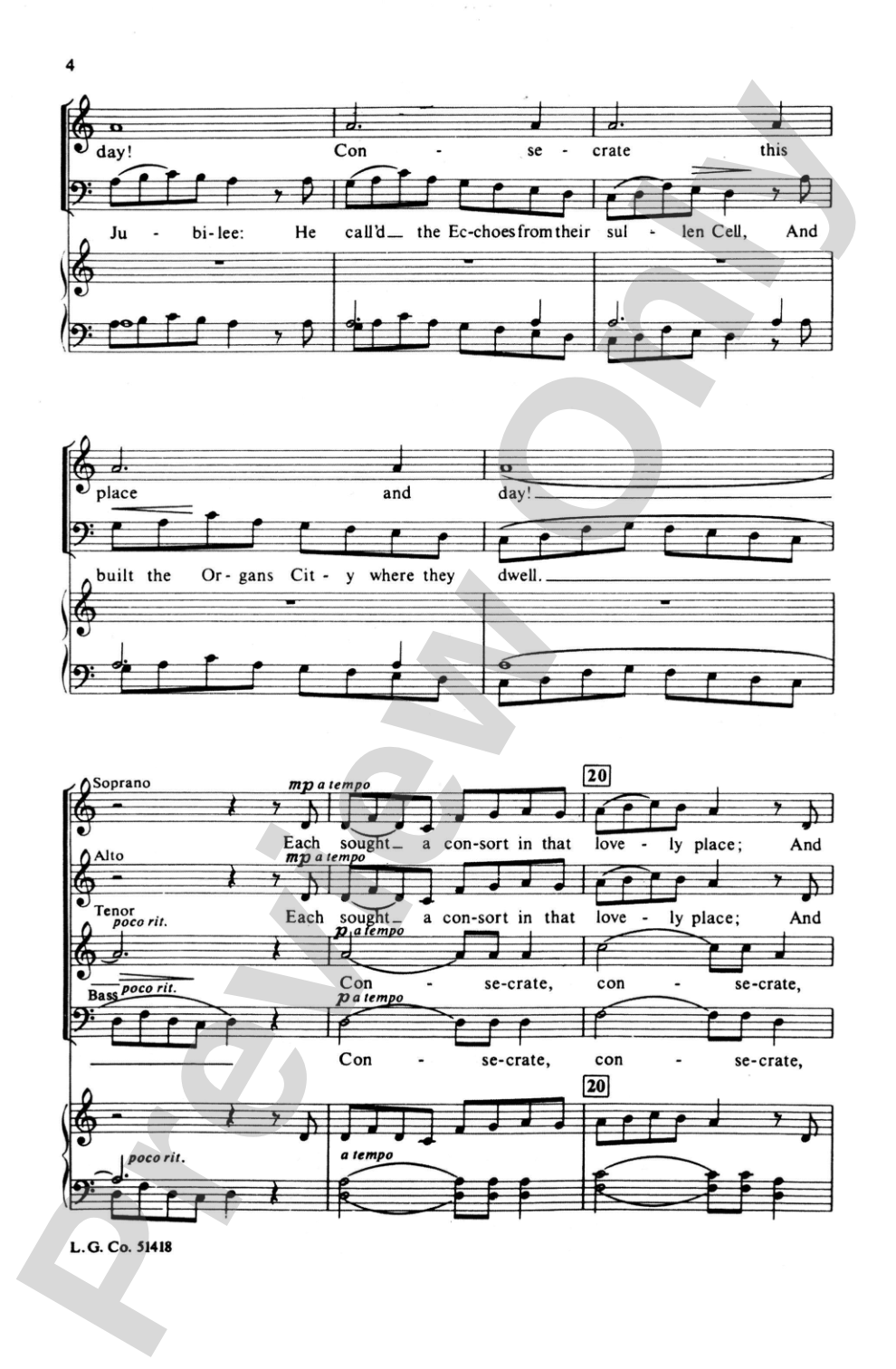
Musicks Empire Sheet Music Preview

Musicks Empire: SATB, a cappella Choral Octavo

From Triptych

Words by Andrew Marvell, music by Lloyd Pfautsch

Item: 00-PO-0007683

Digital Download
$2.05

Minimum order quantity: 20 copies

Description
A tour de force cornerstone of choral literature. Lloyd Pfautsch's remarkable setting of the 17th-century poem by Andrew Marvell continues to be a popular choice with contest, festival, and collegiate choirs. This title is available in MakeMusic Cloud.

Musicks Empire: SATB, a cappella Choral Octavo isn't in MakeMusic Cloud just yet...but it could be. Let us know you'd like to see it, and you'll help shape what comes next. In the meantime, start a free trial and dive into thousands of interactive titles your students can play along with today.

Sample Audio
No sample audio found.
Sample Video
Additional Details
Series: Lawson-Gould
Publisher: Alfred Music
Page Count: 12
SKU: 00-PO-0007683

More about this title

About the Composer: Lloyd Pfautsch

Lloyd Pfautsch (1910, 1998) was a choral conductor and composer whose output shaped American choral music for half a century. A champion of both sacred and secular texts, he composed with an arranger's ear for voice leading and a performer's understanding of what singers need to make music sing.

Pfautsch's settings became staples in choirs large and small because they honor the poetry while remaining deeply singable. His work demonstrates that technical sophistication and accessibility aren't opposing forces.

Why we love this

Pfautsch captures something profound in Marvell's meditation on time and mortality without resorting to heaviness or false drama. The piece builds through sophisticated harmonic movement and independent voice writing that rewards careful preparation and repays it with luminous sound. It sits at the sweet spot where college and strong high school choirs can access genuine artistry.

What to expect

The piece unfolds with the contemplative quality of its 17th-century text while moving through Pfautsch's 20th-century harmonic palette. There is a weightlessness to much of it, as if the voices are working through the poem's ideas in real time rather than presenting a finished interpretation. The overall arc builds from meditation toward a kind of acceptance, with moments of striking beauty arriving quietly rather than through display.

Who it's for

This octavo reaches singers who have moved beyond purely homophonic repertoire and are ready to manage independent voice lines and nuanced harmonic language. It serves advanced high school choirs, collegiate ensembles, and festival or contest-level groups seeking work of genuine substance. It also appeals to directors building a lasting choral library where musical depth and educational value walk hand in hand.

How to get the most out of it

  • Pay close attention to the harmonic movement; Pfautsch's chord progressions often shift subtly between sections, and intonation suffers when singers don't hear the underlying voice leading clearly.
  • Space your rehearsals to allow singers time to internalize the text. The poem's meaning deepens with familiarity, and that understanding translates directly into expression.
  • Balance the parts so that inner voices remain audible; this is not a piece where sopranos or tenors dominate. Each voice's countermelody matters to the overall texture.
  • Work the phrasing across longer musical sentences rather than stopping at the end of every poetic line. The setting often asks for breath-awareness that honors both the text and the music's flow.

How to use it

Program this as a centerpiece for a concert focused on choral literature or English-language texts; it pairs well with both contemporary and period work. It also stands alone effectively as a contest or festival selection where judges expect musicianship and interpretive maturity. Its moderate length and concert-appropriate subject matter make it suitable for spring or fall concert programming.

Skills your students will build

  • Independent voice leading and part maintenance in four-part texture
  • Reading and singing chromatic and altered harmonies
  • Intonation in acoustically complex chords and voice combinations
  • Phrase shaping and breath management across longer musical lines
  • Interpretation of English text in relation to harmonic content

You May Also Like