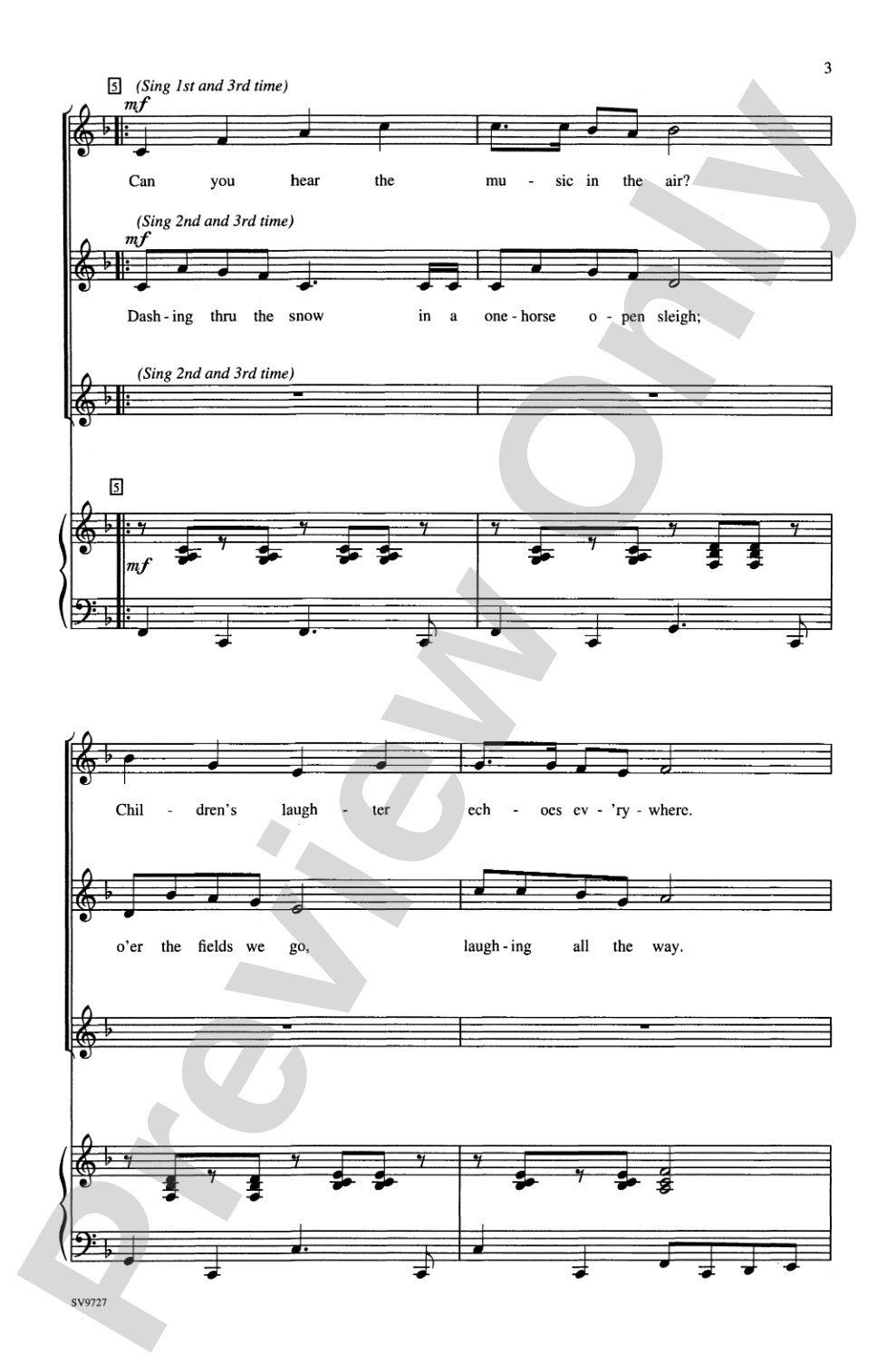
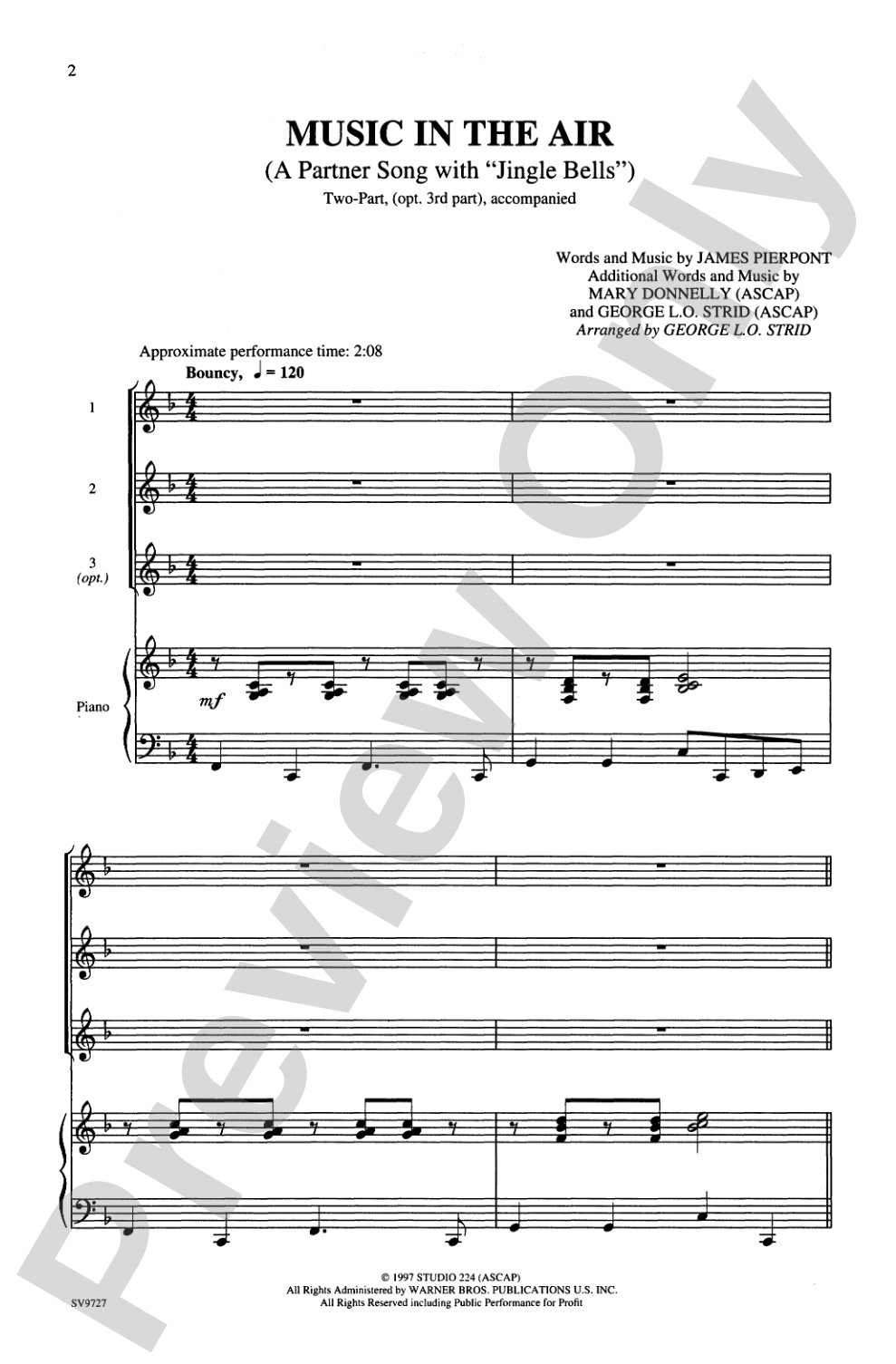
Music in the Air Sheet Music Preview

Music in the Air: 2-Part (Opt. 3-Part) Choral Octavo

A Partner Song with "Jingle Bells"

Words and music by James Pierpont, additional words and music by Mary Donnelly and George L. O. Strid / arr. George L. O. Strid

Item: 00-PO-0005262

Digital Download
$2.25

Minimum order quantity: 20 copies

Description
The writing team that knows what you want for your developing choir brings you this delightful partner song. In combining their original melody and lyric together with 'Jingle Bells,' they have created a holiday fun-for-all! Don't miss the masterful part writing of this one.

Music in the Air: 2-Part (Opt. 3-Part) Choral Octavo isn't in MakeMusic Cloud just yet...but it could be. Let us know you'd like to see it, and you'll help shape what comes next. In the meantime, start a free trial and dive into thousands of interactive titles your students can play along with today.

Sample Audio
No sample audio found.
Sample Video
Additional Details
Series: Alfred Archive Edition: Studio PR Catalog
Publisher: Alfred Music
Page Count: 8
SKU: 00-PO-0005262

More about this title

About the Composer: James Pierpont

James Pierpont (1822-1893) composed one of America's most enduring holiday melodies when he wrote 'Jingle Bells' in 1857. Originally titled 'The One Horse Open Sleigh,' the song became a staple of winter celebrations and has been arranged countless times across every musical genre imaginable. Pierpont's gift for crafting memorable, singable melodies made his work accessible to performers of all levels, a quality that has ensured his music remains relevant to music educators more than a century after his death.

Mary Donnelly and George L. O. Strid, the arrangers here, are known for creating choral music that respects the abilities of developing singers while maintaining musical integrity. Their work with Pierpont's beloved tune demonstrates their skill at honoring a classic while bringing fresh energy to familiar material.

Why we love this

This partner song transforms a holiday standard into a genuine teaching moment rather than just seasonal filler. The pairing of an original melody with 'Jingle Bells' creates the opportunity for your singers to experience counterpoint and blend in a context that feels immediately rewarding. The optional third part means you can expand or adjust the arrangement to match your singers' skill level without losing the charm.

What to expect

There's genuine warmth in hearing two melodies dance together, especially when one is as beloved as 'Jingle Bells.' The arrangement captures holiday spirit without resorting to oversimplification. Singers experience the joy of contributing to something larger than a single melodic line.

Who it's for

Developing choirs in middle or high school find this arrangement especially useful. Its two-part (with optional three-part) scoring accommodates emerging vocal maturity while the familiar 'Jingle Bells' melody builds confidence. Directors planning holiday concerts need accessible yet musically sound options, and this delivers both.

How to get the most out of it

  • Balance the original melody against the 'Jingle Bells' line carefully. The familiar tune shouldn't dominate, since both parts deserve attention from your audience.
  • Work the blend between parts separately before combining them. Even experienced choirs benefit from singing each part solo, then in pairs, before full ensemble singing.
  • Consider tempo flexibility at phrase endings. Slight breath space between phrases helps articulate where each melodic line begins and ends.
  • If using the optional third part, rehearse the two-part version first until it's secure, then layer in the third part to avoid confusion.

How to use it

Anchor this piece in the lighter half of a holiday concert, where it provides contrast to more serious seasonal selections. Its brevity and approachable nature make it ideal for programs that include multiple choral groups performing back-to-back. Consider pairing it with other partner songs or rounds to highlight your choir's ability to manage layered textures.

Skills your students will build

  • Singing independent melodic lines while maintaining harmonic awareness
  • Balancing ensemble blend when multiple melodies occur simultaneously
  • Recognizing and performing partner song/round structures
  • Maintaining steady rhythm and phrasing across different melodic lines

You May Also Like