
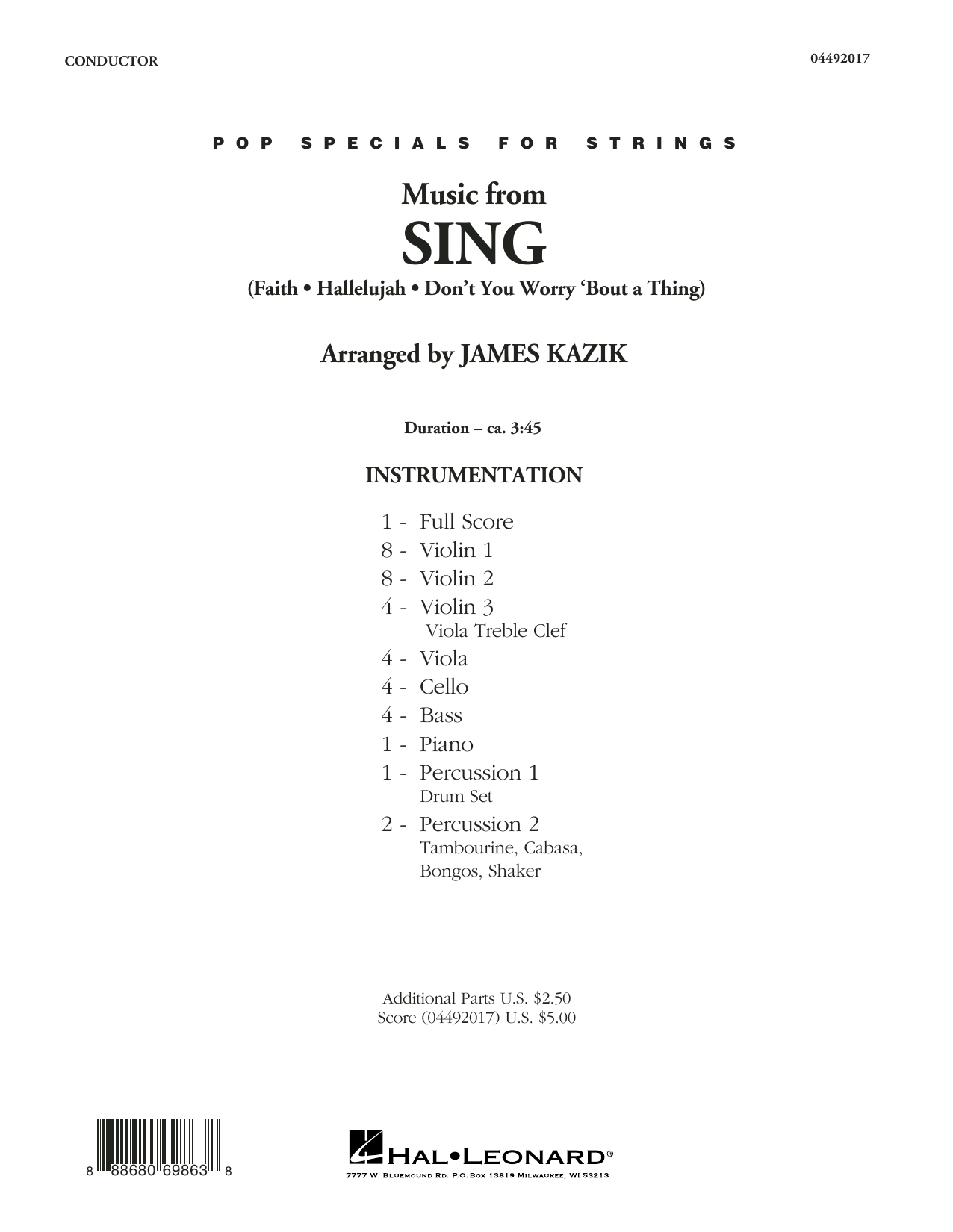

Music from Sing: String Orchestra Conductor Score & Parts
Arranged by James Kazik
Grade: 3-4
Item: 35-PK00389090
$55.00
Pickup currently not available
Buy Extra Parts (Digital PDF Download)
| Product | Price | Quantity |
|---|---|---|
| Music from Sing - Conductor Score (Full Score) | $6.00 | |
| Music from Sing - Violin 1 | $7.00 | |
| Music from Sing - Violin 2 | $7.00 | |
| Music from Sing - Violin 3 (Viola Treble Clef) | $7.00 | |
| Music from Sing - Viola | $7.00 | |
| Music from Sing - Cello | $7.00 | |
| Music from Sing - Bass | $7.00 | |
| Music from Sing - Piano | $7.00 | |
| Music from Sing - Percussion 1 | $7.00 | |
| Music from Sing - Percussion 2 | $7.00 |
Parts Added to Cart!
Description
The upbeat animated film "Sing" features a charming story about a talent show and plenty of terrific music. Here is an appealing medley that includes a new song ("Faith") sung by Stevie Wonder and Ariana Grande, along with the classic pop hit "Hallelujah" (Leonard Cohen) and Stevie Wonder's "Don't You Worry 'Bout a Thing." Dur: 3:45


Music from Sing: String Orchestra Conductor Score & Parts isn't in MakeMusic Cloud just yet...but it could be. Let us know you'd like to see it, and you'll help shape what comes next. In the meantime, start a free trial and dive into thousands of interactive titles your students can play along with today.
Request This Title
Tell us you want it.
Start Your Free Trial
Explore everything that's ready to play right now.
Sample Audio
No sample audio found.
Sample Video
No sample videos found.
Additional Details
Publisher:
Hal Leonard
SKU:
35-PK00389090
More about this title
Why we love this
Kazik has crafted a medley that respects each song's identity while creating natural transitions between wildly different musical worlds. The arrangement captures the joy of the film without relying on cutesy orchestration; instead, it trusts the strength of the melodies themselves. For a Grade 3-4 ensemble, this is the rare program piece that sounds mature and cohesive despite its accessible difficulty.
What to expect
You move through three distinct emotional landscapes: the hopeful, soulful energy of 'Faith'; the aching, introspective beauty of 'Hallelujah'; and the infectious groove and optimism of 'Don't You Worry 'Bout a Thing.' The string writing never feels thin or oversimplified, and the arrangement honors each song's original spirit while making it idiomatic for young orchestras.
Who it's for
String orchestras in grades 3 through 4 seeking contemporary repertoire with real substance. This works equally well for concert programming, film-themed festivals, or ensembles exploring how pop and classical idioms can coexist. Directors who want their students to play recognizable music with genuine emotional content will find this especially valuable.
How to get the most out of it
- Balance the three distinct songs by treating each as its own emotional statement. 'Faith' needs restraint and space; 'Hallelujah' asks for sustained, connected phrasing; 'Don't You Worry' thrives on rhythmic precision and lift.
- The transitions between sections are your greatest interpretive opportunity. A slight ritard or breath before each new song helps the audience understand the shift without feeling abrupt.
- If you have soloists available, consider featuring a vocalist on one or more sections. The arrangement supports this gracefully without requiring it.
How to use it
Pair this with other film or Broadway selections for a thematic concert, or use it as the contemporary anchor in a mixed program of classical and pop repertoire. The three-minute-forty-five-second duration makes it an ideal opener, closer, or bridge between heavier works. Consider programming it mid-year when your ensemble has developed enough facility to execute the stylistic contrasts with confidence.
Skills your students will build
- Stylistic flexibility across soul, contemporary ballad, and funk idioms
- Sustained legato phrasing balanced against rhythmic precision
- Listening for smooth harmonic transitions between sections
- Expressive vibrato control and dynamic shaping across multiple emotional contexts
- Collaborating with optional solo voices while maintaining ensemble cohesion