
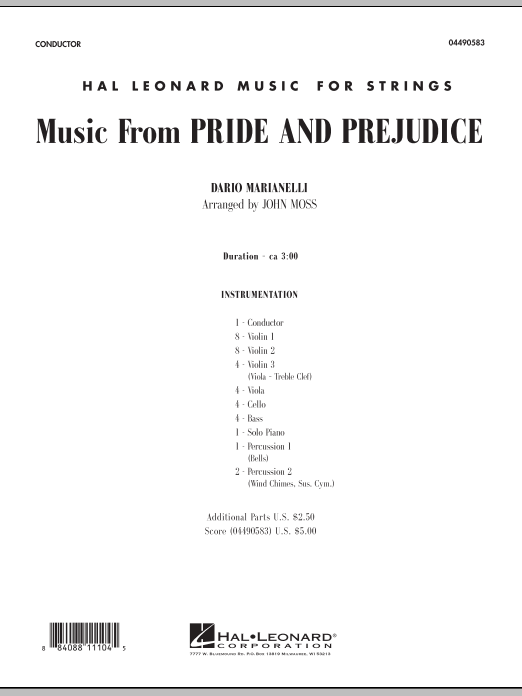

Music from Pride Prejudice: String Orchestra Conductor Score & Parts
By Dario Marianelli / Arranged by John Moss
Grade: 3-4
Item: 35-PK00143664
$45.00
Pickup currently not available
Buy Extra Parts (Digital PDF Download)
Parts Added to Cart!
Description
The lyric and flowing music from this popular movie continues to be a favorite for solo pianists and is now available for piano accompanied by strings. John Moss' arrangement incorporates the main thematic moments and is a wonderful spotlight for a student soloist backed by impressive and dramatic string writing. Dur: 3:00


Music from Pride Prejudice: String Orchestra Conductor Score & Parts isn't in MakeMusic Cloud just yet...but it could be. Let us know you'd like to see it, and you'll help shape what comes next. In the meantime, start a free trial and dive into thousands of interactive titles your students can play along with today.
Request This Title
Tell us you want it.
Start Your Free Trial
Explore everything that's ready to play right now.
Sample Audio
No sample audio found.
Sample Video
No sample videos found.
Additional Details
Publisher:
Hal Leonard
SKU:
35-PK00143664
More about this title
About the Composer: Dario Marianelli
Dario Marianelli is an Italian composer whose film scores have shaped the sound of contemporary period drama. His work on Pride and Prejudice (2005) earned him an Academy Award nomination and demonstrates his gift for writing elegant, character-driven themes that enhance narrative without overwhelming it.
Marianelli's approach to orchestration emphasizes clarity and emotional restraint, qualities that translate powerfully to educational arrangements. His melodies are singable and memorable, making his film music ideal for student performers who benefit from learning through themes that audiences already love.
Why we love this
This arrangement gives your student pianist a genuinely substantial solo vehicle with orchestral support that sounds polished and dramatic. Moss has resisted the temptation to overshadow the soloist; instead, the strings frame and enhance the piano line, creating a performance experience that feels like a real chamber music collaboration rather than accompaniment.
What to expect
Graceful and introspective, with the gentle sophistication of a drawing room conversation captured in music. The themes unfold with a romantic restraint that invites listeners into an intimate emotional moment, then gradually build in warmth and presence.
Who it's for
Orchestras with a capable student pianist who wants a solo spotlight and the instrumental resources to back it up thoughtfully. This works for soloists at the upper intermediate level who can handle the musical demands of singing through the theme without getting lost in the accompaniment texture.
How to get the most out of it
- Shape the piano part with the same lyrical phrasing you'd expect from a string player. These melodies sing, so breathe with them and avoid mechanical rhythm.
- Balance matters enormously here. Your strings should cushion the piano sound rather than compete for attention. A lighter touch from the orchestra often yields better results than pushing for volume.
- Establish a clear harmonic foundation in the cello and bass parts. They anchor the flowing nature of the arrangement and give the soloist something solid to rise above.
- Find the pulse without rigidity. The 3:00 duration suggests these themes should unfold naturally, so conduct with flexibility rather than metronomic precision.
How to use it
This pairs beautifully on a concert that celebrates film music or features a theme around literature and the arts. It also functions as an elegant closer to a spring concert, offering a sophisticated shift in tone from more energetic ensemble works and providing a showcase that audiences recognize and appreciate immediately.
Skills your students will build
- Accompanying a soloist with textural awareness and dynamic control
- Sustaining lyrical phrasing across longer melodic lines without sacrificing harmonic support
- Balancing independent string parts that serve a thematic function rather than doubling
- Reading flowing, scalar orchestration at Grade 3-4 difficulty