
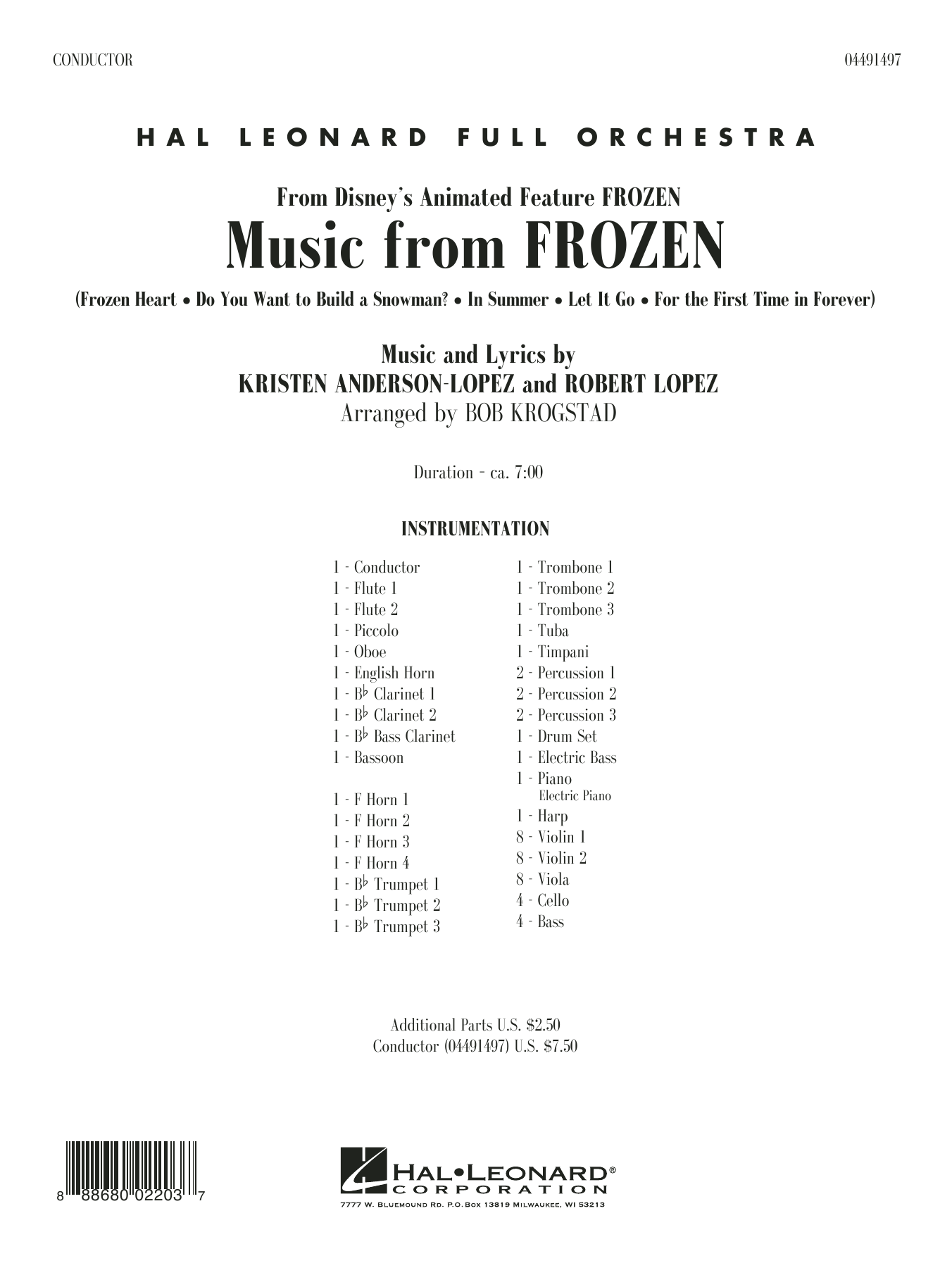

Music from Frozen (arr. Bob Krogstad): Full Orchestra Conductor Score & Parts
By Kristen Anderson-Lopez Robert Lopez / By Robert Lopez / By Kristen Anderson-Lopez / Arranged by Bob Krogstad
Grade: 4
Item: 35-PK01594272
$100.00
Pickup currently not available
Buy Extra Parts (Digital PDF Download)
Parts Added to Cart!
Description
Includes: Do You Want to Build a Snowman?, For the First Time in Forever, Frozen Heart, In Summer, Let It Go.


Music from Frozen (arr. Bob Krogstad): Full Orchestra Conductor Score & Parts isn't in MakeMusic Cloud just yet...but it could be. Let us know you'd like to see it, and you'll help shape what comes next. In the meantime, start a free trial and dive into thousands of interactive titles your students can play along with today.
Request This Title
Tell us you want it.
Start Your Free Trial
Explore everything that's ready to play right now.
Sample Audio
No sample audio found.
Sample Video
No sample videos found.
Additional Details
Publisher:
Hal Leonard
SKU:
35-PK01594272
More about this title
About the Composer: Kristen Anderson-Lopez Robert Lopez
Kristen Anderson-Lopez and Robert Lopez wrote the songs for Disney's Frozen, creating a soundtrack that became a cultural phenomenon. Their work earned an Academy Award for Best Original Song ("Let It Go") and a Grammy Award for Best Compilation Soundtrack, establishing them as major voices in contemporary film music. Both composers bring deep experience in musical theater and animation scoring, understanding how to write melodies that lodge in memory while serving dramatic moments on screen.
Bob Krogstad's arrangement captures the emotional landscape of these five songs while crafting them for the full orchestra. His orchestrations maintain the immediacy of the original melodies while giving student musicians engaging parts at Grade 4 level. Krogstad has extensive experience arranging popular film and theater music for school ensembles, making repertoire accessible without sacrificing musicality.
Why we love this
This collection gives orchestras instant connection to music students actually know and care about. Krogstad's arrangements preserve what makes these songs memorable while distributing the musical interest across the full ensemble, so every section has moments that matter rather than padding the texture. Programming these five selections lets you build a concert around genuine emotional storytelling.
What to expect
These arrangements capture the sweep and emotional directness of the film's score while remaining accessible. You get moments of genuine beauty alongside the energetic character pieces, giving the ensemble room to build musicianship through material that actually speaks to them.
Who it's for
Full orchestras working at Grade 4 that want to program something contemporary and engaging. Students respond immediately to this material, and the arrangements give every section legitimate musical work rather than simple accompaniment patterns.
How to get the most out of it
- Shape the melodies with clear phrase direction rather than playing through them mechanically. These songs gain their power from how the accompaniment supports the singer or lead melodic line, so balance is essential.
- Pay attention to the dynamic markings even when they seem subtle. The movement from quiet to powerful moments in pieces like 'Let It Go' relies on the orchestra responding to small changes in intensity.
- Listen to the original recordings as an ensemble and discuss where the orchestra should sit in the mix versus where the voice dominates. Student musicians perform better when they understand the dramatic context.
- Lock the rhythmic pulse between the string and wind sections early in rehearsal. At this grade level, ensemble precision matters more than soloistic flourishes.
How to use it
Consider programming all five together as a Frozen medley to create a complete narrative arc within your concert, or space them across the program as contrasting mood pieces. They work equally well as a spring concert feature or as a winter concert highlight, and the familiarity of the material makes them excellent choices for community concerts where engagement matters.
Skills your students will build
- Balancing melody and accompaniment roles within an ensemble texture
- Shaping long phrases with appropriate dynamic direction
- Responding to dramatic context while maintaining rhythmic precision
- Reading parts in standard orchestral voicings across all instrumental families