
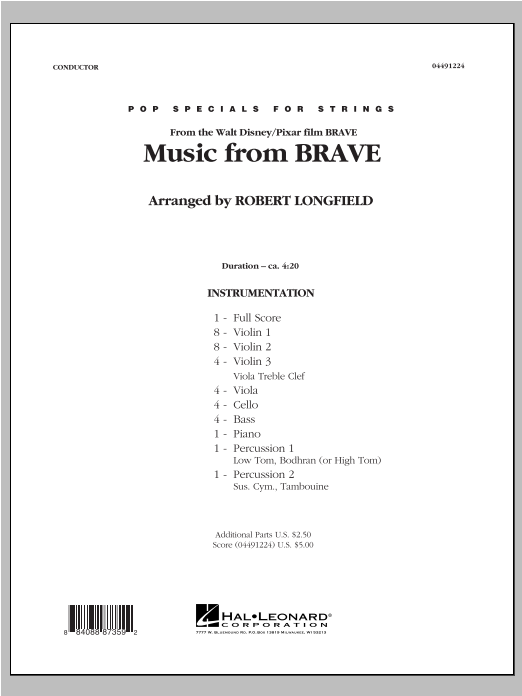

Music From Brave: String Orchestra Conductor Score & Parts
Arranged by Robert Longfield
Grade: 3-4
Item: 35-PK00251173
$55.00
Pickup currently not available
Buy Extra Parts (Digital PDF Download)
| Product | Price | Quantity |
|---|---|---|
| Music From Brave - Conductor Score (Full Score) | $6.00 | |
| Music From Brave - Violin 1 | $7.00 | |
| Music From Brave - Violin 2 | $7.00 | |
| Music From Brave - Violin 3 (Viola Treble Clef) | $7.00 | |
| Music From Brave - Viola | $7.00 | |
| Music From Brave - Cello | $7.00 | |
| Music From Brave - Bass | $7.00 | |
| Music From Brave - Piano | $7.00 | |
| Music From Brave - Percussion 1 | $7.00 | |
| Music From Brave - Percussion 2 | $7.00 |
Parts Added to Cart!
Description
Dur: 4:20


Music From Brave: String Orchestra Conductor Score & Parts isn't in MakeMusic Cloud just yet...but it could be. Let us know you'd like to see it, and you'll help shape what comes next. In the meantime, start a free trial and dive into thousands of interactive titles your students can play along with today.
Request This Title
Tell us you want it.
Start Your Free Trial
Explore everything that's ready to play right now.
Sample Audio
No sample audio found.
Sample Video
No sample videos found.
Additional Details
Publisher:
Hal Leonard
SKU:
35-PK00251173
More about this title
Why we love this
Longfield captures the emotional core of Brave's score while keeping the orchestration accessible for developing string players. The arrangement respects the film's sweeping melodic lines without sacrificing playability, making it an excellent choice for groups wanting to program film music that actually sounds like film music.
What to expect
Sweeping and heroic, with the kind of lyrical generosity that defines the film's score. The arrangement carries a sense of determination and warmth, the strings singing out over gently rolling accompaniment patterns that feel both supportive and alive.
Who it's for
String orchestras at the grade 3-4 level who want to program something with immediate appeal to students and audiences alike. This works especially well for younger players who haven't yet tackled large-scale classical works but are ready to experience how orchestral writing can serve dramatic storytelling.
How to get the most out of it
- Balance the melody between first violins and violas during the main theme; the two parts weave together, so clarity requires intentional voice leading rather than dynamic dominance.
- Sustain tone quality through the held notes in the middle section. Younger players tend to thin out on long bows, so mark breath points where the line naturally breaks.
- Keep the accompaniment figures (especially in second violins and cellos) rhythmically tight. The Scottish character relies partly on rhythmic precision beneath the soaring melody.
- Shape the final phrase with a slight ritardando rather than a sudden drop in tempo; let the ending breathe before the cut-off.
How to use it
Pair this with lighter classical pieces to create a diverse concert that shows your group's range, or build an entire concert around film and television music with other contemporary arrangements. The four-minute duration makes it an ideal anchor piece for a shorter concert program or a standalone spotlight for a spring pops concert.
Skills your students will build
- Sustaining long melodic lines across full phrases
- Balancing between primary melody and secondary harmonic voices
- Responding to dynamic nuance within an arrangement of vocal, memorable music
- Reading accidentals and chromatic movement in accessible harmonic language
- Maintaining rhythmic precision in accompaniment figures beneath an exposed melody