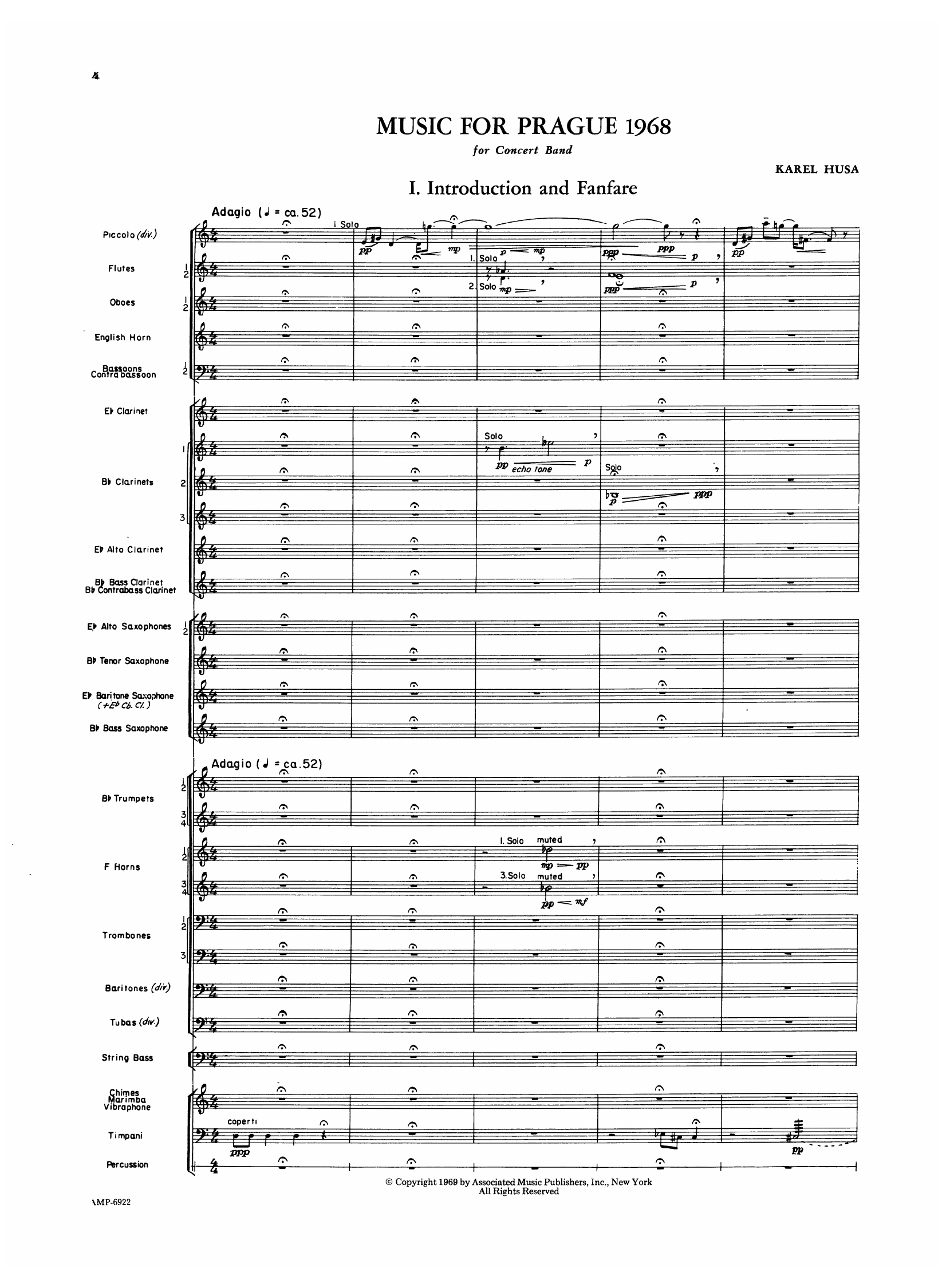
Music For Prague (1968) (Score Only) Sheet Music Preview

Music For Prague (1968) (Score Only): Concert Band Conductor Score & Parts

By Karel Husa

Item: 35-PK01083729

Digital Download
$45.00

Buy Extra Parts (Digital PDF Download)

Parts Added to Cart!

Description
This impressive and historically significant work is found on state lists all across the country and is highly respected as an important contribution to the contemporary literature for concert band. Composed in 1968 and memorializing the 1968 Soviet bloc invasion of Czechoslovakia, Husa arranged this for orchestra soon after. One year later Husa was awarded the Pulitzer Prize for his String Quartet No. 3.

Music For Prague (1968) (Score Only): Concert Band Conductor Score & Parts isn't in MakeMusic Cloud just yet...but it could be. Let us know you'd like to see it, and you'll help shape what comes next. In the meantime, start a free trial and dive into thousands of interactive titles your students can play along with today.

Sample Audio
No sample audio found.
Sample Video
Additional Details
Publisher: Hal Leonard
SKU: 35-PK01083729

More about this title

About the Composer: Karel Husa

Karel Husa is a Czech-American composer and conductor whose career spans classical composition, contemporary music, and wind band literature. Born in Prague in 1921, Husa studied at the Prague Conservatory and the Paris Conservatoire before establishing himself as a major voice in twentieth-century music. His works combine rigorous modernist technique with emotional directness, and he has earned recognition across orchestral, chamber, and band genres.

Why we love this

This score commands respect on concert programs precisely because of what it communicates beyond the notes. Husa's harmonic language feels urgent without being inaccessible to advanced high school ensembles, and the work's presence on state competition lists reflects its pedagogical value alongside its artistic weight. Conductors return to this piece because it teaches students to play with purpose and emotional clarity.

What to expect

The score unfolds with an undercurrent of tension; melodies emerge from darker harmonic territory, building toward moments of stark beauty. Husa avoids melodrama, instead letting dissonance and orchestration choices do the expressive work. The overall trajectory feels both urgent and meditative, moving through periods of struggle toward hard-won clarity.

Who it's for

Advanced concert bands preparing for festival competition or concert programming. This work fits ensembles with strong sectional balance and students ready to engage with contemporary compositional language that carries genuine historical weight.

How to get the most out of it

  • Balance transparency in the middle voices during thematic statements; the architecture of the piece depends on clarity rather than weight.
  • Pay attention to articulation contrasts. Shifts between legato and separated passages create momentum without requiring tempo changes.
  • Rehearse exposed solos and chamber moments separately. This work builds its emotional impact through intimate textures that lead into fuller scoring.
  • The historical context is worth discussing with your ensemble. Students who understand what this piece commemorates bring different focus to rehearsals.

How to use it

Consider this for a concert exploring twentieth-century responses to political and social events, or as a centerpiece in a program that pairs it with contrasting works from the same era. The piece carries enough substance to anchor a festival appearance or serve as the meaningful closer to a regular season concert.

Skills your students will build

  • Reading and executing chromatic harmony and twentieth-century harmonic language
  • Balancing transparency in contemporary scoring with multiple simultaneous lines
  • Sustaining focus through emotionally complex material
  • Understanding historical context as a tool for musical interpretation
  • Executing articulation clarity and textural shifts in contemporary idioms

You May Also Like