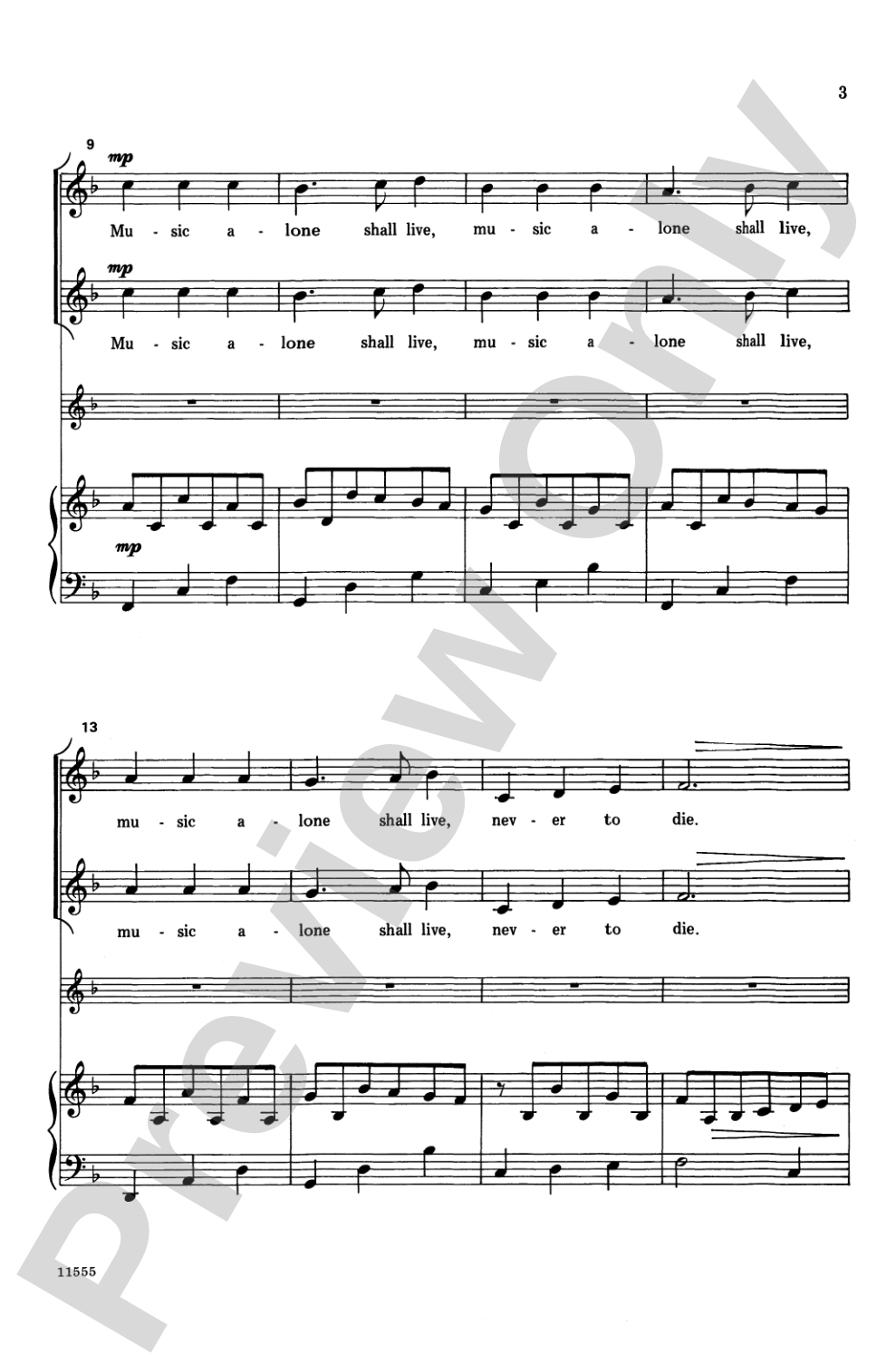
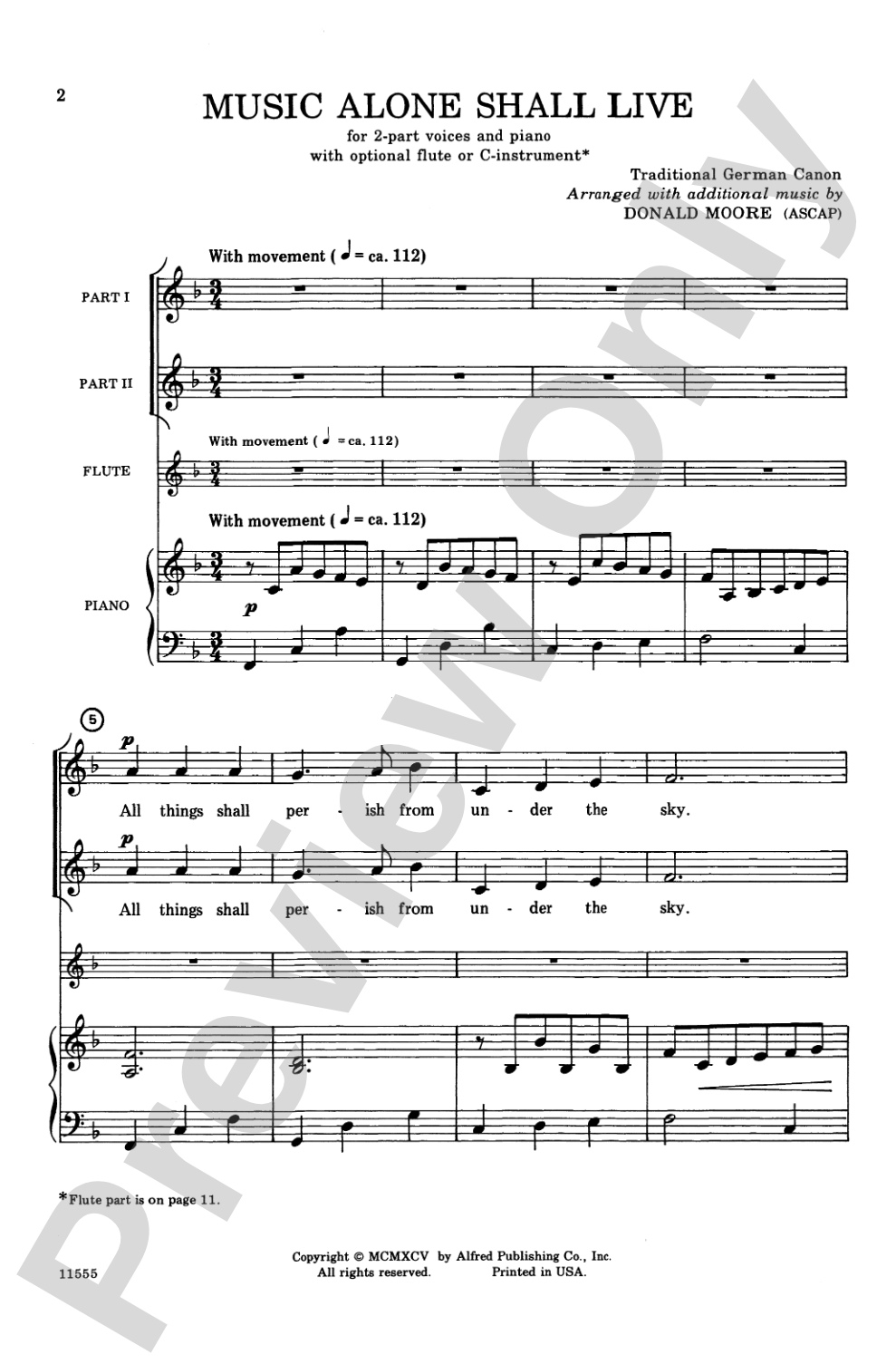
Music Alone Shall Live Sheet Music Preview

Music Alone Shall Live: 2-Part Choral Octavo

Music by Donald Moore

Item: 00-PO-0002060

Digital Download
$2.25

Minimum order quantity: 20 copies

Description
A traditional German canon arranged in a straightforward and educationally appropriate style by Donald Moore. Easy singable melodies fit together perfectly. A follow-up to Moore's best selling "Sing With Joy!" and "Simply Alleluia." Excellent for Music In Our Schools Month. Optional flute or C instrument part included in the publication.

Music Alone Shall Live: 2-Part Choral Octavo isn't in MakeMusic Cloud just yet...but it could be. Let us know you'd like to see it, and you'll help shape what comes next. In the meantime, start a free trial and dive into thousands of interactive titles your students can play along with today.

Sample Audio
No sample audio found.
Sample Video
Additional Details
Series: Alfred Archive Edition: Alfred Choral Designs
Publisher: Alfred Music
Page Count: 12
SKU: 00-PO-0002060
Instrumentation: Opt. Flute

More about this title

About the Composer: Donald Moore

Donald Moore

Donald Moore earned his Bachelor of Music in organ performance and Master of Arts in Teaching from Kent State University. He serves as Organist-Choirmaster at Pilgrim United Church of Christ in Cuyahoga Falls, Ohio, and has established himself as a prolific composer and arranger with more than 500 published works across sacred, secular, educational, and popular choral repertoire, as well as organ and piano compositions.

Moore's works appear regularly at state contests, festivals, and music conventions across multiple levels of recognition. He is a seventeen-time recipient of the ASCAP Composers Standard Award and was recently honored by the American Choral Directors Association as one of 400 significant composers in American choral music history. Beyond music, Moore maintains an active involvement in competitive racing.

Why we love this

Moore understands exactly what 2-part choirs need: melodies that sit comfortably in the voice, parts that interlock without contrivance, and text setting that lets words land naturally. This arrangement of a traditional German canon delivers immediate success in rehearsal, making it ideal for building confidence and musicianship in younger or developing singers while maintaining musical integrity.

What to expect

The traditional German canon carries a gentle, reflective quality that Moore's straightforward arrangement honors without overcomplication. Singers experience the satisfaction of seeing two simple melodies resolve into harmonic unity, creating a moment of musical clarity that feels both accessible and genuinely moving.

Who it's for

This octavo fits 2-part choirs of any age, from upper elementary through adult singers, particularly those building confidence with part independence. It works equally well for community choirs, school ensembles, and adult singers returning to music, and it pairs naturally with Music In Our Schools Month programming or spring concert themes.

How to get the most out of it

  • Shape the melodic lines with gentle phrasing rather than articulating every note crisply; the canon's dialogue benefits from legato singing that allows phrases to breathe.
  • Introduce parts separately, having one group sing the melody while the other enters on cue, then trade roles to internalize the staggered entrance before singing together.
  • If using the optional flute part, balance it as a color choice rather than a doubling; it works best when it adds texture without overwhelming the voices.
  • Establish a steady tempo early and maintain it without rushes; canon accuracy depends on rhythmic consistency from the start.

How to use it

Program this as a moment of focus in a concert of lighter repertoire, or use it as an encore that lets the audience hear the elegant simplicity of canon form without technical complexity. It also serves well in a curricular context to teach part singing and canon structure without requiring extensive rehearsal time.

Skills your students will build

  • Singing independent melodic lines against simultaneous vocal parts
  • Understanding canon form and staggered entrances
  • Phrase shaping and legato singing technique
  • Rhythmic precision and ensemble timing
  • Reading and performing optional instrumental doubling

You May Also Like