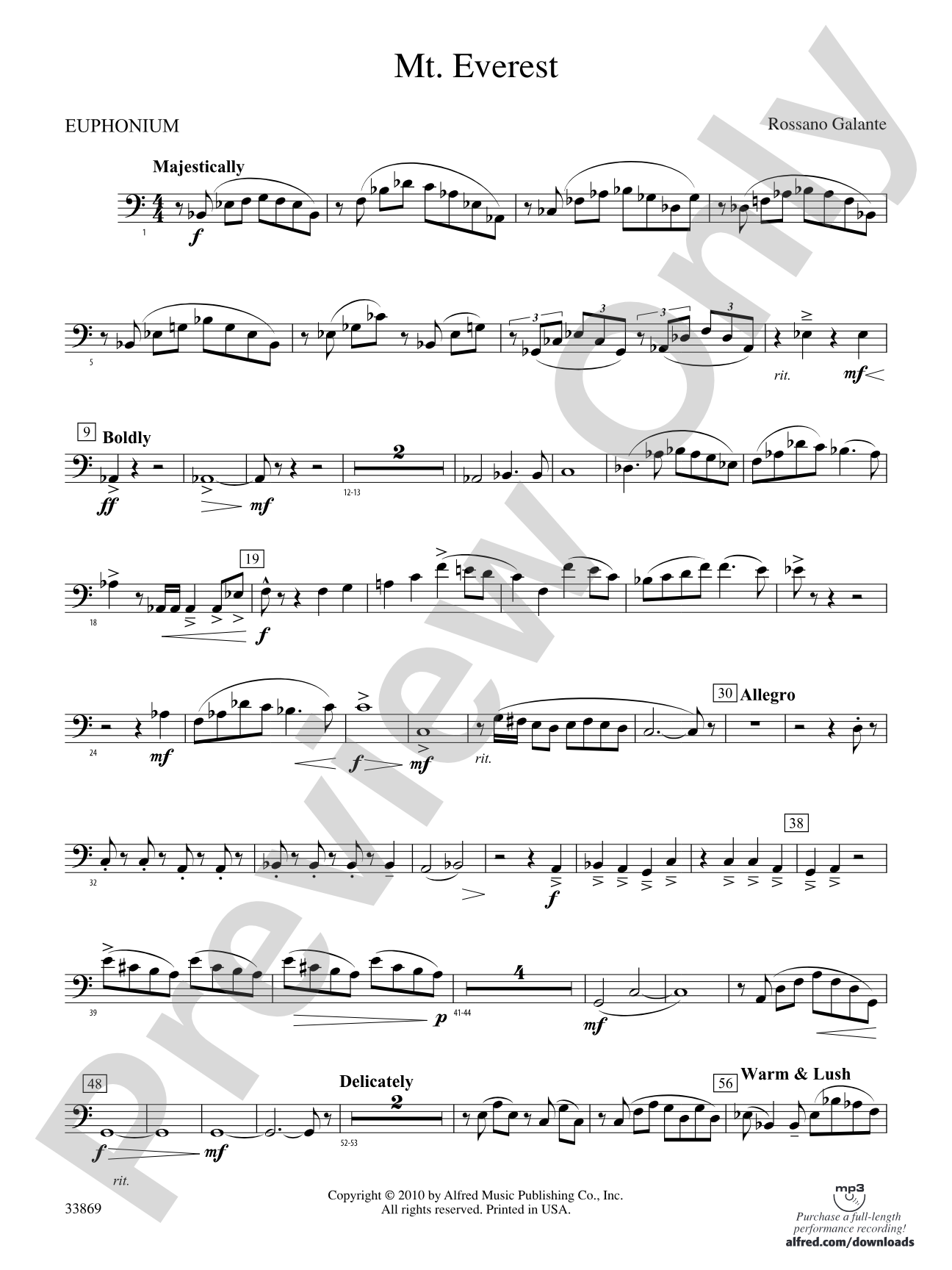
Mt. Everest: Baritone B.C. Sheet Music Preview

Mt. Everest: Baritone B.C.

By Rossano Galante

Grade: 4 (Medium Difficult)

Item: 00-PC-0014600_BBC1

Digital Download
$3.00
Description
Comprised of robust brass melodies, sweeping woodwind lines, and rhythmic ostinati, this composition captures the epic grandeur and beauty of Everest, the highest mountain on earth. This title is available in MakeMusic Cloud.

Don't just read it, hear it, play along with it, and watch your students grow with it. In MakeMusic Cloud, Mt. Everest: Baritone B.C. comes alive with professional accompaniment, adjustable tempo, and built-in practice tools that turn solo practice into real progress.

Sample Audio
0:00
0:00
Sample Video
Additional Details
Series: Alfred Concert Band
Publisher: Alfred Music
Page Count: 264
SKU: 00-PC-0014600_BBC1

More about this title

About the Composer: Rossano Galante

Rossano Galante

Rossano Galante studied trumpet performance at SUNY Buffalo, graduating in 1992, and was one of only nineteen candidates worldwide selected that year for the University of Southern California's Film Scoring Program. There he trained under Jerry Goldsmith, the Academy Award-winning composer of The Omen, before relocating to California in 1999 to establish himself in composition and film orchestration.

Over his career, Galante has served as orchestrator on more than eighty feature films, collaborating with Oscar-nominated composers Marco Beltrami and Christopher Lennertz on projects ranging from major franchises (Fast X, Avengers: Age of Ultron, A Quiet Place series) to character-driven dramas. Beyond film work, he maintains an active concert composition practice, having received numerous commissions from bands and orchestras worldwide and published over 68 concert works with Alfred, Schirmer, Hafabra, C.L. Barnhouse, and Dehaske/Curnow.

Why we love this

Galante brings the orchestrational sophistication of his film scoring background directly into the concert band idiom. The piece balances accessibility at Grade 4 with genuine compositional substance: brass and woodwind lines that sing with purpose, rhythmic architecture that drives momentum, and programmatic storytelling that gives your ensemble something profound to communicate beyond the technical challenges.

What to expect

The music evokes the grandeur and isolation of high altitude: broad, sweeping gestures that build toward moments of quiet beauty and triumphant clarity. The writing captures both the physical struggle and the transcendent stillness of standing at the world's highest point, moving between passages of driving momentum and reflective, almost delicate orchestration.

Who it's for

This work suits intermediate to advancing concert bands seeking substantial programmatic material that doesn't require championship-level virtuosity. Directors programming festival contests or spring concerts will find it engaging for audiences while offering students meaningful technical and musical growth without overwhelming rehearsal time.

How to get the most out of it

  • Shape the brass melodies with dynamic contour that mirrors the mountain's elevation and descent. Avoid playing them as a single volume throughout; let the peak moments truly soar while creating space around the climactic passages.
  • Balance the sweeping woodwind lines against the rhythmic foundation. Woodwinds need clarity and forward motion, but not at the expense of the ensemble's overall cohesion. Rehearse the ostinati patterns independently so the rhythmic backbone holds steady.
  • Use the programmatic narrative as your rehearsal anchor. Discuss the emotional arc of climbing Everest with your band: the determination of the ascent, the triumph of the summit, the introspection of the descent. This interpretive framework will generate more nuanced musical choices than technical rehearsal alone.
  • Pay attention to the full score's layering. With 264 pages of material, there are likely detailed doublings and supporting voices that may seem secondary but tie the harmonic fabric together. Make sure every section knows what parts they're supporting and why.

How to use it

Program Mt. Everest as the centerpiece of a concert theme around nature, exploration, or human achievement. It pairs well with lighter or more lyrical opening works and can anchor a concert's second half. The piece's contest eligibility also makes it a natural fit for festival seasons when you want students to perform substantial, rewarding repertoire at a competitive level.

Skills your students will build

  • Sustaining musicality within fast-moving ostinato patterns
  • Balancing exposed melodic lines across sections (brass and woodwind lead voice exchanges)
  • Reading and executing dynamic shaping that serves programmatic narrative
  • Coordinating rhythmic precision across layered textures
  • Responding to a conductor's interpretive choices in programmatic, non-standardized repertoire

You May Also Like