
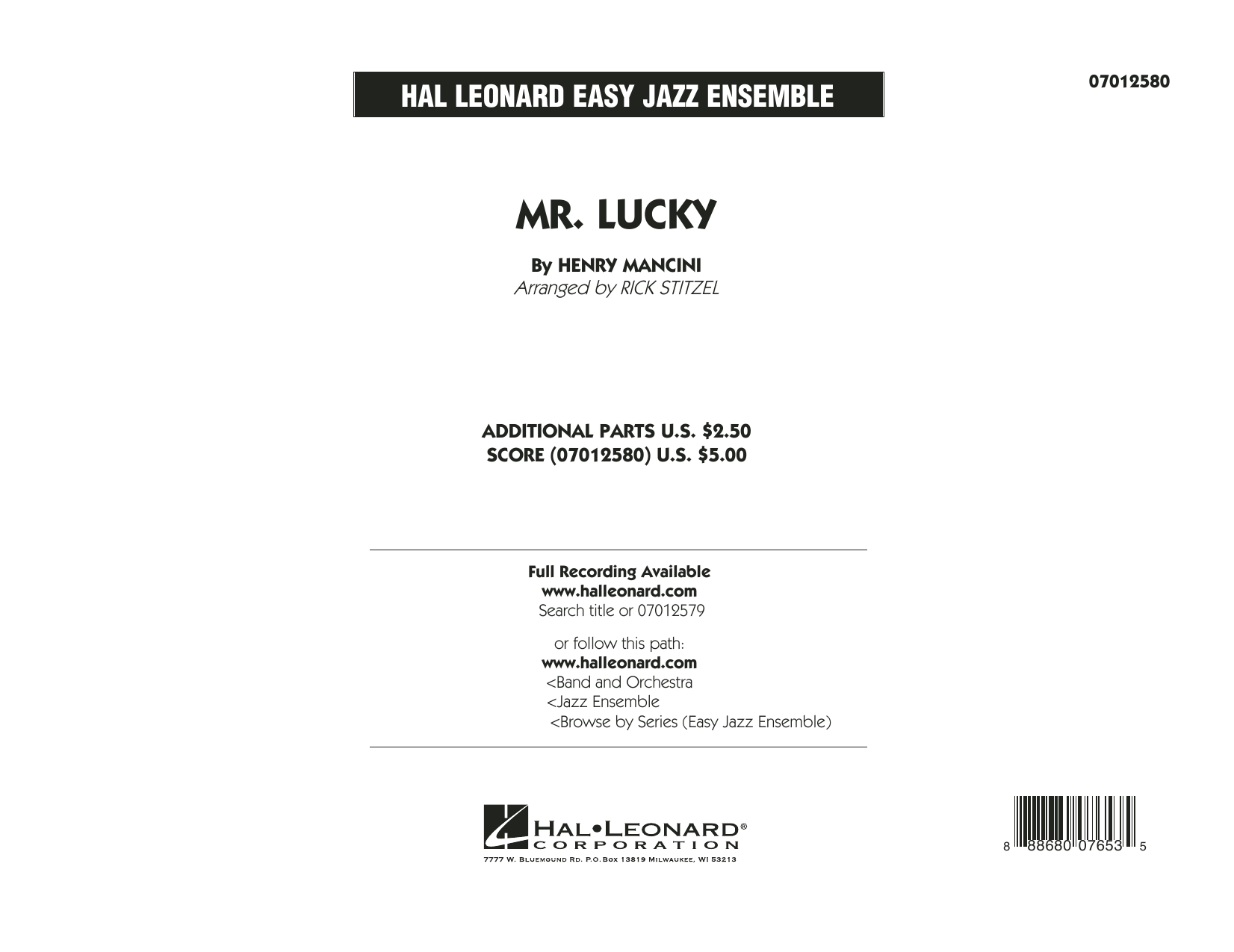

Mr. Lucky: Jazz Ensemble Conductor Score & Parts
As performed by Henry Mancini / Arranged by Rick Stitzel
Grade: 2
Item: 35-PK00312727
$40.00
Pickup currently not available
Buy Extra Parts (Digital PDF Download)
| Product | Price | Quantity |
|---|---|---|
| Mr. Lucky - Conductor Score (Full Score) | $6.00 | |
| Mr. Lucky - Alto Sax 1 | $6.00 | |
| Mr. Lucky - Alto Sax 2 | $6.00 | |
| Mr. Lucky - Tenor Sax 1 | $6.00 | |
| Mr. Lucky - Tenor Sax 2 | $6.00 | |
| Mr. Lucky - Baritone Sax | $6.00 | |
| Mr. Lucky - Trumpet 1 | $6.00 | |
| Mr. Lucky - Trumpet 2 | $6.00 | |
| Mr. Lucky - Trumpet 3 | $6.00 | |
| Mr. Lucky - Trumpet 4 | $6.00 | |
| Mr. Lucky - Trombone 1 | $6.00 | |
| Mr. Lucky - Trombone 2 | $6.00 | |
| Mr. Lucky - Trombone 3 | $6.00 | |
| Mr. Lucky - Trombone 4 | $6.00 | |
| Mr. Lucky - Guitar | $6.00 | |
| Mr. Lucky - Piano | $6.00 | |
| Mr. Lucky - Bass | $6.00 | |
| Mr. Lucky - Drums | $6.00 | |
| Mr. Lucky - Vibes | $6.00 | |
| Mr. Lucky - Flute | $6.00 | |
| Mr. Lucky - Bb Clarinet 1 | $6.00 | |
| Mr. Lucky - Bb Clarinet 2 | $6.00 | |
| Mr. Lucky - F Horn | $6.00 | |
| Mr. Lucky - Tuba | $6.00 |
Parts Added to Cart!
Description
This steamy and sultry theme from Henry Mancini is instantly recognizable from just the opening phrase. Rick Stitzel's medium slow swing treatment is largely ensemble based, and will sound great with young players.


Mr. Lucky: Jazz Ensemble Conductor Score & Parts isn't in MakeMusic Cloud just yet...but it could be. Let us know you'd like to see it, and you'll help shape what comes next. In the meantime, start a free trial and dive into thousands of interactive titles your students can play along with today.
Request This Title
Tell us you want it.
Start Your Free Trial
Explore everything that's ready to play right now.
Sample Audio
No sample audio found.
Sample Video
No sample videos found.
Additional Details
Publisher:
Hal Leonard
SKU:
35-PK00312727
More about this title
About the Artist: Henry Mancini
Henry Mancini stands as one of the most prolific and successful composers in American music history, with a career spanning film, television, and concert music. His gift for crafting instantly memorable melodies and his mastery of orchestration made him a defining voice in mid-century popular music, earning him four Academy Awards and 20 Grammy nominations.
For music educators, Mancini's work represents a bridge between classical training and contemporary idiom. His compositions teach harmonic sophistication, clear melodic writing, and the art of orchestration without abandoning accessibility. "Mr. Lucky" exemplifies his knack for creating themes that lodge themselves in listeners' ears while remaining musically substantive.
Why we love this
Rick Stitzel's arrangement captures everything that makes Mancini's original irresistible without overcomplicating the ensemble writing. The Grade 2 difficulty means your students can actually execute the swagger this tune demands, and the medium slow swing feel gives younger players space to breathe while still delivering genuine sophistication. Audiences recognize the melody instantly, which always wins points with both parents and program committee members.
What to expect
Smooth and sophisticated, with just enough grit to keep things interesting. The arrangement glides along with understated confidence, letting the melody do the heavy lifting while the rhythm section and ensemble create a soundscape that feels both cool and effortless.
Who it's for
Jazz ensembles at the high school and strong middle school level, particularly those looking to add a recognizable standard to their repertoire without extensive sectional rehearsal time. Directors who want their students to experience authentic swing feel and ensemble textures will find this accessible and musically rewarding.
How to get the most out of it
- Shape the opening phrase with legit phrasing rather than mechanical articulation; the sultry character demands that the melody float even in a faster passage
- Balance the ensemble blend by treating background figures as supporting actors, not soloists. Horn and trombone lines should anchor without overwhelming the featured voices
- Lock the tempo around quarter note = 80 to 90; faster tempos rob the groove of its swagger and make the syncopation feel rushed
- Pay attention to dynamic control in the sustained notes and longer values, where intonation problems become obvious and phrasing direction becomes essential
How to use it
Use this as a statement piece in a pops concert or as a transition moment between harder-swinging tunes and more lyrical material. It works equally well as a showcase for the ensemble's ability to blend and sustain, or as a training ground for developing swing feel and intonation in a low-pressure, crowd-friendly setting.
Skills your students will build
- Swing rhythmic subdivision and interpretation
- Legit phrasing and dynamic control in ballad tempos
- Ensemble balance and blend in an ensemble-based texture
- Listening and responding to harmonic movement
- Sustaining pitch control over longer held notes