
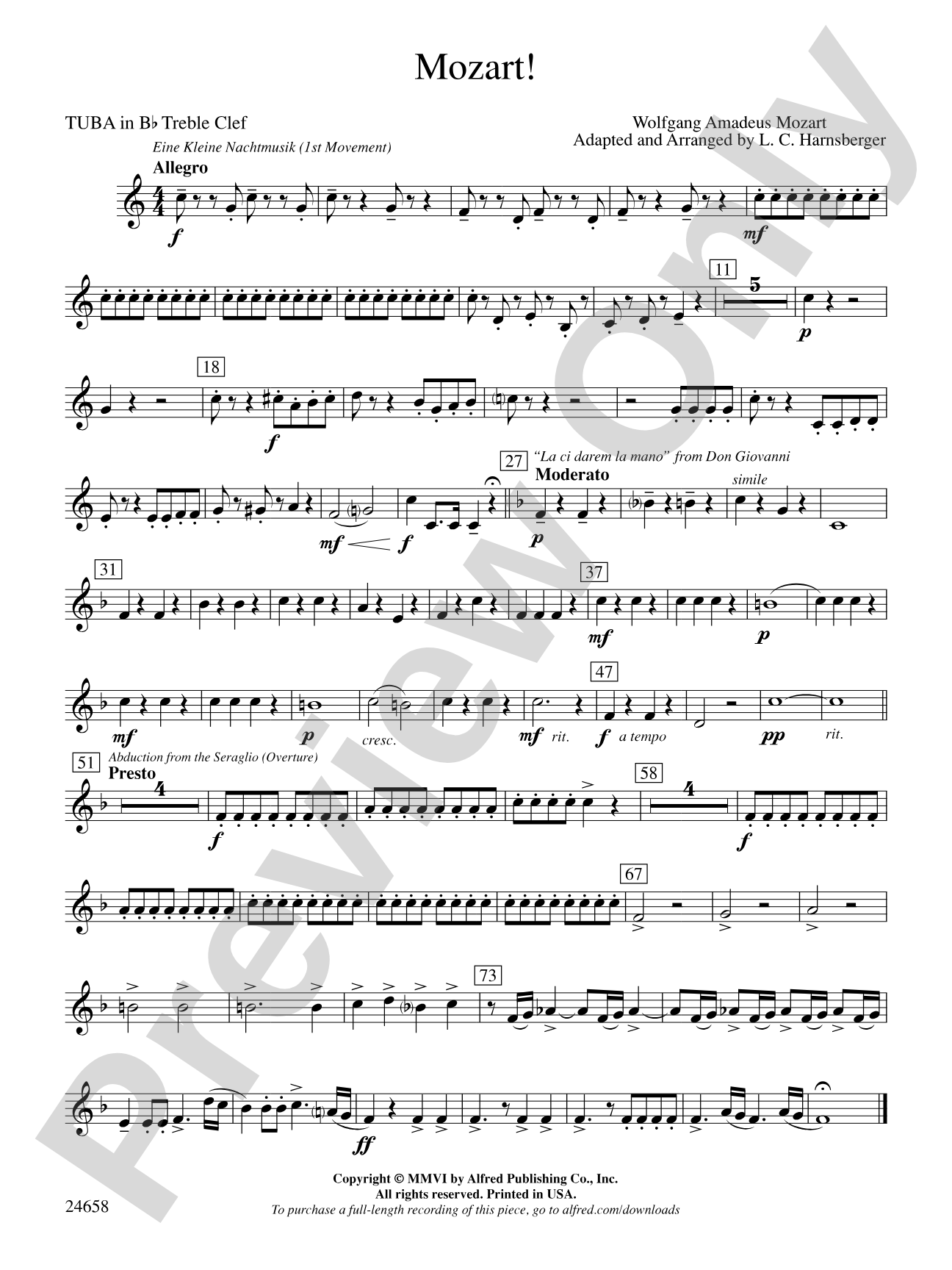

Mozart!: (wp) B-flat Tuba T.C.
By Wolfgang Amadeus Mozart / arr. L. C. Harnsberger
Grade: 2 (Medium Easy)
Item: 00-PC-0000826_wpTBBTC
$3.00
Pickup currently not available
Description
Wolfgang Amadeus Mozart is one of the most popular composers of all time. Three of his best-loved melodies are included in this medley of Mozart favorites. The arrangement begins with themes from the first movement of Eine Kleine Nachtmusik. The next section features the beautiful melody "La ci dara la mano" from Mozart's operatic masterpiece Don Giovanni. The piece concludes with themes from the overture from the opera Abduction from the Seraglio. Each piece is nicely scored with enjoyable parts for everyone in the band. This wonderful transcription of Mozart melodies is a great addition to any concert.


Don't just read it, hear it, play along with it, and watch your students grow with it. In MakeMusic Cloud, Mozart!: (wp) B-flat Tuba T.C. comes alive with professional accompaniment, adjustable tempo, and built-in practice tools that turn solo practice into real progress.
Open in the Player
Jump straight in and assign it today.
Start Your Free Trial
Open this title and explore the full library in minutes.
Sample Audio
1
Audio File
--:--
0:00
0:00
Sample Video
No sample videos found.
Additional Details
Series:
Young Symphonic
Publisher:
Alfred Music
Page Count:
200
SKU:
00-PC-0000826_wpTBBTC
More about this title
About the Arranger: L. C. Harnsberger

L. C. Harnsberger studied composition at the University of Southern California, where he worked with respected composers and arrangers including Morton Lauridsen and William A. Schaefer. Since completing his degree, he has developed a prolific career writing and arranging for wind ensembles, orchestras, chamber groups, and solo performers across multiple genres.
Harnsberger's output spans band music, full orchestra works, solo piano pieces, and choral accompaniments, all published through Alfred Music Publishing. His Essential Dictionary of Music stands out as his most widely recognized publication; this compact reference resource covers definitions, composers, theory, and instrument ranges, making it a standard reference for musicians at all levels.
Why we love this
Harnsberger's arrangement distills three iconic Mozart moments into a single coherent program piece that sounds far more sophisticated than Grade 2 typically allows. The medley structure keeps rehearsals fresh (three distinct sections mean three distinct learning curves) while maintaining the lyrical integrity of each source material, so your students play recognizable Mozart, not a simplified approximation of it.
What to expect
Elegant and approachable. The familiar melodies ground listeners immediately, while the orchestration feels expansive enough to suggest Mozart's orchestral sophistication without overwhelming younger musicians. The arc from intimate chamber writing to operatic warmth to spirited overture creates a satisfying musical journey.
Who it's for
Grade 2 concert bands seeking accessible yet musically substantial repertoire that doesn't talk down to young players. This arrangement works equally well for groups building confidence in classical literature or looking for a concert opener that showcases musicality without extreme technical demands.
How to get the most out of it
- Balance the melody between first clarinets and first trumpets through the Eine Kleine Nachtmusik section; these voices often double, so clarify which carries the line in each phrase during sectional rehearsals.
- Shape the Don Giovanni melody with dynamic restraint in the middle section. This is the emotional center of the piece, so resist the temptation to play it loudly; instead, focus on legato phrasing and gentle swells.
- Establish a clean ensemble tempo before the Abduction from the Seraglio section begins. The character shifts to lighter and more energetic, so a clear downbeat from the conductor prevents the transition from feeling rushed or ragged.
- Lock the rhythm section (bass clarinet, baritone, tuba, timpani if present) on the repeated figures that anchor each section. Grade 2 bands often rush these accompaniment patterns, so isolate them in early rehearsals.
How to use it
Program this early in a concert to establish classical credentials and set a refined tone for the audience. It also pairs well with Grade 2-3 contemporary pieces, allowing you to bracket the program with a classical foundation. For contest-eligible programs, it demonstrates your band's ability to execute standard concert repertoire with sensitivity.
Skills your students will build
- Phrasing and shaping longer melodic lines across multiple phrases
- Balancing between melody and accompaniment roles within the same section
- Transitioning cleanly between contrasting tempos and characters
- Reading and executing articulation markings across classical style contexts
- Ensemble intonation in sustained harmonic sections (Don Giovanni melody)