
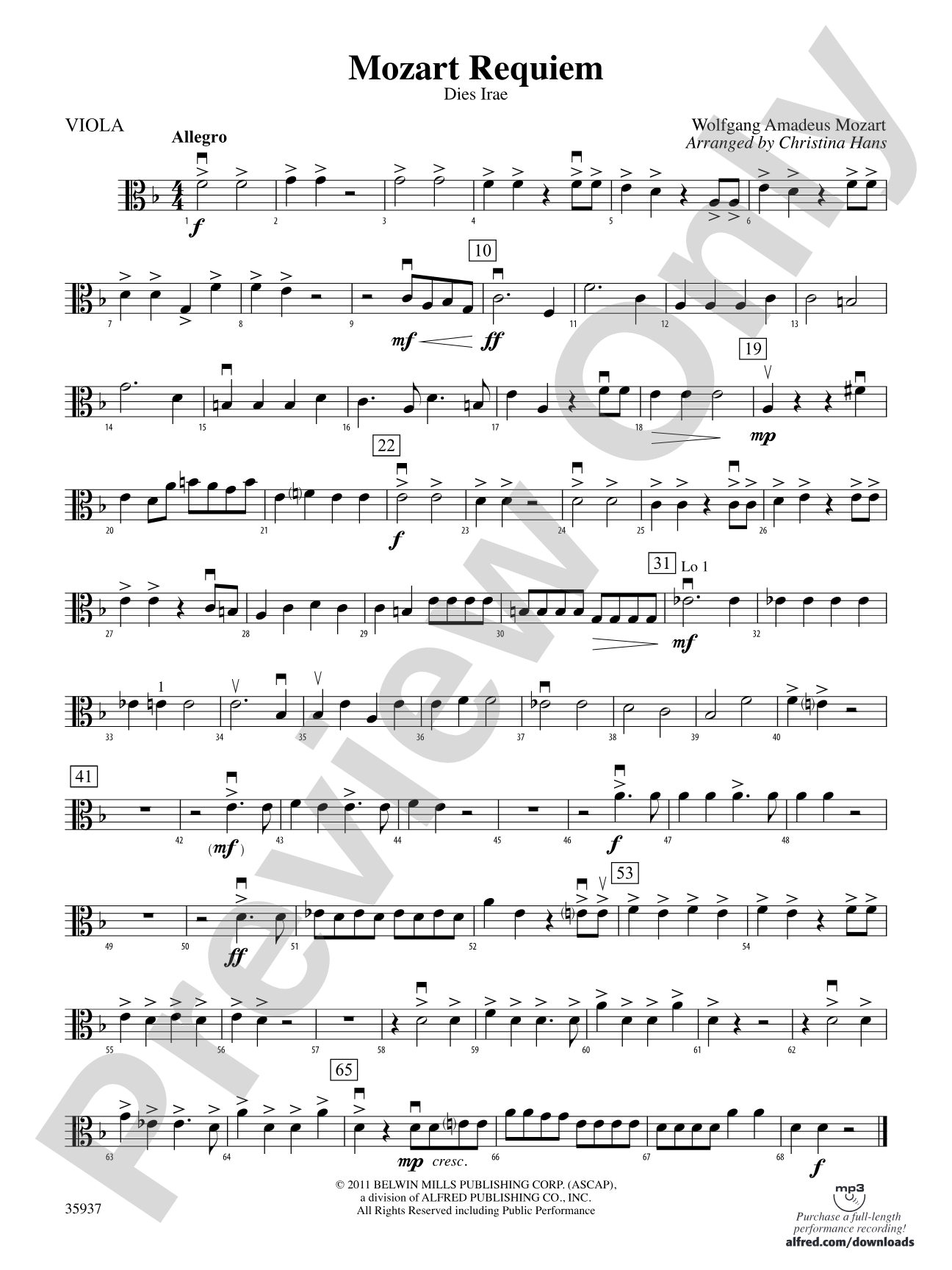

Mozart Requiem -- Dies Irae: Viola
By Wolfgang Amadeus Mozart / arr. Christina Hans
Grade: 3.5
Item: 00-PC-0015019_VA1
$5.99
Pickup currently not available
Description
Much mystery surrounds the Requiem which Mozart was writing just before his death and that mystery can be felt in this arrangement of the choral section Dies Irae (Day of Wrath). It will provide a serious and full sounding addition to your next concert or contest. Written with the young orchestra in mind, this piece will allow your students to experience Mozart's powerful final work without struggling for notes. (2:15)


Don't just read it, hear it, play along with it, and watch your students grow with it. In MakeMusic Cloud, Mozart Requiem -- Dies Irae: Viola comes alive with professional accompaniment, adjustable tempo, and built-in practice tools that turn solo practice into real progress.
Open in the Player
Jump straight in and assign it today.
Start Your Free Trial
Open this title and explore the full library in minutes.
Sample Audio
1
Audio File
--:--
0:00
0:00
Sample Video
Additional Details
Series:
Belwin Concert String Orchestra
Publisher:
Alfred Music
Page Count:
62
SKU:
00-PC-0015019_VA1
Instrumentation:
string
More about this title
About the Composer: Wolfgang Amadeus Mozart
Wolfgang Amadeus Mozart (1756–1791) completed more than 600 compositions across every major genre, from operas and symphonies to chamber music and sacred works. He spent his final months in Vienna composing the Requiem, a monumental mass for the dead that blends his mature harmonic language with profound spiritual depth. The work remained unfinished at his death and was completed by his student Franz Xaver Süssmayr, yet it stands as one of the most performed sacred compositions in the Western canon.
For music educators, Mozart's Requiem represents the pinnacle of Classical composition: clarity of form paired with emotional intensity, accessible melodies built on sophisticated harmonic architecture, and orchestration that demonstrates both restraint and power. Teaching students to perform his music builds their understanding of phrase structure, balanced phrasing, and the relationship between melodic beauty and harmonic support.
Why we love this
This arrangement cuts straight to the heart of Mozart's spiritual intensity without asking Grade 3.5 orchestras to navigate the technical demands of the original score. Christina Hans has preserved the Dies Irae's dramatic character—its minor-key turbulence and rhythmic propulsion—while keeping string writing idiomatic and playable. The result is a piece that sounds substantial and mature in performance, giving your ensemble genuine repertoire rather than a simplified approximation.
What to expect
The Dies Irae unfolds as a grave meditation on mortality, beginning in darkness and building toward moments of agitation before subsiding into resignation. Syncopated rhythmic figures drive the harmonic tension, while the minor key and sparse orchestration create an atmosphere of mystery and weight. There is beauty here, but it is austere and earned.
Who it's for
String orchestras at the intermediate level (Grade 3-4 ability) who want to program a serious masterwork without technical barriers. Directors preparing for festival or concert performance will find parts that sit comfortably for second-year players while maintaining artistic credibility.
How to get the most out of it
- Balance the violas and cellos carefully in the opening measures. They carry harmonic motion that defines the piece's dark character, so they need presence without drowning out the violins' melodic line.
- Shape phrases through bow pressure rather than tempo changes. A single gesture breathed together across a four-measure phrase will feel more connected than stopping to reset between measures.
- Engage the full dynamic range between the forte passages and the softer sections. Contrast is what keeps the Dies Irae's drama alive; a performance that stays in the middle ground loses its power.
- Treat the rhythmic figures as incisive rather than aggressive. The piece should feel relentless and grave, not rushed or heavy-handed.
How to use it
This piece serves as a powerful concert opener or a centerpiece for a program exploring sacred or classical repertoire. Its two-minute-fifteen-second duration makes it an ideal pairing with lighter or more contemporary works, providing ballast and stylistic contrast. Consider programming it for a winter or memorial concert where its liturgical character feels contextually appropriate.
Skills your students will build
- Sustaining long melodic lines with consistent tone and vibrato control
- Reading and maintaining focus in minor-key orchestration
- Playing with rhythmic precision in syncopated figures across multiple parts
- Balancing individual voice lines within four-part string writing
- Responding to dramatic dynamic contrasts and harmonic shifts
- Understanding phrase architecture in Classical formal structures