
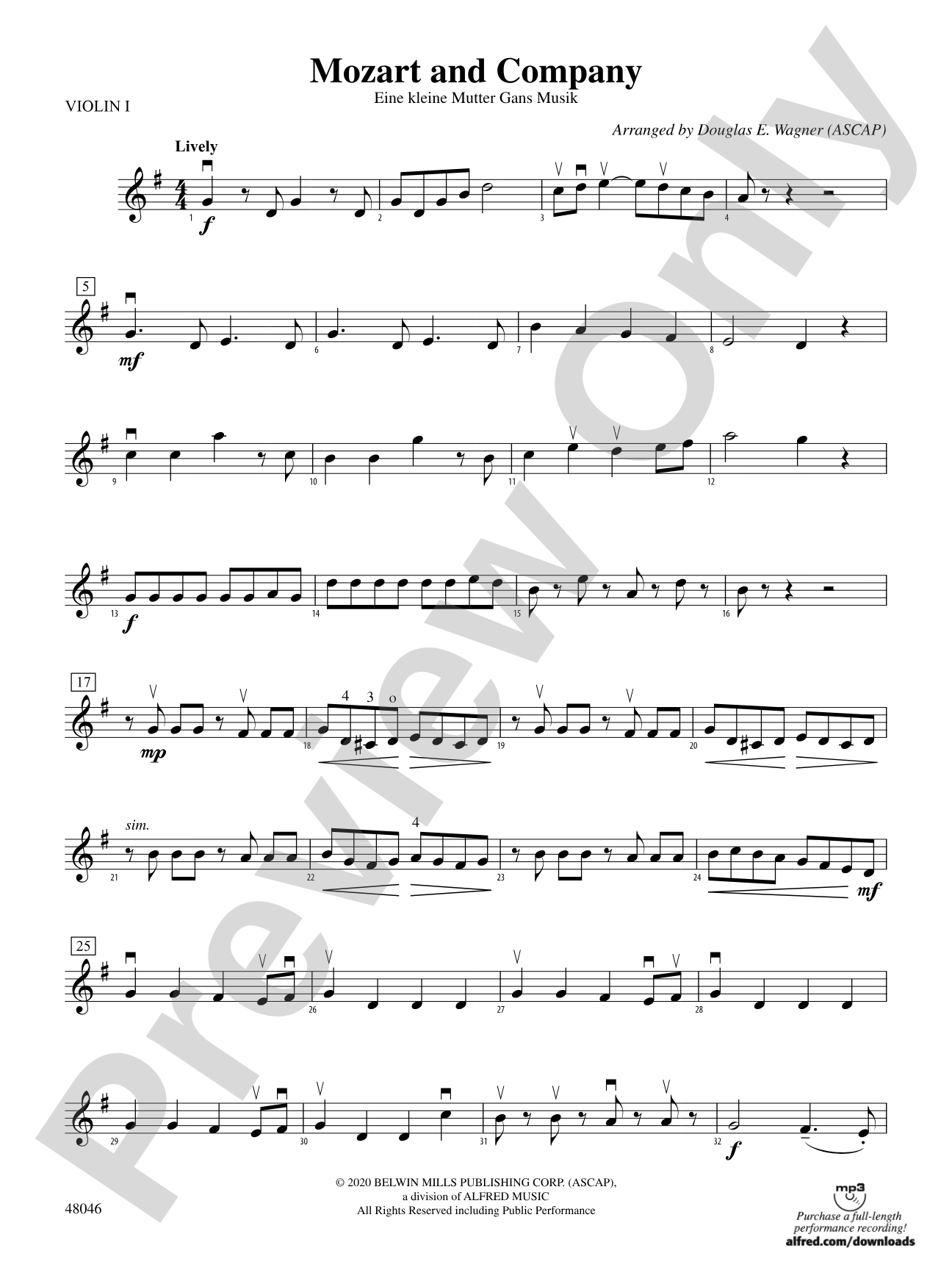

Mozart and Company: 1st Violin
Eine kleine Mutter Gans Musik
Various / arr. Douglas E. Wagner
Grade: 2
Item: 00-PC-0018507_VN1
$3.00
Pickup currently not available
Description
Scored in authentic Classical style by Douglas E. Wagner, excerpts from A Little Night Music, The Marriage of Figaro, and The Magic Flute cleverly intertwine with the traditional nursery tunes, "Jack and Jill," "Three Blind Mice," and "Twinkle, Twinkle, Little Star." Mozart and Company is not difficult to put together and is full of teachable moments. (2:35) This title is available in MakeMusic Cloud.


Don't just read it, hear it, play along with it, and watch your students grow with it. In MakeMusic Cloud, Mozart and Company: 1st Violin comes alive with professional accompaniment, adjustable tempo, and built-in practice tools that turn solo practice into real progress.
Open in the Player
Jump straight in and assign it today.
Start Your Free Trial
Open this title and explore the full library in minutes.
Sample Audio
1
Audio File
--:--
0:00
0:00
Sample Video
Additional Details
Series:
Belwin Intermediate String Orchestra
Publisher:
Alfred Music
Page Count:
144
SKU:
00-PC-0018507_VN1
More about this title
About the Composer: Douglas E. Wagner

Douglas E. Wagner studied music at Butler University, earning both undergraduate and graduate degrees before spending three decades as a high school music director and administrator in the Midwest. Since 1973, he has composed and arranged over 3,500 works across nearly every ensemble type: choir, band, orchestra, handbell ensemble, organ, piano, and voice. His music has been performed in concert halls and broadcast on radio and television throughout the United States and internationally.
Wagner's catalogue has sold more than seventeen million copies worldwide. He now works full-time as a composer from his home in Indianapolis, Indiana, focusing entirely on creating accessible, musically sound works for educational and church musicians.
Why we love this
Wagner threads together genuine Classical excerpts with beloved nursery tunes in a way that feels organic rather than gimmicky, giving young orchestras real exposure to Mozart's melodic genius without overwhelming them technically. The score is genuinely easy to put together, which means rehearsal time goes toward making music rather than solving logistical puzzles. Best of all, the interweaving itself becomes the teachable moment: students hear how a master composer might have written these familiar melodies.
What to expect
Playful and elegant at once. The piece has the lightness and accessibility of a pops concert while maintaining the harmonic sophistication and melodic craft of authentic Mozart. Hearing nursery rhymes dressed in Classical clothing creates a charming, clever atmosphere that appeals to both young performers and audiences.
Who it's for
Grade 2 string orchestras that are ready for a more sophisticated sound but still need straightforward part writing and logical bowing patterns. This work serves young ensembles curious about Classical repertoire and orchestration without requiring advanced technique or reading skills.
How to get the most out of it
- Balance the string sections so the melody stands out clearly, especially when Mozart's material shares the line with a nursery tune countermelody. This clarity helps the audience follow the clever textural layering.
- Shape phrases in the Classical idiom by releasing at cadence points with intention. Young orchestras often push through these moments; letting them breathe lifts the entire performance.
- Bring out the contrasts between sections. The shift from a Mozart excerpt to a nursery tune arrangement offers natural visual and musical punctuation that engages both performers and listeners.
How to use it
Program this as a spring concert opener or closer to energize an audience and showcase your group's ensemble cohesion without demanding heavy dramatic lift. The moderate runtime (2:35) and upbeat character make it an ideal bridge between more serious repertoire or a perfect standalone feature for a short concert.
Skills your students will build
- Identifying and balancing multiple melodic lines within a single arrangement
- Recognizing Classical period harmonic progressions and cadential structures
- Shaping phrases with dynamic inflection and intentional releases
- Reading string orchestra scores with multiple divisi sections
- Distinguishing between compositional styles (nursery tune vs. Classical excerpt) through performance choices