
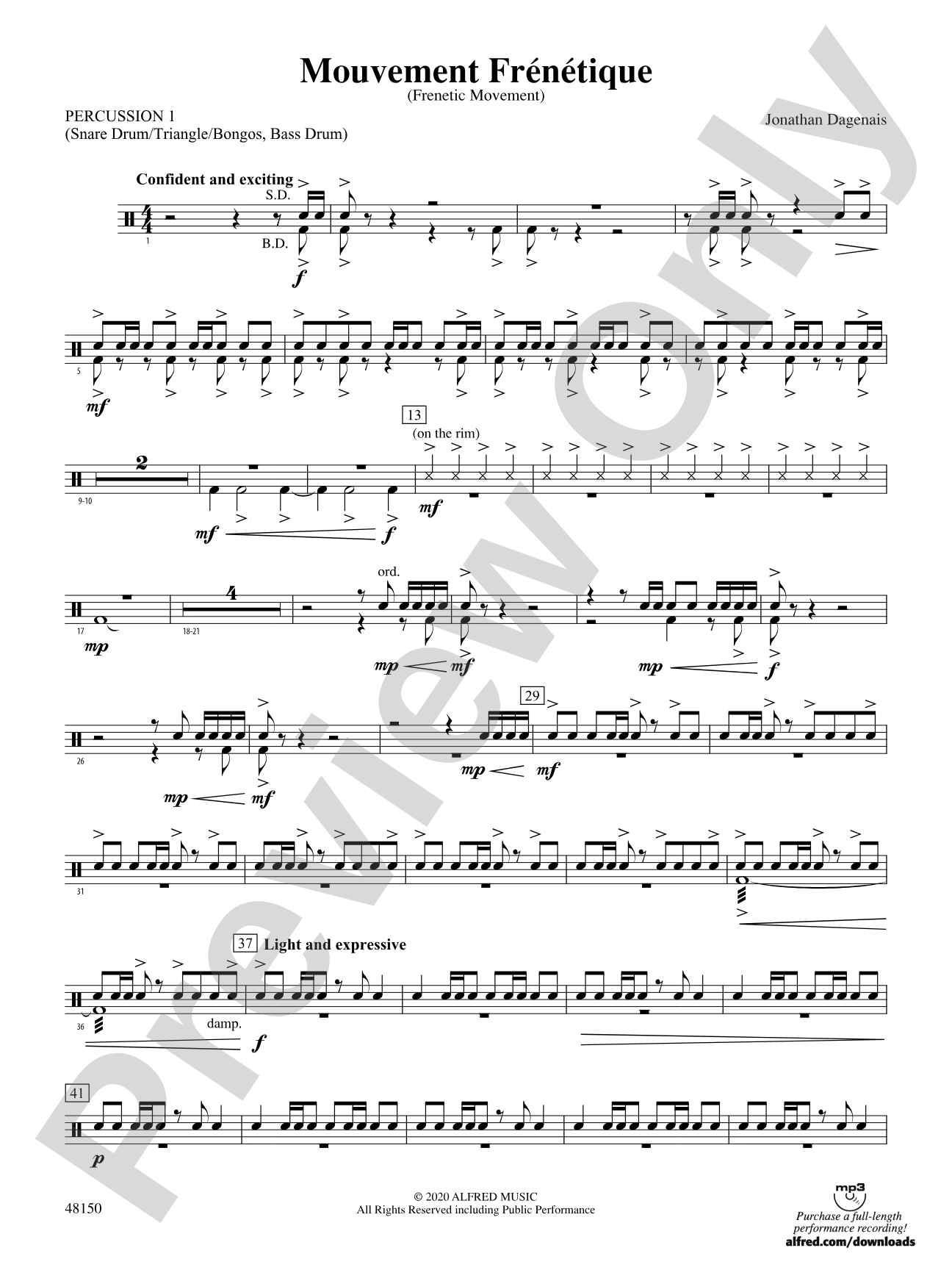

Mouvement Frénétique: 1st Percussion
By Jonathan Dagenais
Grade: 4.5 (Medium Advanced)
Item: 00-PC-0018465_PC1
$3.00
Pickup currently not available
Description
Mouvement Frénétique is a short, dynamic, frenetic, and rhythmic flight of fancy based on a simple motif of four notes that are repeated, varied and developed throughout. Rhythmic percussion, a broad mix of colors, and use of the Lydian scale add complexity, beauty, and energy to this electrifying piece. (5:30) This title is available in MakeMusic Cloud.


Don't just read it, hear it, play along with it, and watch your students grow with it. In MakeMusic Cloud, Mouvement Frénétique: 1st Percussion comes alive with professional accompaniment, adjustable tempo, and built-in practice tools that turn solo practice into real progress.
Open in the Player
Jump straight in and assign it today.
Start Your Free Trial
Open this title and explore the full library in minutes.
Sample Audio
1
Audio File
--:--
0:00
0:00
Sample Video
Additional Details
Series:
Alfred Concert Band
Publisher:
Alfred Music
Page Count:
312
SKU:
00-PC-0018465_PC1
More about this title
About the Composer: Jonathan Dagenais

Jonathan Dagenais brings together formal training in both composition and conducting with decades of practical experience. He earned his Master's in Conducting from McGill University and his Bachelor's in Composition from the Université de Montréal, and has taught music theory, composition, ear training, and conducting at CEGEP and university levels. His concert band works appear regularly on North American festival syllabi and professional recordings, establishing him as a prolific voice in the wind band repertoire.
Beyond the page, Dagenais is known for his collaborative approach to ensemble building. He co-founded the Orchestre à Vents Non Identifié (OVNI) in Montreal in 2005, a wind orchestra dedicated to refined tone, active listening, and thoughtful interpretation. His conducting appointments have included the McGill Wind Orchestra, the Montreal Video Game Orchestra, and the Ottawa Pops Orchestra. He has adjudicated and led clinics at more than 25 North American festivals and competitions, and serves as artistic director of Musicfest Quebec.
Why we love this
Dagenais builds enormous energy from minimal material. A four-note motif becomes the engine for five and a half minutes of driving, colorful invention, making this an ideal festival selection for groups ready to showcase precision, rhythmic control, and ensemble sound. The Lydian scale and layered percussion writing give conductors real color to shape without requiring advanced harmonic literacy from the students.
What to expect
Frenetic and propulsive, like watching a single spark ignite into sustained combustion. The repeated motif never settles; it tumbles through registers and orchestrations, gaining speed and color with each transformation. Rhythmic percussion snaps through the texture like a heartbeat, while the Lydian tonality creates a restless, slightly off-kilter energy that keeps the ear engaged.
Who it's for
Concert bands at the Grade 4.5 level with solid rhythmic chops and the ability to balance complex layering. This is an excellent choice for groups preparing for festival competition or looking to program something contemporary that challenges ensemble precision without requiring a large instrumentation or advanced solo work.
How to get the most out of it
- Establish the four-note motif as your ensemble's cornerstone. Drill it in isolation across sections so every player internalizes the rhythmic profile and pitch relationships; this foundation makes all variations and developments land clearly.
- Balance the rhythmic percussion carefully. The piece depends on these colors to drive momentum, so ensure they sit prominently without burying the harmonic voices underneath.
- Use the Lydian inflection as a tonal anchor. Once your band hears that raised fourth degree consistently, the harmonic character becomes unmistakable and props up precision in the many rhythmic unison passages.
- Shape the dynamic arc across the full five and a half minutes. This is a flight of fancy that needs breathing room; resist the temptation to keep everything at top volume.
How to use it
Pair this with a ballad or slower movement to maximize the impact of its kinetic drive. It works equally well as a closer (leaving the audience energized) or as a centerpiece that showcases your band's rhythmic facility and contemporary music fluency.
Skills your students will build
- Reading and executing repeated motifs with consistent accuracy across multiple statement variations
- Balancing layered rhythmic profiles and complex percussion writing
- Intonation control in the Lydian mode, particularly the raised fourth scale degree
- Maintaining rhythmic precision through rapid unison passages and syncopated figures
- Responding to conductor cues that shape energy and dynamics across a longer arc