
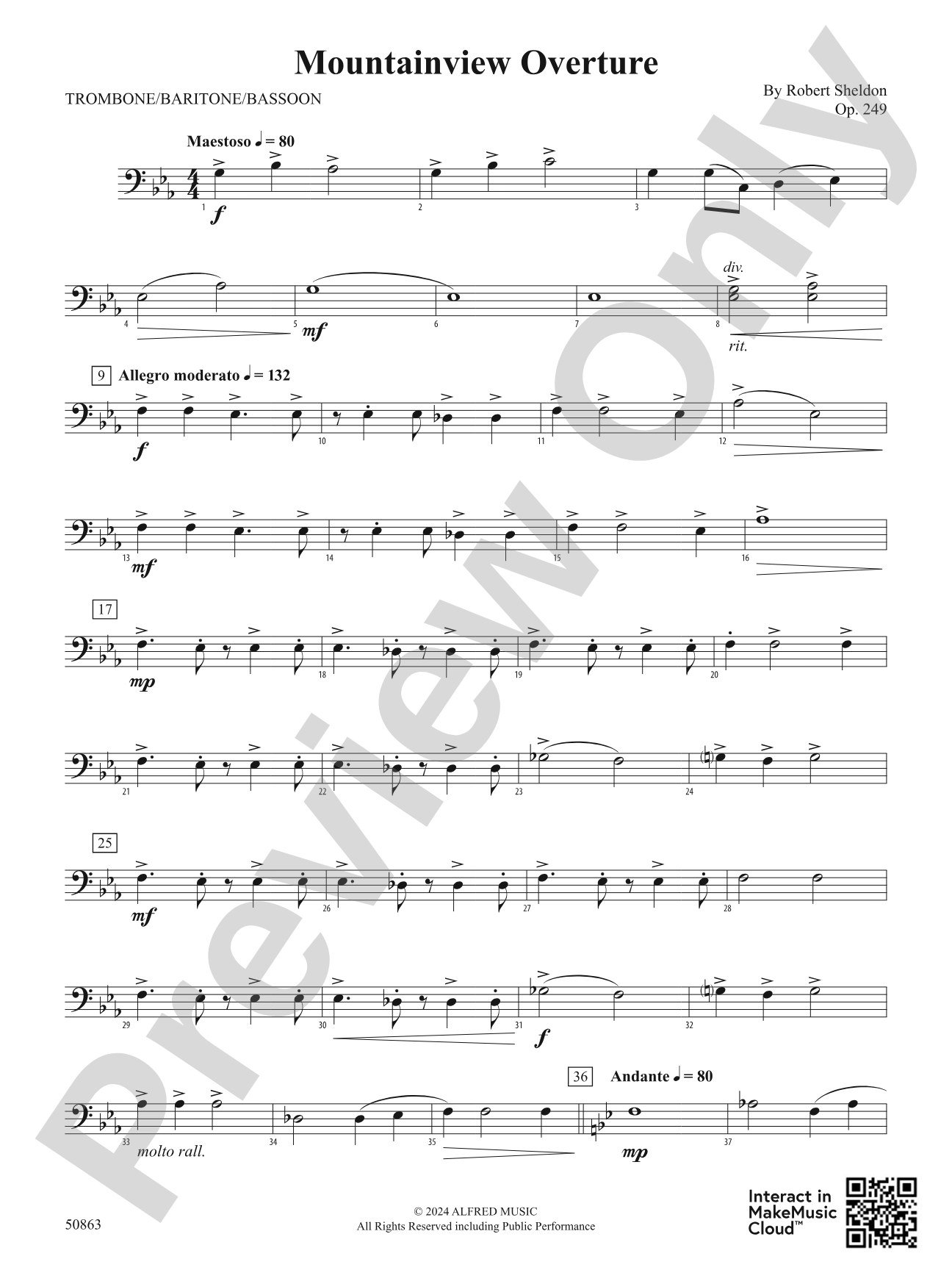

Mountainview Overture: 1st Trombone
By Robert Sheldon
Grade: 2
Item: 00-PC-0019197_TN1
$3.00
Pickup currently not available
Description
Written in standard overture form, Mountainview Overture, by Robert Sheldon, has enjoyable parts for every section and offers many stylistic and expressive development opportunities. This bright and tuneful piece is perfect for concerts, festivals, and adjudicated events. (3:05) Correlates to Sound Innovations, Book 2, Level 2.


Don't just read it, hear it, play along with it, and watch your students grow with it. In MakeMusic Cloud, Mountainview Overture: 1st Trombone comes alive with professional accompaniment, adjustable tempo, and built-in practice tools that turn solo practice into real progress.
Open in the Player
Jump straight in and assign it today.
Start Your Free Trial
Open this title and explore the full library in minutes.
Sample Audio
1
Audio File
--:--
0:00
0:00
Sample Video
Additional Details
Series:
Sound Innovations for Concert Band
Publisher:
Alfred Music
SKU:
00-PC-0019197_TN1
More about this title
About the Composer: Robert Sheldon

Robert Sheldon stands among the most frequently programmed composers in wind band repertoire. His works appear regularly on state and national contest lists, and his music has been performed at prestigious venues including Carnegie Hall, Symphony Hall, and the Kennedy Center. Beyond composing, Sheldon serves as the lead author of Sound Innovations for Concert Band, a widely adopted series in secondary music programs.
Sheldon's influence extends internationally through his work as a guest conductor, clinician, and commission composer. He has appeared at honor bands, state conferences, and music education seminars across the United States, Japan, Canada, Italy, Germany, Australia, and China. His contributions to wind band pedagogy and performance have earned recognition from the American School Band Director's Association, Phi Beta Mu, and the American Society of Composers, Authors and Publishers. In 2020, VanderCook College of Music awarded him an honorary doctorate.
Why we love this
Sheldon writes overtures that actually work for young bands. Mountainview balances a coherent structural arc with genuine melodic appeal, giving every section meaningful material to play rather than padding the arrangement with busy counterpoint. The piece sits comfortably at Grade 2, which means your musicians spend their energy on musicality and expression rather than wrestling with technical demands they're not ready for.
What to expect
Mountainview has the brightnesss and forward motion of a traditional concert overture without becoming novelty music. Sheldon's harmonic language is accessible yet never bland, and the thematic material lodges in your students' ears because it's genuinely singable. The piece conveys architectural intelligence and purposeful orchestration at a level that young musicians can feel themselves.
Who it's for
Band directors at the middle school and early high school level who need repertoire that reinforces foundations while maintaining genuine musical substance. This works equally well as a concert opener, a festival selection, or a confidence builder for ensembles still solidifying their blend and intonation.
How to get the most out of it
- Bring out the contrasting themes without losing the overall narrative. The A section and B section material should feel like distinct musical characters within the same conversation.
- Work your section leaders on balancing transparency in the middle voices. At Grade 2, young players often disappear when they're not on melody, but supporting lines anchor harmonic clarity.
- Shape the dynamic arc gradually across the 3:05 form rather than making sudden jumps. This teaches students how phrasing operates beyond the individual phrase.
- Use the score's tempo and expression markings as rehearsal anchors. Sheldon writes idiomatically, so his articulation and dynamic suggestions serve the piece's intent, not arbitrary convention.
How to use it
Open a concert with this to set an uplifting tone and immediately signal competence to your audience. It also works as a test run before tackling more ambitious festival repertoire, since the piece demands clarity of texture and unified phrasing without overwhelming young players technically. If you're working from Sound Innovations, Book 2, programming Mountainview Overture reinforces the method's vocabulary in a performance context.
Skills your students will build
- Phrase shaping across complete musical forms
- Dynamic contrast and control within a single tempo
- Transparent middle voice voicing and harmonic awareness
- Ensemble balance in multi-thematic orchestration
- Reading standard concert band instrumentation and transpositions