
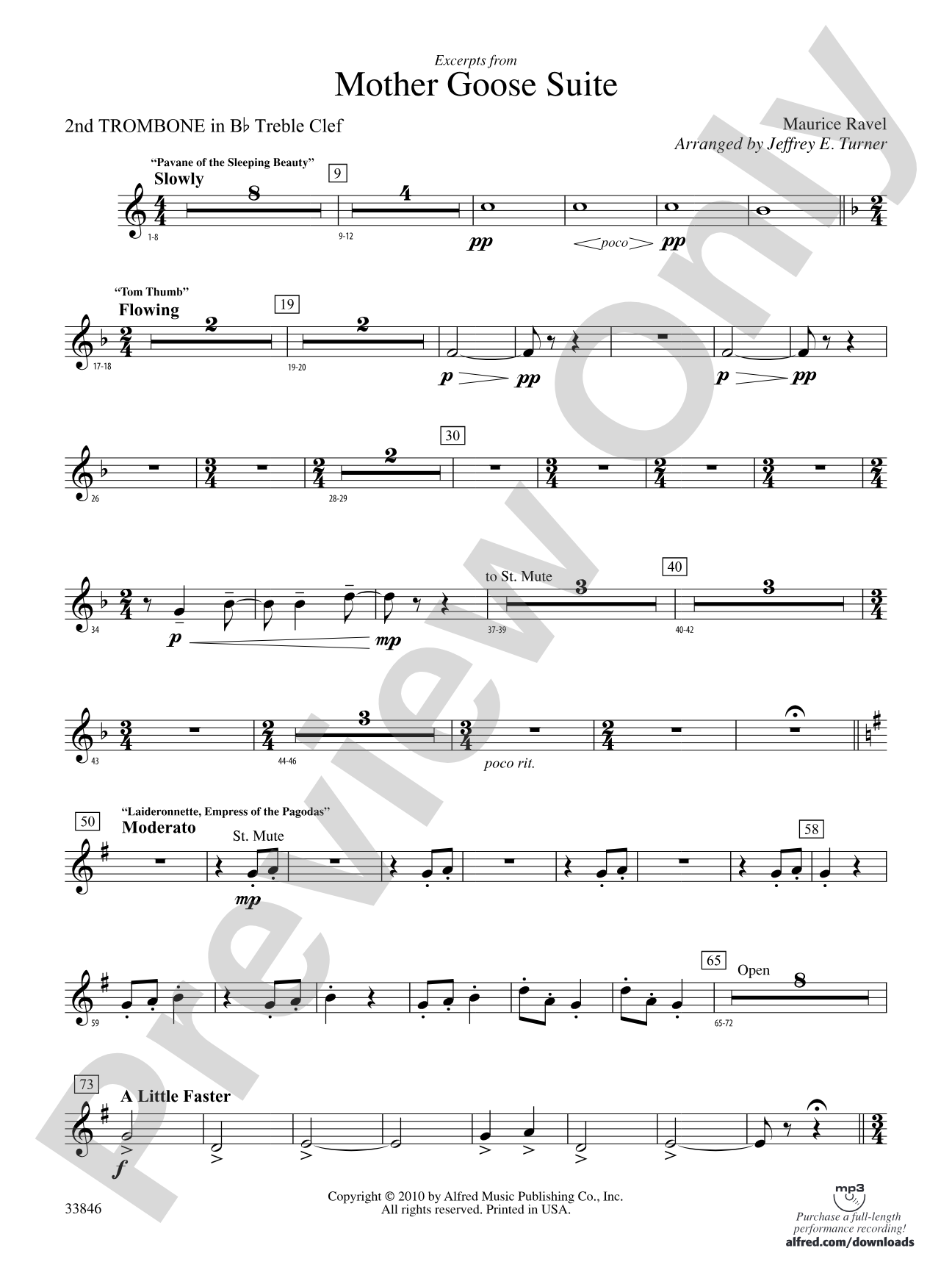
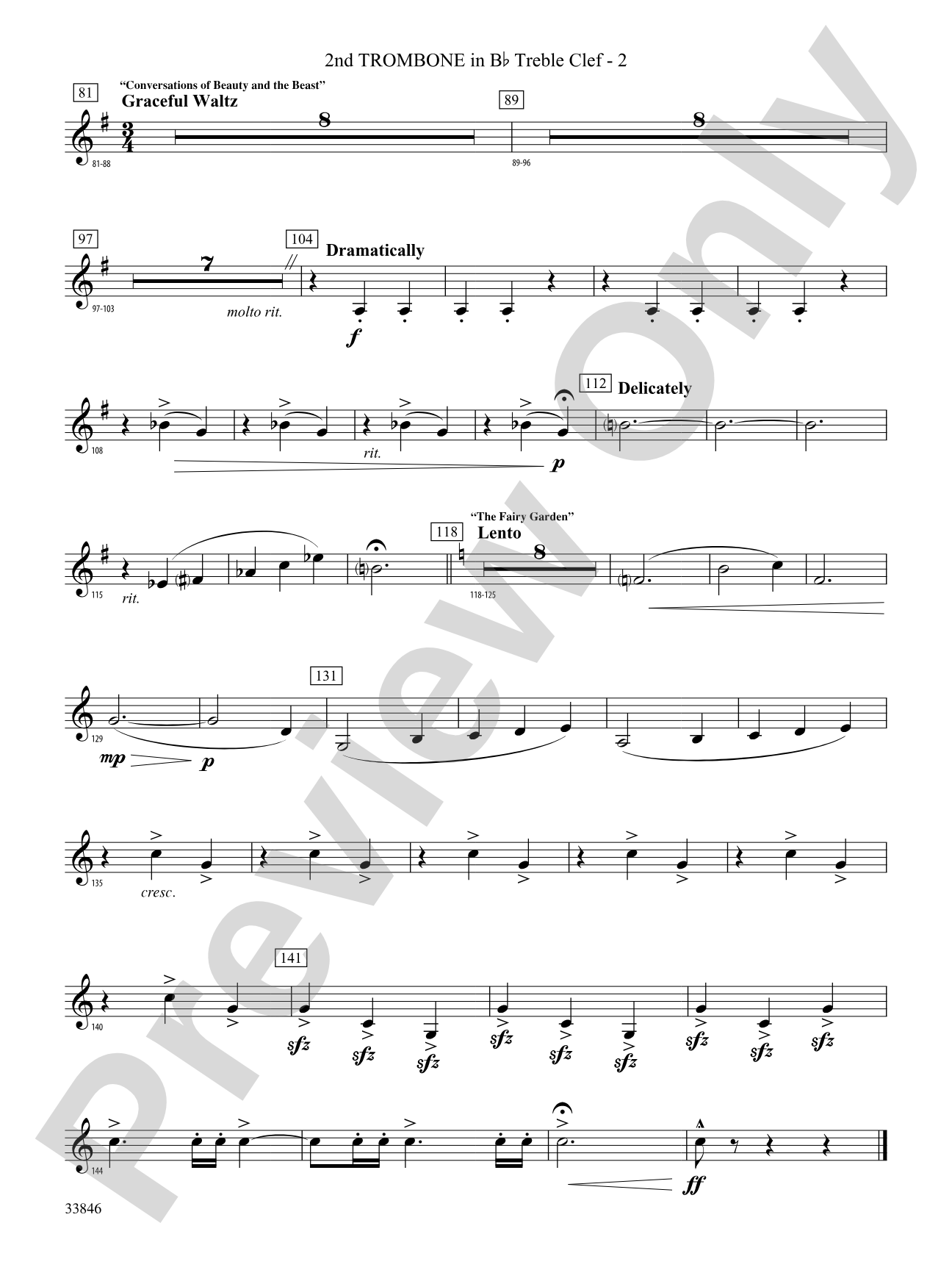

Mother Goose Suite: (wp) 2nd B-flat Trombone T.C.
By Maurice Ravel / arr. Jeffrey E. Turner
Grade: 3 (Medium)
Item: 00-PC-0014577_wpTN2TC
$3.00
Pickup currently not available
Description
Ravel wrote the Mother Goose Suite for two children who were very special to him. His fascination with the wonder and imagination of childhood are evident in this piece. This arrangement will take your young band on a journey through the enchanted world of fairy tales---from the reflective "Sleeping Beauty Pavane," to the playful "Tom Thumb," the exotic "Empress of the Pagoda," through the courtship of "Beauty and the Beast," and concluding where all fairy tales must, with a happily-ever-after ending in "The Fairy Garden." This piece is an excellent vehicle for featuring your soloists, and the well-crafted orchestration will showcase the wealth of sound and colors in any band. Being generously cued, even smaller bands will be able to enjoy Ravel's music. Mother Goose Suite is sure to delight the little child in all of us.


Don't just read it, hear it, play along with it, and watch your students grow with it. In MakeMusic Cloud, Mother Goose Suite: (wp) 2nd B-flat Trombone T.C. comes alive with professional accompaniment, adjustable tempo, and built-in practice tools that turn solo practice into real progress.
Open in the Player
Jump straight in and assign it today.
Start Your Free Trial
Open this title and explore the full library in minutes.
Sample Audio
1
Audio File
--:--
0:00
0:00
Sample Video
No sample videos found.
Additional Details
Series:
Young Symphonic
Publisher:
Alfred Music
Page Count:
248
SKU:
00-PC-0014577_wpTN2TC
More about this title
About the Composer: Maurice Ravel
Maurice Ravel (1875-1937) was a French composer whose harmonic innovation and orchestral color defined early 20th-century music. His work balanced structural clarity with impressionistic textures, and he was a master orchestrator who understood how to draw singing lines and vivid sonorities from instrumental combinations. Ravel's music for children and fairy tales reveals his genuine affection for childhood imagination; he composed Mother Goose as a four-hand piano suite for two young pianists, then later orchestrated it into one of his most beloved works.
Why we love this
This arrangement captures the orchestral shimmer and narrative arc of Ravel's original while remaining accessible to developing ensembles. The generous cueing means Grade 3 bands won't struggle with doublings, yet the music never sounds simplified; students play genuine Ravel, not a reduction. Programming this signals to your audience that your band has refined taste and the technical control to handle sophisticated harmonic language.
What to expect
A stroll through an enchanted storybook where every movement brings a new emotional hue. The opening Sleeping Beauty Pavane unfolds with serene, dreamy quality; Tom Thumb darts playfully through the ensemble; the Empress of the Pagoda shimmers with exotic orchestral color; Beauty and the Beast unfolds as a tender romance; and the Fairy Garden bursts with celebration. Throughout, Ravel's harmonic language creates an impression of wonder without ever becoming overly sentimental.
Who it's for
Young concert bands at the Grade 3 level who are ready to engage with masterwork literature and have developed enough maturity to handle nuanced phrasing and coloristic writing. Directors seeking repertoire that builds technical skill without sacrificing artistic substance will find this arrangement rewards the investment.
How to get the most out of it
- Attend closely to the impressionistic harmony; resist the urge to over-blend. These chords gain their beauty from slightly transparent voicing and clear doublings across sections.
- Balance solo features generously. Ravel writes these passages with character and exposure in mind; give your soloists the confidence to sing without drowning them in accompaniment.
- Shape the phrasing across the five movements as a journey rather than separate pieces. Find subtle tempo relationships between sections to maintain narrative continuity.
- Use the recorded accompaniment (if available through your license) during early sectional rehearsals so students hear the piece in full orchestration and understand their role within the whole.
How to use it
Program this as a centerpiece concert work that stands on its own or as part of a spring concert celebrating artistry and growth. Its narrative structure and ballet heritage pair well alongside contemporary works or other twentieth-century masterworks. The modest instrumentation requirements and generous cueing also make it suitable for festival competition where you want to demonstrate musicianship and control over repertoire difficulty.
Skills your students will build
- Balancing dynamics within impressionistic harmonic progressions
- Maintaining tonal clarity across widely spaced voicings and unusual doublings
- Sustaining focused ensemble sound through slow, lyrical passages
- Following extended solo passages and featured instrument lines
- Interpreting program music and connecting instrumental color to narrative
- Managing sectional independence (especially in movements with alternating thematic material)