
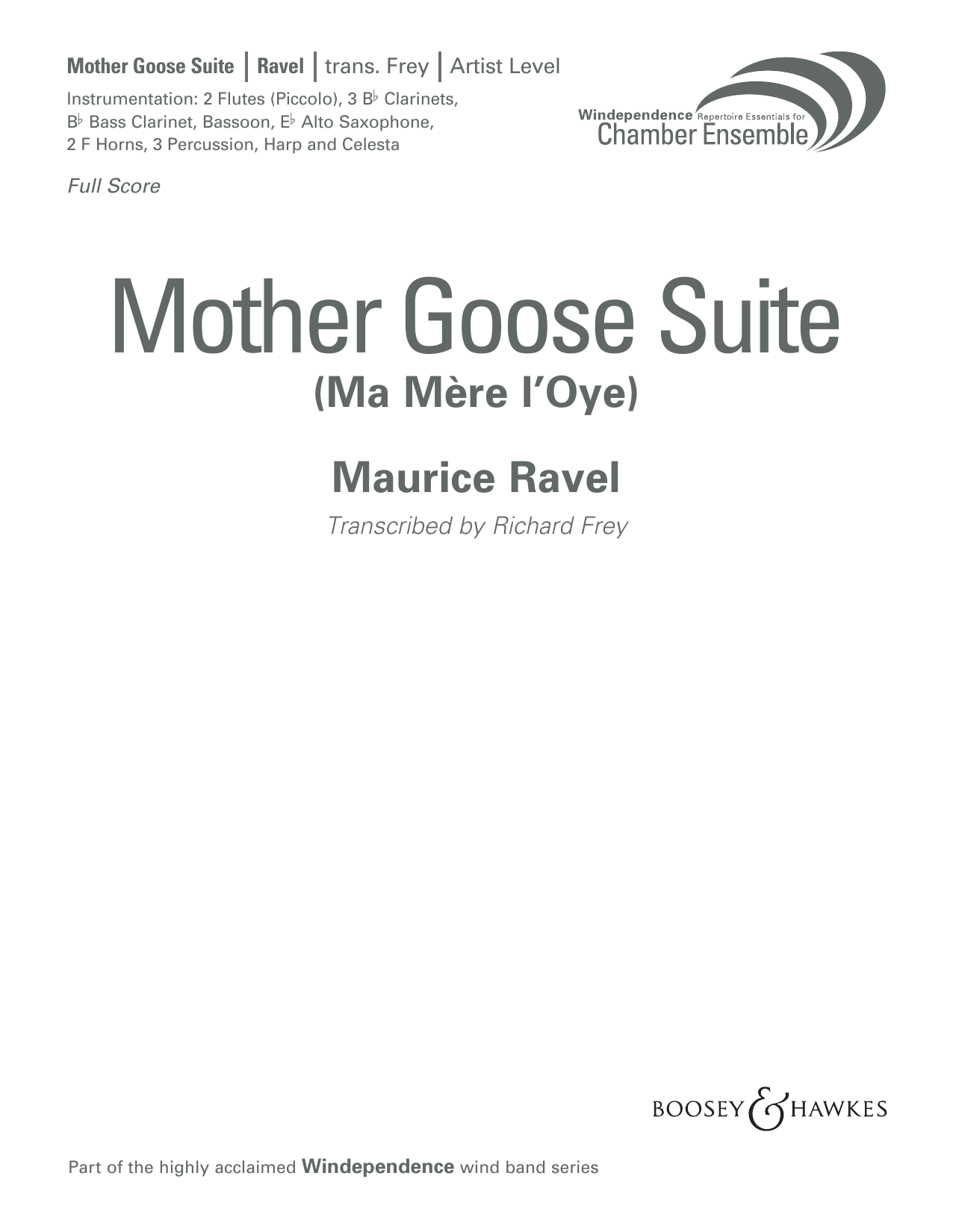

Mother Goose Suite (Ma Mére L'Oye) (arr. Richard Frey): Concert Band Conductor Score & Parts
By Maurice Ravel / Arranged by Richard Frey
Grade: 5
Item: 35-PK00427259
$145.00
Pickup currently not available
Buy Extra Parts (Digital PDF Download)
Parts Added to Cart!
Description
Maurice Ravel's "Mother Goose Suite" compirses five charming miniatures, each evoking a fairy tale scene. From the simplicity of the opening "Pavane of Sleeping Beauty" to the whirling dance of the "Conversation of Beauty and the Beast," Ricahrd Frey's colorful new setting for chamber winds and percussion captures the beauty and elegance of Ravel's entrancing work.


Mother Goose Suite (Ma Mére L'Oye) (arr. Richard Frey): Concert Band Conductor Score & Parts isn't in MakeMusic Cloud just yet...but it could be. Let us know you'd like to see it, and you'll help shape what comes next. In the meantime, start a free trial and dive into thousands of interactive titles your students can play along with today.
Request This Title
Tell us you want it.
Start Your Free Trial
Explore everything that's ready to play right now.
Sample Audio
No sample audio found.
Sample Video
No sample videos found.
Additional Details
Publisher:
Hal Leonard
SKU:
35-PK00427259
More about this title
About the Composer: Maurice Ravel
Maurice Ravel (1875-1937) was a French composer whose orchestrations and instrumental colorings rank among the most imaginative in twentieth-century classical music. His meticulous approach to instrumentation and his gift for reimagining musical material across different ensembles made him a composer's composer, one whose works reward close study of how timbre itself becomes musical substance.
Ravel wrote Mother Goose as a four-hand piano suite in 1908, then orchestrated it for full orchestra in 1911. The work reveals his obsession with texture and translucence. Each movement presents a narrative miniature drawn from French fairy tales and children's literature, giving the suite an accessibility that never compromises its musical sophistication.
Why we love this
Ravel's orchestration instinct translates remarkably well to the wind band medium, and Frey's arrangement preserves the suite's essential character while opening it to ensembles of modest size. Grade 5 bands gain access to music that sounds genuinely elegant and refined, not diluted or simplified. The variety across movements prevents rehearsal fatigue while maintaining enough musical substance to keep students engaged.
What to expect
The suite unfolds like turning pages in a storybook; each movement inhabits its own musical world without losing connection to an overarching sense of charm and grace. Moments shimmer with delicate transparency, while others sparkle with rhythmic vitality. The whole experience feels European, elegant, and slightly timeless.
Who it's for
Directors seeking substantial classical repertoire that sits comfortably at Grade 5 and builds musicianship without requiring virtuosic technique. Students benefit from encountering Ravel's compositional approach directly, understanding how masters handle orchestral color and structural clarity. This works equally well for concert programming or festival performance.
How to get the most out of it
- Balance the color palette carefully in the Pavane. The opening needs transparency; resist the urge to blend voices into a thick chord. Ravel's magic depends on hearing individual lines.
- Shape phrases with the harmonic rhythm rather than the melodic line. The music breathes in longer architectural breaths than the note-by-note surface might suggest.
- Let the woodwind soloists own their moments in Conversation of Beauty and the Beast. This movement thrives on character and playfulness, not precision.
- Commit to consistent articulation across the ensemble within each movement. Ravel uses articulation as orchestral color; vague attacks muddy the effect.
How to use it
Place this as a centerpiece on a concert featuring early twentieth-century French or Russian works, or use it to anchor a program built around fairy tale themes. It works particularly well as the opening item on a concert, where its refinement and directness set a sophisticated tone. Consider pairing it with other Ravel arrangements or works from composers in his circle.
Skills your students will build
- Balancing individual woodwind and brass lines for transparency in multi-layered textures
- Shaping musical phrases based on harmonic rhythm rather than surface melodic movement
- Executing crisp, consistent articulation patterns across the ensemble
- Responding to character changes across contrasting movements within a single work
- Maintaining ensemble blend while preserving orchestral color distinctions