
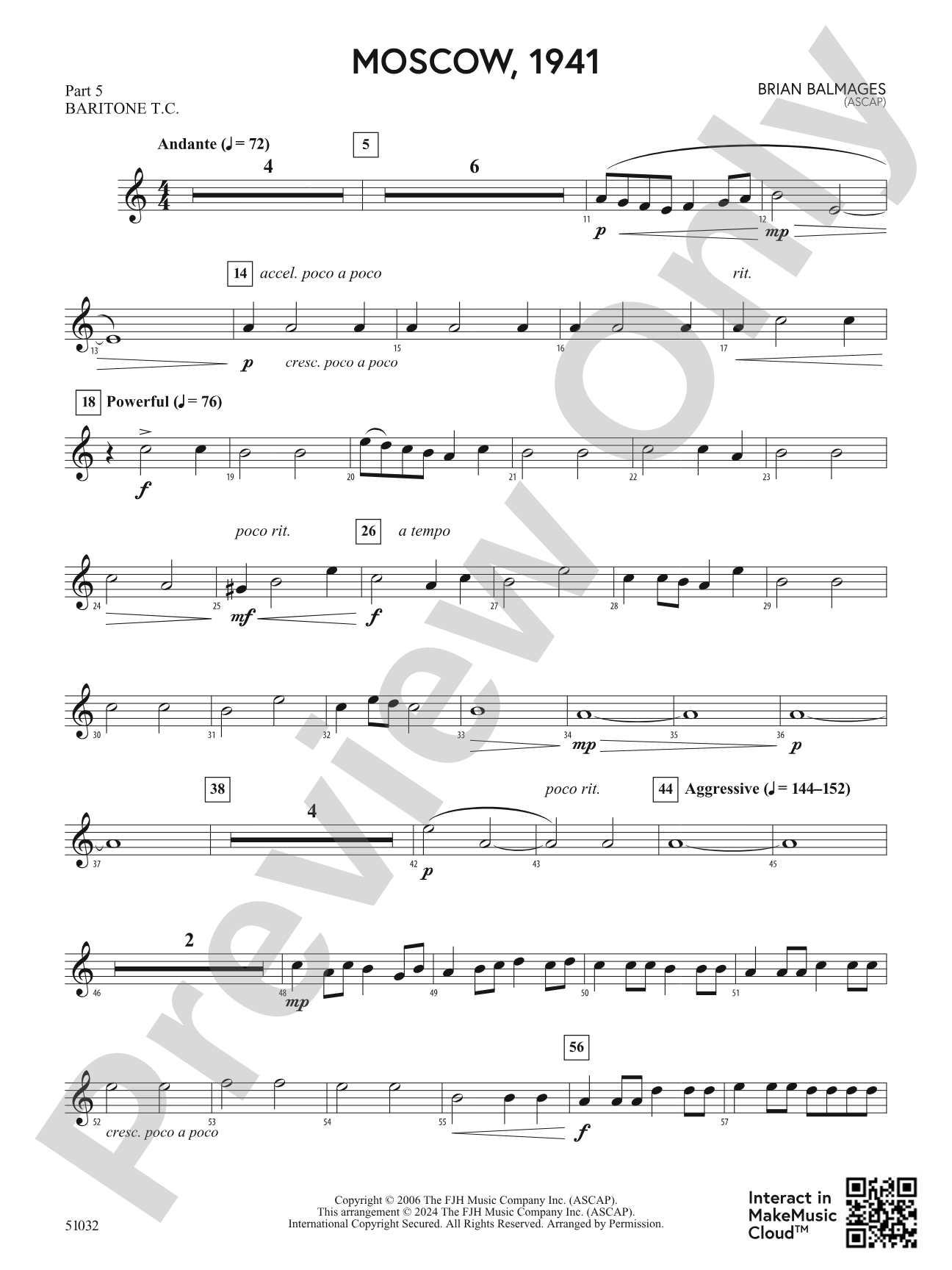

Moscow, 1941: Part 5 - Euphonium T.C.
By Brian Balmages
Grade: 3
Item: 00-PC-0019375_PART5_EUPTC
$3.00
Pickup currently not available
Description
Now available in ColorFlex format, Moscow, 1941 is a powerful work by Brian Balmages based on the famous Russian song Meadowlands. The music tells the story of the Red Army successfully defending Moscow against the German invasion of WWII. Exploring various sounds, colors, and harmonies, this captivating work is sure to inspire your students and audience! (4:20)


Don't just read it, hear it, play along with it, and watch your students grow with it. In MakeMusic Cloud, Moscow, 1941: Part 5 - Euphonium T.C. comes alive with professional accompaniment, adjustable tempo, and built-in practice tools that turn solo practice into real progress.
Open in the Player
Jump straight in and assign it today.
Start Your Free Trial
Open this title and explore the full library in minutes.
Sample Audio
1
Audio File
--:--
0:00
0:00
Sample Video
Additional Details
Series:
MakeMusic Young Band
Publisher:
MakeMusic Publications
SKU:
00-PC-0019375_PART5_EUPTC
More about this title
About the Composer: Brian Balmages

Brian Balmages has built a career writing for orchestras, bands, and chamber ensembles at every level, from elementary schools to professional symphony orchestras. His works have premiered at Carnegie Hall, the Kennedy Center, Sydney Opera House, and the Toronto Centre for the Arts. He received the A. Austin Harding Award from the American School Band Directors Association and won the 2020 NBA William D. Revelli Composition Contest. An elected member of the American Bandmasters Association, he holds alumni status from both James Madison University and the University of Miami, where he was commissioned to compose for a presidential inauguration. His music was performed at the 2013 Presidential Inaugural Prayer Service.
As a conductor, Balmages maintains active guest engagements with all-state ensembles, university orchestras, and professional groups worldwide. He has conducted at the Midwest Clinic, Western International Band Clinic, College Band Directors Conference, and numerous international venues. Currently, he serves as Director of MakeMusic Publications and Digital Education for Alfred and MakeMusic.
Why we love this
Balmages writes programmatic music that grips student musicians and audiences alike without sacrificing musicality for accessibility. This work draws on one of history's most recognizable Russian songs and translates its heroic narrative into orchestration that grade 3 bands can actually execute, making it ideal for festival seasons or programs where you need repertoire with real emotional weight.
What to expect
Resolute and cinematic, the work unfolds like a historical account scored for wind band. Russian melody intertwines with harmonic colors that shift from somber to triumphant, capturing both the gravity of conflict and the exhilaration of resistance.
Who it's for
Grade 3 concert bands seeking repertoire with historical resonance and accessible voicing. Directors programming festivals or concerts where students need engaging material that tells a story and connects to curricular content beyond music.
How to get the most out of it
- Balance the famous Meadowlands melody against the harmonic landscape surrounding it. The song's power comes from its prominence, so ensure your lead voices sit forward while accompaniment remains transparent.
- Explore the dynamic range across the full four minutes and twenty seconds. Balmages uses orchestral color changes to advance the story, so treat each section's dynamic marking as essential to the narrative arc rather than arbitrary.
- Use the flexible instrumentation to your advantage by doubling vulnerable inner parts. With ColorFlex scoring, you can redistribute the arrangement to match your band's strengths and fill gaps where needed.
How to use it
Program this alongside other programmatic band works in a concert dedicated to historical storytelling, or use it as a centerpiece in a festival entry. The four-minute duration makes it an ideal anchor for a mixed-length concert set, and its thematic clarity engages audiences who may be less familiar with concert band literature.
Skills your students will build
- Balancing lyrical melody with accompaniment textures
- Interpreting dynamic contrast as narrative device
- Performing with flexible instrumentation and part reassignment
- Sustaining ensemble sound across a four-minute programmatic arc