
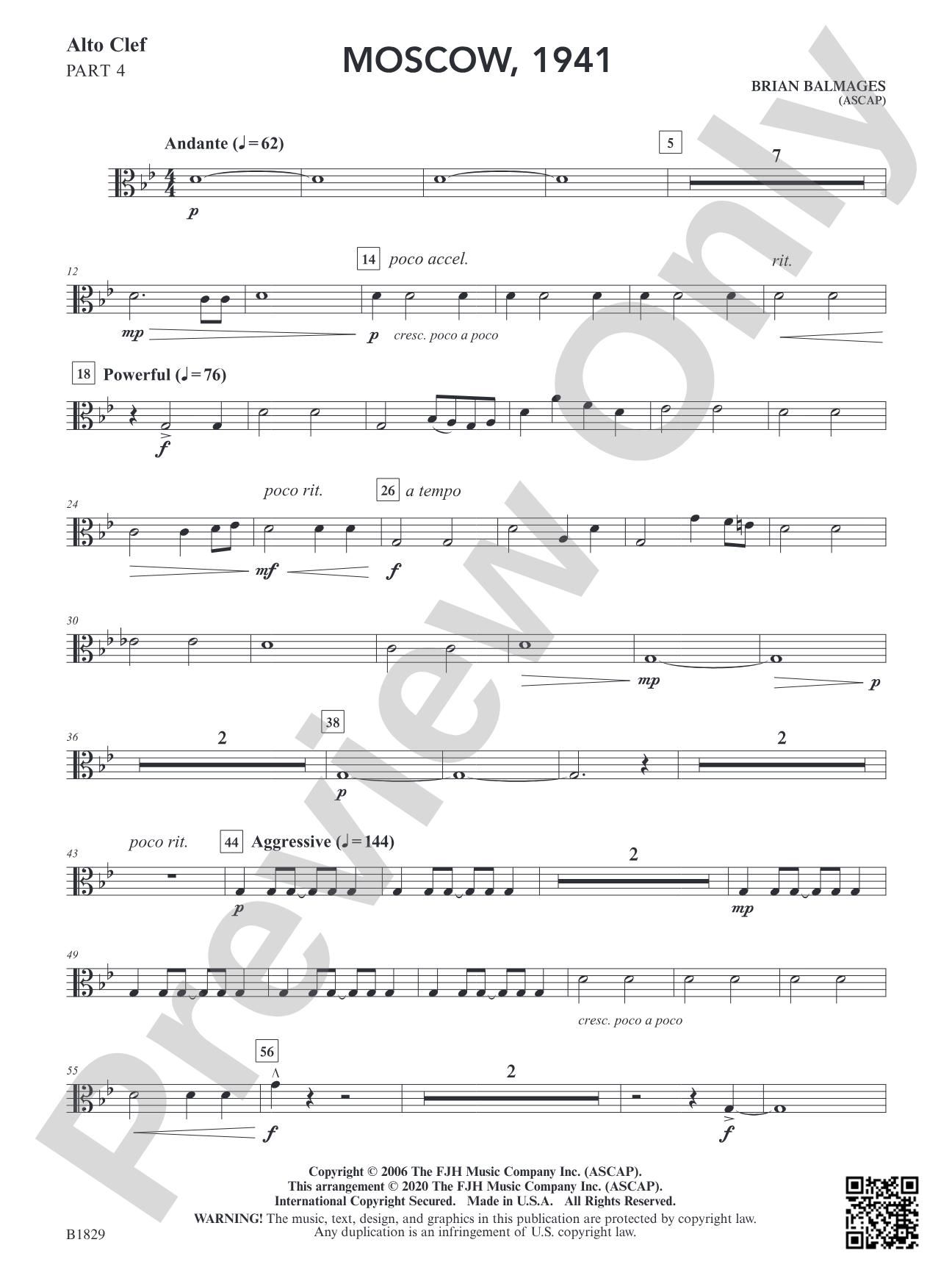

Moscow, 1941: Alto Clef 4
By Brian Balmages
Grade: 2
Item: 98-PC-DB1829_ACLEF4
$7.00
Pickup currently not available
Description
This powerful and inspiring work will surely motivate your students! Based on the famous Russian song Meadowlands, this work also uses original material to tell the story of the Red Army successfully defending Moscow against the German invasion of WWII. Exploring various sounds, colors, and harmonies, this captivating work is an easy choice for your next program!


Moscow, 1941: Alto Clef 4 isn't in MakeMusic Cloud just yet...but it could be. Let us know you'd like to see it, and you'll help shape what comes next. In the meantime, start a free trial and dive into thousands of interactive titles your students can play along with today.
Request This Title
Tell us you want it.
Start Your Free Trial
Explore everything that's ready to play right now.
Sample Audio
1
Audio File
--:--
0:00
0:00
Sample Video
No sample videos found.
Additional Details
Series:
The ReImagine Initiative
Publisher:
The FJH Music Company, Inc.
SKU:
98-PC-DB1829_ACLEF4
Instrumentation:
4-Part Fully Adaptable with Percussion
More about this title
About the Composer: Brian Balmages

Brian Balmages has built a composing and conducting career that moves fluidly between orchestral, band, and chamber music contexts. His works have reached audiences at Carnegie Hall, the Kennedy Center, Sydney Opera House, and the Toronto Centre for the Arts, performed by ensembles ranging from professional orchestras to elementary school groups. He earned the A. Austin Harding Award from the American School Band Directors Association, won the 2020 NBA William D. Revelli Composition Contest for Love and Light, and holds membership in the American Bandmasters Association.
Balmages has received the inaugural James Madison University Distinguished Alumni Award from the School of Visual and Performing Arts and was commissioned by the University of Miami to compose for the inauguration of its 6th president, Dr. Julio Frenk. His music was performed during the 2013 Presidential Inaugural Prayer Service attended by President Obama and Vice President Biden. As a conductor, he maintains active engagements with all-state ensembles, university groups, and professional orchestras worldwide, with notable guest appearances at the Midwest Clinic, Western International Band Clinic, and the College Band Directors Conference. He currently serves as Director of MakeMusic Publications and Digital Education for Alfred and MakeMusic.
Why we love this
Balmages anchors this work in a recognized Russian melody while layering original compositional material that genuinely serves the narrative. The 4-part flexible instrumentation means you can program it whether you have a full band, a developing ensemble, or a string group, making it remarkably practical for diverse school situations. Grade 2 accessibility combined with genuine artistic substance gives students a piece they can perform with pride rather than one they merely read through.
What to expect
The piece balances reverence for historical weight with forward momentum. The Meadowlands melody carries a haunting, resolute quality, while Balmages's original material introduces both tension and triumph, building an emotional arc that reflects the dramatic historical moment. Listening to it, you sense both the gravity of defense and the resilience of human spirit.
Who it's for
This work suits concert band programs at the Grade 2 level, including developing middle school ensembles and high school groups seeking accessible material with real artistic substance. It also works for flexible mixed ensembles (band, strings, or combination) when you need a single score that adapts to your available instrumentation without sacrificing musical integrity.
How to get the most out of it
- Balance the familiar melodic material (based on Meadowlands) against the original compositional passages so listeners grasp the work's narrative arc rather than hearing it as disconnected sections.
- Explore the dynamic range and harmonic colors intentionally during rehearsals. Balmages writes with specific instrumentation in mind even within the flexible framework, so studying which voices carry melody versus harmony at each moment enriches interpretation.
- Use the percussion parts to anchor key dramatic moments. The programmatic nature of the work means percussion serves both rhythmic and storytelling functions, so clarity there elevates the entire ensemble's execution.
- Invest rehearsal time in the transitions between sections. Flexible instrumentation sometimes means uneven doubling across parts; clean hand-offs between musical ideas make the difference between a good performance and a compelling one.
How to use it
Program this as a centerpiece for a concert exploring historical narratives in music, or use it to open a set that progresses from accessible Grade 2 works toward more complex repertoire. It also pairs well with other contemporary band works that tell stories, offering students a full concert theme rather than scattered selections.
Skills your students will build
- Reading and performing flexible instrumentation written for 4-part ensembles
- Balancing melody and supporting harmonic lines within a programmatic framework
- Responding to dynamic and harmonic contrast to shape a musical narrative
- Coordinating with percussion parts that serve both rhythmic and storytelling functions
- Performing accessible Grade 2 material with artistic attention rather than technical default