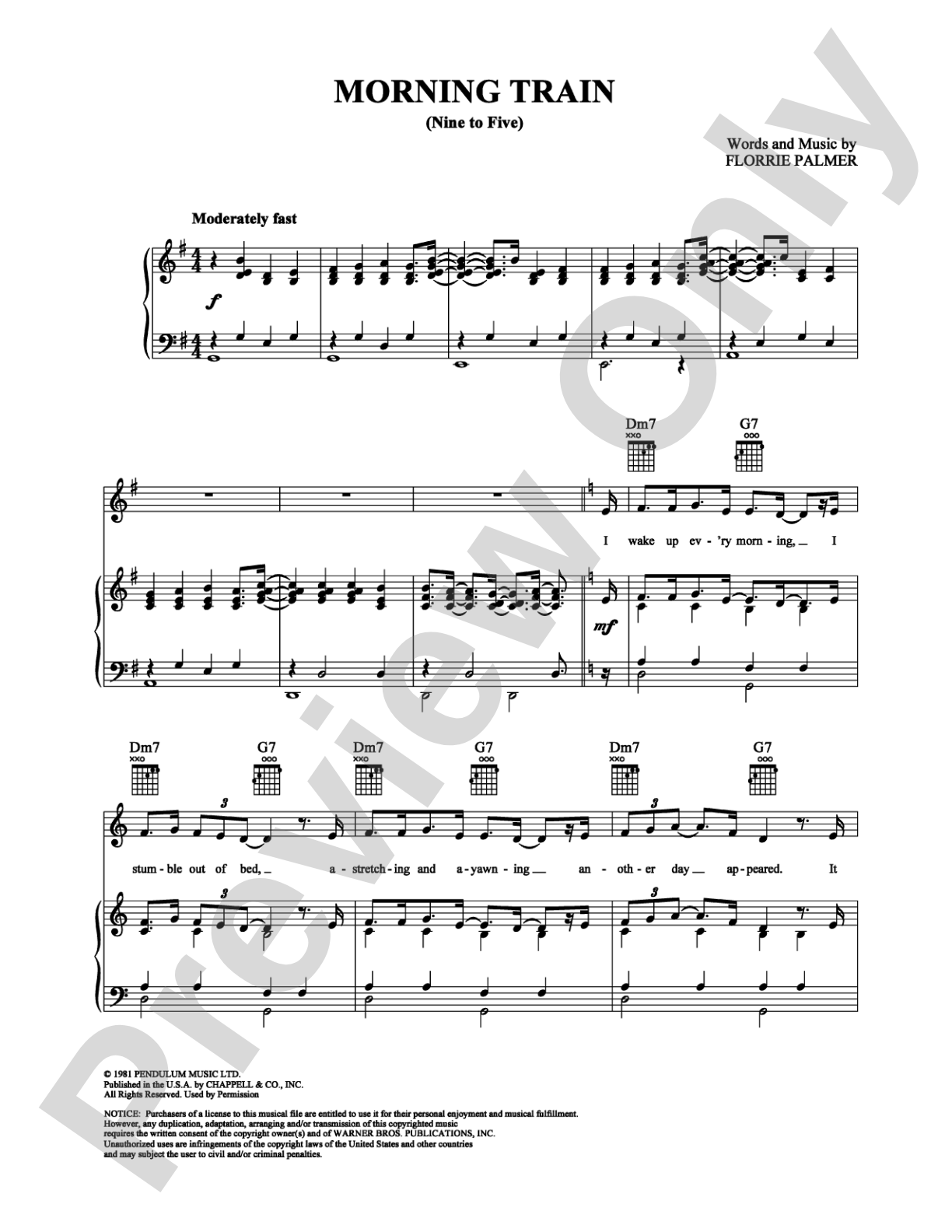
Morning Train (Nine to Five): Piano/Vocal/Chords Digital Sheet Music

Morning Train (Nine to Five): Piano/Vocal/Chords Digital Sheet Music

Sheena Easton, Florrie Palmer

Item: 00-PS-0006273

Digital Download
$3.99
Description

Morning Train (Nine to Five): Piano/Vocal/Chords Digital Sheet Music isn't in MakeMusic Cloud just yet...but it could be. Let us know you'd like to see it, and you'll help shape what comes next. In the meantime, start a free trial and dive into thousands of interactive titles your students can play along with today.

Sample Audio
No sample audio found.
Sample Video
Additional Details
SKU: 00-PS-0006273

More about this title

About the Artist: Sheena Easton

Sheena Easton rose to prominence in the early 1980s as a Scottish pop artist known for her versatility across pop, rock, and R&B styles. Her breakthrough came through television exposure and a string of chart hits that showcased her ability to interpret contemporary material with both polish and emotional authenticity. She became particularly recognized for her work in film soundtracks and her skill as an interpreter of songs written by other songwriters.

Why we love this

This arrangement captures the infectious energy of Easton's signature hit with practical voicings that work equally well in a vocal studio or as a learning tool for singers exploring contemporary pop interpretation. The chord symbols are precise and helpful without oversimplifying the harmonic movement, making it valuable for pianists who want to understand the song's structure beyond the printed melody.

What to expect

The song pulses with forward momentum, balancing workplace humor with an undercurrent of determination. The melody sits comfortably in a conversational range, and the harmonic language stays accessible while maintaining the sophisticated pop-rock production that made the original recording memorable.

Who it's for

This arrangement works for singers preparing audition material, voice students exploring pop and rock repertoire, and pianists accompanying vocalists in studio or informal settings. It's also useful for music theory students studying contemporary harmonic language and rhythm in popular music.

How to get the most out of it

  • Pay attention to the rhythmic pocket in the piano part; the syncopation against the vocal line is what gives the song its propulsive feel, so lock the two parts together rather than letting them drift independently.
  • Shape the vocal line with the natural stress patterns of the lyrics; this song thrives on conversational phrasing rather than operatic diction.
  • Use the chord symbols to experiment with comping variations if you're accompanying a singer; the basic progression is sturdy enough to support different textural approaches depending on the room and ensemble size.

How to use it

Consider this for a pop or contemporary music showcase, or as part of a mixed repertoire recital where a vocalist wants to include recognizable material alongside classical or musical theater pieces. It also serves as an excellent warm-up or practice material for singers working through their audition portfolios.

Skills your students will build

  • Reading and interpreting chord symbols in a pop/rock context
  • Coordinating vocal phrasing with syncopated piano accompaniment
  • Understanding contemporary harmonic progressions
  • Interpreting rhythmic notation in popular music idiom
  • Balancing melodic storytelling with rhythmic precision

You May Also Like