Randall Hartsell grew up in North Carolina with a determined approach to his craft. Unable to access a piano at home initially, he walked to his aunt and uncle's house each day after school for an hour of practice, a discipline that shaped his musicianship. When his parents finally purchased a piano a year later, he was ready. During high school, he began composing pieces inspired by his English literature studies and wrote accompaniments and broadcast music for the school choir. His formal training came later than his passion; composition study waited until his senior year of college at East Carolina University.
After graduating, Hartsell taught in a small town and returned to composing with renewed focus. A pivotal meeting with publisher Lynn Freeman Olson in the early 1980s led to his first major publication, the three-book series Something Special (1990) with Alfred Music. Since then, more than 60 of his collections and solos have been published. Today, Hartsell maintains an active presence in Charlotte, North Carolina, where he teaches, composes, accompanies, adjudicates, and serves as church organist and conductor. His work consistently demonstrates that musical growth comes from both discipline and genuine love for the craft.
Why we love this
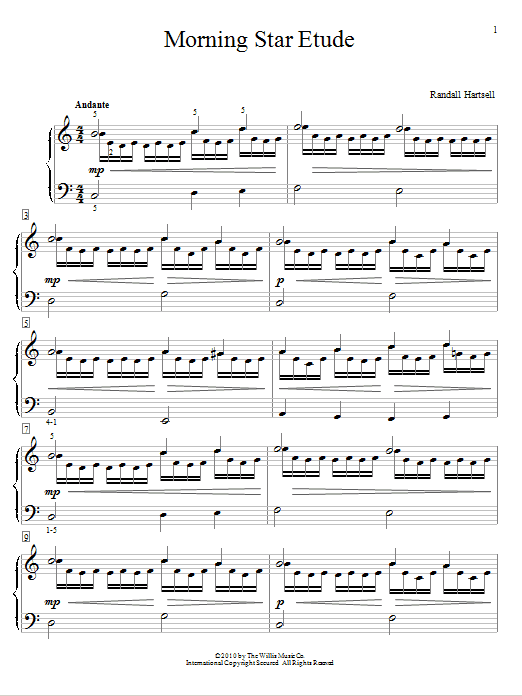
Hartsell's Grade 2 etudes are built on genuine musicality rather than dry technical drill. Students encounter lyrical melodies that reward careful attention to touch and phrasing while tackling the fundamental hand position and finger independence work this level demands. The piece stays engaging precisely because it never asks the student to sacrifice musicality for mechanics.
What to expect
Quiet and reflective, with a gentle warmth that suggests daybreak. The writing sits comfortably under the hands without awkward reaches, allowing students to focus on singing tone and smooth phrase connections rather than navigating the keyboard.
Who it's for
Early elementary pianists building foundational technique and musical expression simultaneously. This etude works especially well for students around two to three years into lessons who have solid hand position but are still developing consistent finger strength and independence.
How to get the most out of it
Shape the opening melody as though you're singing it; let the accompanying hand follow your lead rather than playing mechanically in strict time
Identify the highest note in each phrase and play through to that point as a single musical gesture rather than stopping at measure lines
Practice the hand parts separately until the fingering pattern is secure in your hands, then add the emotional intent back in when you combine them
How to use it
Assign this as a supplementary repertoire piece during the same month or term when technique is emphasizing finger independence and legato playing. It bridges the gap between exercise books and standalone recital pieces, offering students their first experience with a complete musical thought in a modest three-page format.
Skills your students will build
Finger independence within a five-finger hand position
Legato phrasing across hand position shifts
Dynamic control in the middle and upper registers
Sustaining a melodic line while managing accompaniment texture
You May Also Like
Scan to Complete Your Purchase
Use your phone's camera to scan the code below
You'll log in on your phone and the order will be added to your account