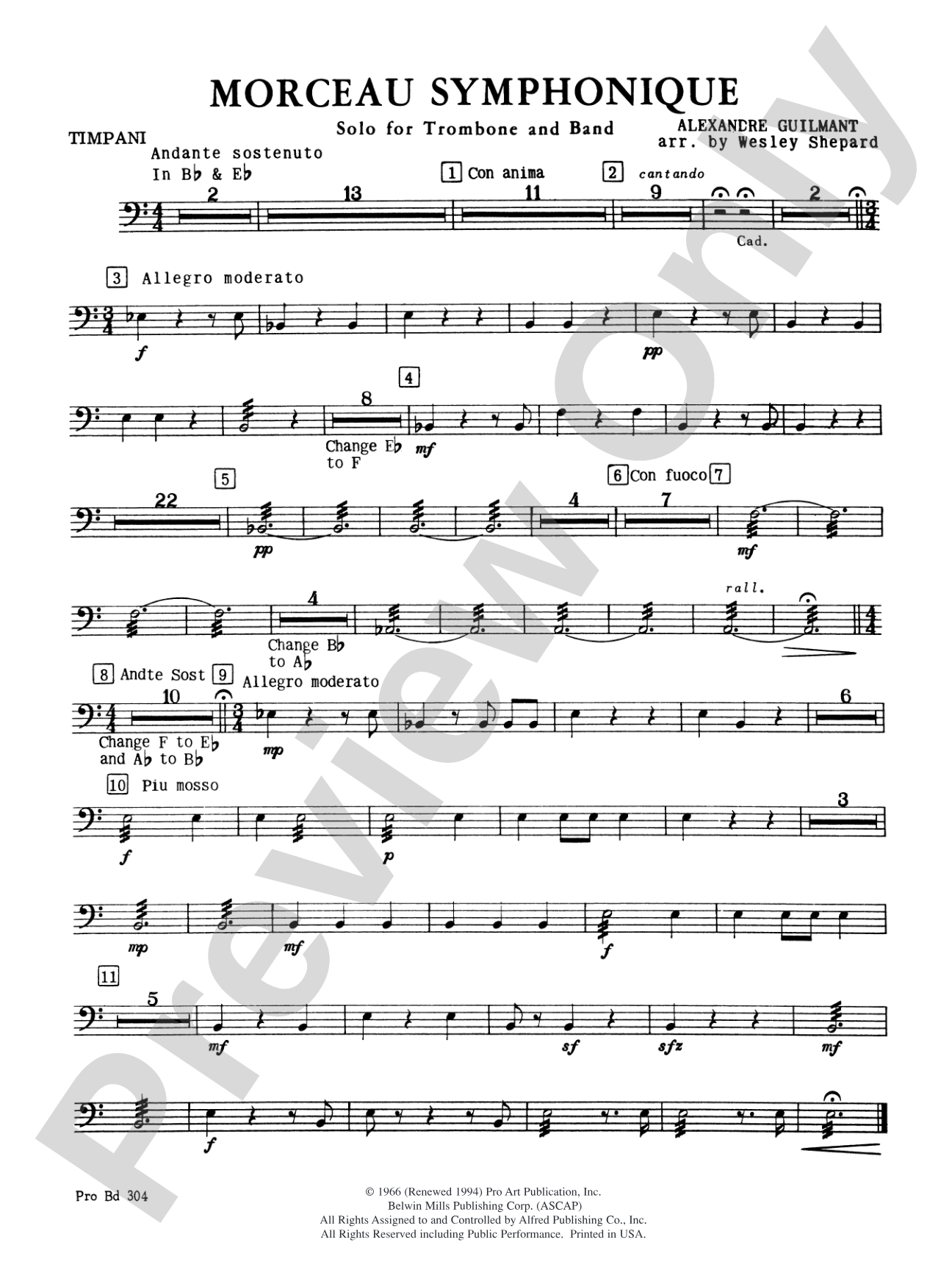
Morceau Symphonique (Trombone Solo and Band): Timpani Sheet Music Preview

Morceau Symphonique (Trombone Solo and Band): Timpani

Trombone Solo Feature

By Alexandre Guilmant / arr. Wesley Shepard

Grade: 3 (Medium Easy)

Item: 00-PC-0002547_TMP

Digital Download
$3.00
Description

Don't just read it, hear it, play along with it, and watch your students grow with it. In MakeMusic Cloud, Morceau Symphonique (Trombone Solo and Band): Timpani comes alive with professional accompaniment, adjustable tempo, and built-in practice tools that turn solo practice into real progress.

Sample Audio
No sample audio found.
Sample Video
Additional Details
Series: Belwin Symphonic Band
Publisher: Alfred Music
Page Count: 176
SKU: 00-PC-0002547_TMP

More about this title

About the Composer: (Felix) Alexandre Guilmant

Alexandre Guilmant (1837-1911) was a French organist and composer whose prolific output bridged the Romantic era and the early twentieth century. A virtuoso at the organ, Guilmant composed extensively for both sacred and secular settings, leaving behind a substantial catalog of works that remain essential to band and wind ensemble repertoires. His compositional voice balances technical brilliance with accessible lyricism, making his work ideal for both concert and educational settings.

Guilmant served as professor of organ at the Paris Conservatory and was deeply invested in advancing French musical pedagogy. His contributions to the wind band literature remain particularly significant; many of his pieces have become staples in concert band programs worldwide and continue to develop musicianship across generations of players.

Why we love this

This is a genuine masterwork that sits squarely in the sweet spot between musical substance and ensemble accessibility. The trombone solo shines without overshadowing the band, and Shephard's arrangement preserves Guilmant's lyrical voice while giving your ensemble a concert piece that sounds far more sophisticated than its Grade 3 designation suggests.

What to expect

Guilmant's writing flows with the graceful, song-like quality characteristic of French Romantic instrumental music. The trombone carries a lyrical melody that feels both noble and intimate, accompanied by harmonic coloring that lends warmth and sophistication to every phrase.

Who it's for

Band directors seeking a vehicle for a strong trombone soloist in a full ensemble setting, particularly those programming a concert that needs musical weight without excessive technical demand. This works equally well for skilled Grade 3 ensembles and strong Grade 2 groups, making it flexible for mixed-ability settings.

How to get the most out of it

  • Balance the trombone soloist with the band so the solo voice projects naturally without the ensemble receding into accompaniment; the relationship should feel collaborative, not hierarchical.
  • Shape the melodic line through subtle dynamic swells rather than obvious crescendos; Romantic-era elegance lives in the curves, not the peaks.
  • Pay attention to the harmonic foundation in the lower voices; a secure low brass section makes the solo line soar.
  • Allow the trombone player adequate space in sustained passages to breathe musically and shape phrases with the kind of legato the piece demands.

How to use it

Program this as a centerpiece in a mixed concert or as the anchor of a "French Romantics" thematic concert pairing. It works as a natural transition between lighter opener and heavier closing numbers, or as a standalone feature that showcases both your trombone section and your band's musicianship in a single, satisfying performance.

Skills your students will build

  • Long-line phrasing and rubato in Romantic-era style
  • Balanced ensemble sonority with solo accompaniment
  • Sustained harmonic support and voice independence
  • Legit trombone solos with idiomatic phrasing
  • Attention to dynamic nuance and color rather than volume extremes

You May Also Like