
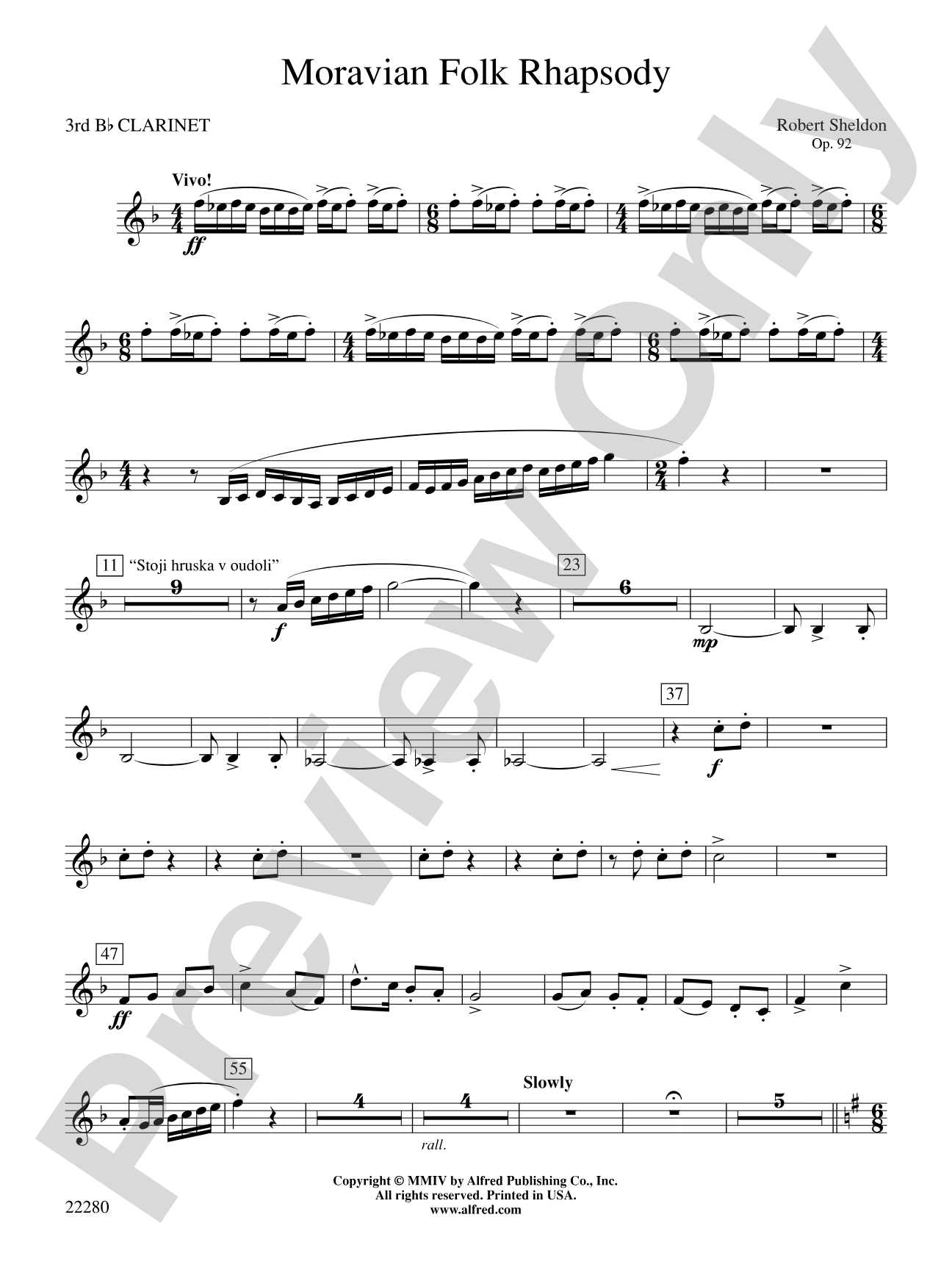

Moravian Folk Rhapsody: 3rd B-flat Clarinet
By Robert Sheldon
Grade: 4 (Medium Difficult)
Item: 00-PC-0000534_C3
$3.00
Pickup currently not available
Description
This work for band is a setting of several delightful Moravian folk dances. "Stoji hruska v oudoli" is a fast-paced two-step dance. "Rozluc se Ancicko" features a clarinet solo in a mournful, yet lilting, slow 6/8 melody. "Preskoda nastokrat" is a highly rhythmic piece in a moderate tempo that features a brief double reed/piccolo section. "Ma zlata maticka" begins with an unaccompanied alto saxophone solo, then includes a folk dance that begins slowly and increases in tempo. "Vojaci jedou" is a proud and uplifting march in 3/4 time. "U Kláštera pole" ends the rhapsody with a lively 2/4 dance that builds to a rousing conclusion. Performers and audiences alike will enjoy the wonderful colors and tonality of this charming music from the Czech Republic. (9:20) This title is available in MakeMusic Cloud.


Don't just read it, hear it, play along with it, and watch your students grow with it. In MakeMusic Cloud, Moravian Folk Rhapsody: 3rd B-flat Clarinet comes alive with professional accompaniment, adjustable tempo, and built-in practice tools that turn solo practice into real progress.
Open in the Player
Jump straight in and assign it today.
Start Your Free Trial
Open this title and explore the full library in minutes.
Sample Audio
1
Audio File
--:--
0:00
0:00
Sample Video
Additional Details
Series:
Alfred Concert Band
Publisher:
Alfred Music
Page Count:
296
SKU:
00-PC-0000534_C3
More about this title
About the Composer: Robert Sheldon

Robert Sheldon stands among the most frequently performed composers in the wind band repertoire. His works appear regularly on state and national contest lists, performed by ensembles ranging from high school bands to professional groups worldwide. He has received significant recognition from the American School Band Directors Association, Phi Beta Mu, and the American Society of Composers, Authors and Publishers, and holds an honorary doctorate from VanderCook College of Music.
Beyond composition, Sheldon serves as lead author of Sound Innovations for Concert Band and maintains an active schedule as guest conductor for All-State and Regional Honor Bands. He has conducted his own works in venues including Carnegie Hall, Orchestra Hall, Boston Symphony Hall, the Sydney Opera House, and the Kennedy Center, and regularly presents clinics at universities and state music education conferences throughout the United States, Japan, Canada, Italy, Germany, Australia, and China.
Why we love this
Sheldon crafts a program that moves from energetic dances through introspective solos to triumphant closure, giving your band substantive contrasts without demanding extreme technical demands. Each movement spotlights different sections (clarinet, saxophone, double reed and piccolo), which keeps rehearsal engagement high across the ensemble. The folk material itself carries authenticity and charm that audiences instantly recognize, making this a concert centerpiece that feels fresh even at Grade 4.
What to expect
This rhapsody captures the character of Moravian life through music that dances, mourns, marches, and celebrates. From the mournful clarinet melody to the rousing final 2/4 dance, the work travels through genuine folk idioms while remaining welcoming to young musicians.
Who it's for
Conductors seeking a Grade 4 work that combines cultural authenticity with accessible writing will find a piece that engages both band and audience. High school bands benefit from the featured solo passages, which reward careful attention to intonation and musical phrasing while keeping section rehearsals focused on realistic goals.
How to get the most out of it
- Balance the alto saxophone solo that opens 'Ma zlata maticka' with soft harmonic support in the lower voices; this moment sets the intimate tone before the dance accelerates.
- In 'Stoji hruska v oudoli,' lock the articulation across the two-step rhythm so the fast tempo reads as one unified pulse rather than scattered eighth notes.
- Shape the tempo shift in 'Ma zlata maticka' deliberately; the increase from slow to fast should feel organic, not abrupt. Have the ensemble feel the new tempo before the acceleration begins.
- Emphasize the 3/4 March character of 'Vojaci jedou' with clear downbeats; resist the temptation to rush, as the pride of the piece depends on its measured dignity.
How to use it
Program this as a concert opener or closer for a concert centered on world music, or use it to anchor a fall festival performance where audiences expect a crowd-pleasing standard. It works equally well as a contest selection, where the variety of tempos and textures commands attention without requiring virtuosity beyond Grade 4 reach.
Skills your students will build
- Executing fast articulation in two-step and dance rhythms
- Balancing solo voice against harmonic accompaniment
- Adjusting intonation in exposed clarinet and saxophone passages
- Reading and performing in mixed meters (2/4, 3/4, and 6/8)
- Shaping tempo transitions within a single movement
- Blending folk idioms with standard concert band sonority