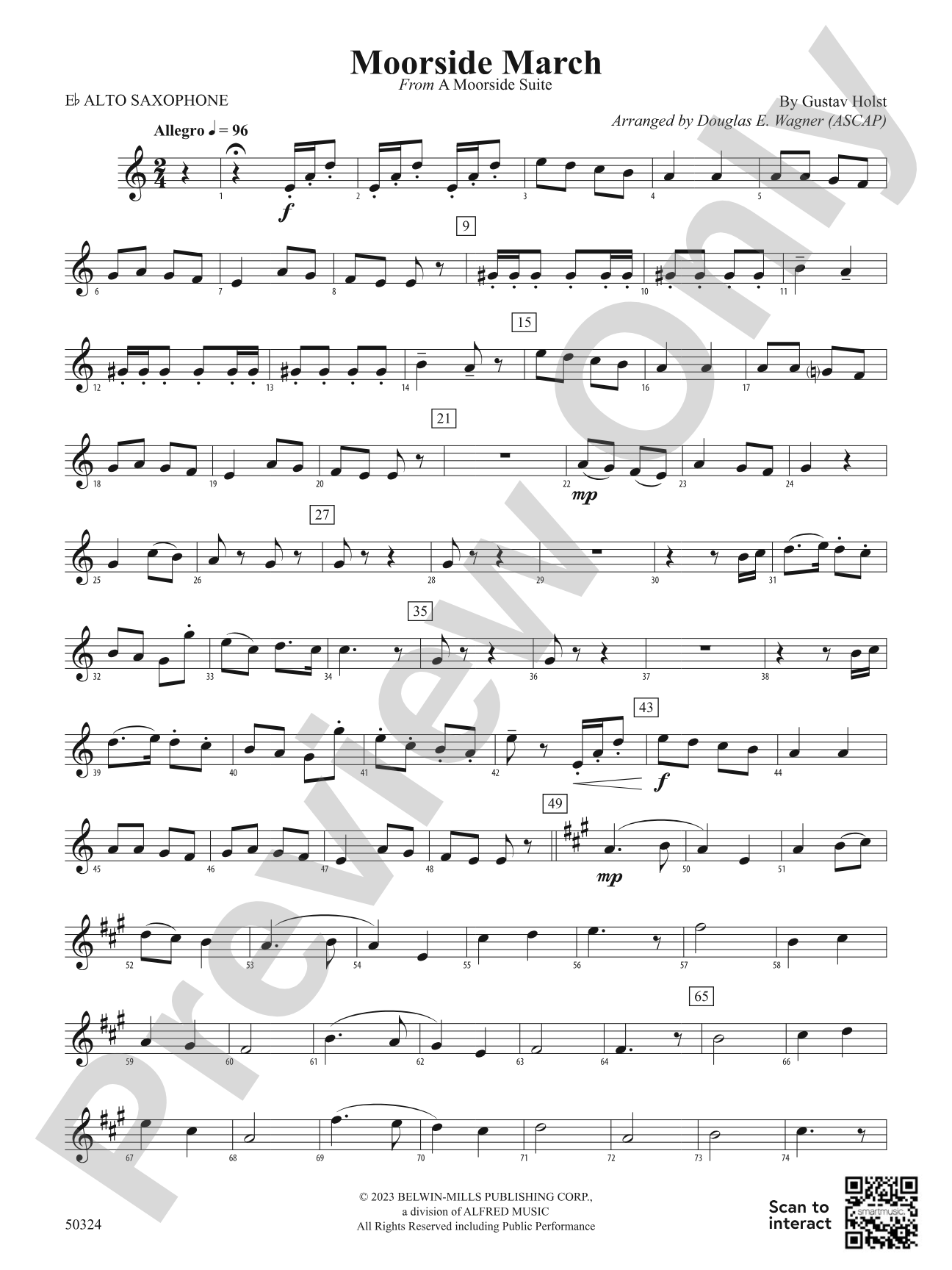
Moorside March: E-flat Alto Saxophone Sheet Music Preview

Moorside March: E-flat Alto Saxophone

From A Moorside Suite

By Gustav Holst / arr. Douglas E. Wagner

Grade: 2

Item: 00-PC-0018991_AX1

Digital Download
$3.00
Description
A Moorside Suite was written in 1928 as a test piece for the National Brass Band Festival championship competition held that year. The three-movement work includes a jaunty "Scherzo," a lovely "Nocturne," and the popular "March," which has enjoyed countless performances since its premiere. Douglas E. Wagner created this arrangement with younger players in mind. Though slightly abridged, the main themes and styles are present in a carefully-crafted performance piece accessible to concert bands at this level. This authentic arrangement still bears Holst's unmistakable musical signature. (3:35)

Don't just read it, hear it, play along with it, and watch your students grow with it. In MakeMusic Cloud, Moorside March: E-flat Alto Saxophone comes alive with professional accompaniment, adjustable tempo, and built-in practice tools that turn solo practice into real progress.

Sample Audio
0:00
0:00
Sample Video
Additional Details
Series: Belwin Young Band
Publisher: Alfred Music
SKU: 00-PC-0018991_AX1

More about this title

About the Composer: Gustav Holst

Gustav Holst (1874-1934) stands as one of Britain's most influential composers, known for blending classical forms with bold orchestration and imaginative harmonic language. His works for band and orchestra remain cornerstones of the repertoire, celebrated for their accessibility and genuine musical depth. Holst taught at St. Paul's Girls' School in London for most of his career, where he composed many of his most enduring pieces for student musicians, believing that music of quality should reach young players.

Why we love this

Wagner's arrangement respects Holst's original voice while meeting your ensemble where it is. Grade 2 players encounter genuine masterwork material, not a watered-down approximation, which builds confidence and musicianship across your section leaders and developing players alike. The march's immediate appeal and proven longevity make this a repertoire choice that satisfies both artistic goals and audience engagement.

What to expect

Bright, purposeful, and celebratory. The march carries the energy of a festive procession, with clear themes that lodge in memory while the harmonic foundation provides harmonic interest beneath the surface. There is elegance in the writing despite its straightforward accessibility.

Who it's for

Concert bands at the Grade 2 level seeking authentic repertoire that challenges without overwhelming. Young musicians ready to engage with recognizable masterwork material and directors building programs that balance accessibility with musical substance.

How to get the most out of it

  • Balance the march's rhythmic drive with clear articulation in the lower voices; the piece moves forward on its harmonic foundation, not just the melody line.
  • Shape the themes with attention to phrase length rather than forcing strict dynamics at every marking; Holst's melodies breathe naturally at four and eight-bar intervals.
  • Let the woodwind doublings carry the primary tune without overshadowing the brass foundation; doubling provides security and color, not independence.
  • Secure the ensemble's rhythmic precision in the busier passages through consistent subdivision; young bands benefit from internal counting awareness before polishing surface tempo.

How to use it

Open a concert with this march to establish momentum and audience goodwill, or close a set with it as a crowd-pleasing finale. Its proven track record makes it especially valuable in festival or contest contexts where judges and audiences alike recognize quality writing at this level.

Skills your students will build

  • Phrasing and shape within predictable harmonic structures
  • Section balance between melody carriers and harmonic support
  • Rhythmic precision in marcato and flowing articulation styles
  • Confidence with standard march form and harmonic progressions
  • Dynamic control across different orchestration densities

You May Also Like