
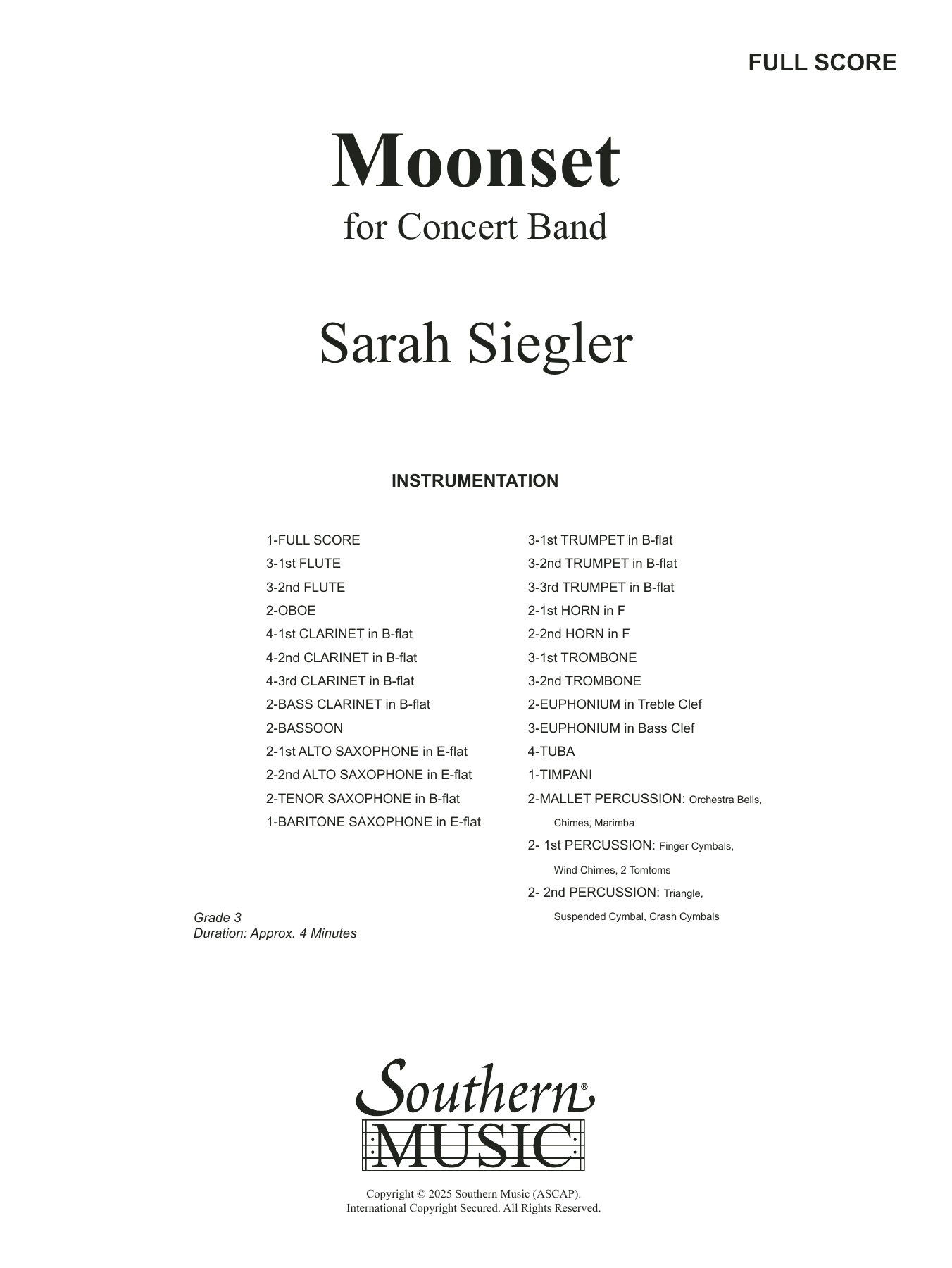

Moonset: Concert Band Conductor Score & Parts
By Sarah Siegler
Grade: 3
Item: 35-PK01726490
$65.00
Pickup currently not available
Buy Extra Parts (Digital PDF Download)
| Product | Price | Quantity |
|---|---|---|
| Moonset - Full Score | $14.00 | |
| Moonset - Flute 1 | $2.50 | |
| Moonset - Flute 2 | $2.50 | |
| Moonset - Oboe | $2.50 | |
| Moonset - Clarinet 1 | $2.50 | |
| Moonset - Clarinet 2 | $2.50 | |
| Moonset - Clarinet 3 | $2.50 | |
| Moonset - Bass Clarinet | $2.50 | |
| Moonset - Bassoon | $2.50 | |
| Moonset - Alto Sax 1 | $2.50 | |
| Moonset - Alto Sax 2 | $2.50 | |
| Moonset - Tenor Saxophone | $2.50 | |
| Moonset - Baritone Saxophone | $2.50 | |
| Moonset - Trumpet 1 | $2.50 | |
| Moonset - Trumpet 2 | $2.50 | |
| Moonset - Trumpet 3 | $2.50 | |
| Moonset - Horn 1 | $2.50 | |
| Moonset - Horn 2 | $2.50 | |
| Moonset - Trombone 1 | $2.50 | |
| Moonset - Trombone 2 | $2.50 | |
| Moonset - Euphonium TC | $2.50 | |
| Moonset - Euphonium BC | $2.50 | |
| Moonset - Tuba | $2.50 | |
| Moonset - Timpani | $2.50 | |
| Moonset - Mallets | $2.50 | |
| Moonset - Percussion 1 | $2.50 | |
| Moonset - Percussion 2 | $2.50 |
Parts Added to Cart!
Description
Evocative and retrospective, MOONSET is a highly original work for concert band. It explores soundscapes in unique manner and serves as an excellent work for contest or festival or just as that "something different" number on your program.


Discover MakeMusic Cloud: thousands of interactive titles your students can play along with today.
Sample Audio
No sample audio found.
Sample Video
Additional Details
Publisher:
Hal Leonard
SKU:
35-PK01726490
More about this title
About the Composer: Sarah Siegler

Sarah Siegler brings twenty years of string orchestra directing experience from Connecticut and Wisconsin to her work as a composer and educator. Her background spans multiple instruments and ensembles, from trumpet in marching band to violin in orchestra to conducting choir, giving her a broad perspective on what engages student musicians across different settings.
Siegler holds degrees from St. Olaf College and VanderCook College of Music Chicago, where she earned her Master of Music Education. She now leads Grand Mesa Strings, an educational music publishing company, channeling her commitment to writing pieces that build student skills while remaining genuinely rewarding to perform.
Why we love this
Moonset stands out precisely because it resists the predictable. Rather than relying on standard melodic storytelling, Siegler constructs an atmospheric work that challenges students to think about color, texture, and mood as primary compositional elements. At Grade 3, this is exactly the kind of piece that expands what young musicians believe concert band music can be.
What to expect
Moonset evokes quiet contemplation and visual imagery, asking the listener to imagine light fading across a landscape. The piece creates space for individual voices to emerge from within a larger harmonic fabric, resulting in an intimate yet ensemble-based sound.
Who it's for
Directors seeking repertoire that sounds mature and original without overwhelming Grade 3 players. This work belongs in programs where you want to showcase your band's musicianship and offer students an experience beyond typical genre expectations.
How to get the most out of it
- Listen closely for the balance between sustained tones and moving lines. The piece's evocative quality depends on allowing the underlying soundscape to breathe without overshadowing the foreground details.
- Attend to the conductor's gestures during passages that shift between sections. Siegler's harmonic movement often moves in unexpected ways, requiring precise ensemble attention to stay locked together.
- Shape phrases by thinking about light and shadow rather than traditional crescendo and diminuendo markings. This interpretive approach helps the band understand why Moonset exists as a soundscape piece.
How to use it
Pair Moonset with works of contrasting energy to demonstrate your band's dynamic range. It serves as an excellent centerpiece for a concert theme exploring mood and atmosphere, or as the opening number that establishes a reflective evening for the audience.
Skills your students will build
- Tone control and sustained playing in a textural context
- Listening for blend and balance within complex harmonic movement
- Interpreting non-traditional musical narratives without explicit melodic structure
- Maintaining ensemble cohesion while individual parts remain independent
- Shaping musical phrases through color and atmosphere rather than obvious arc