
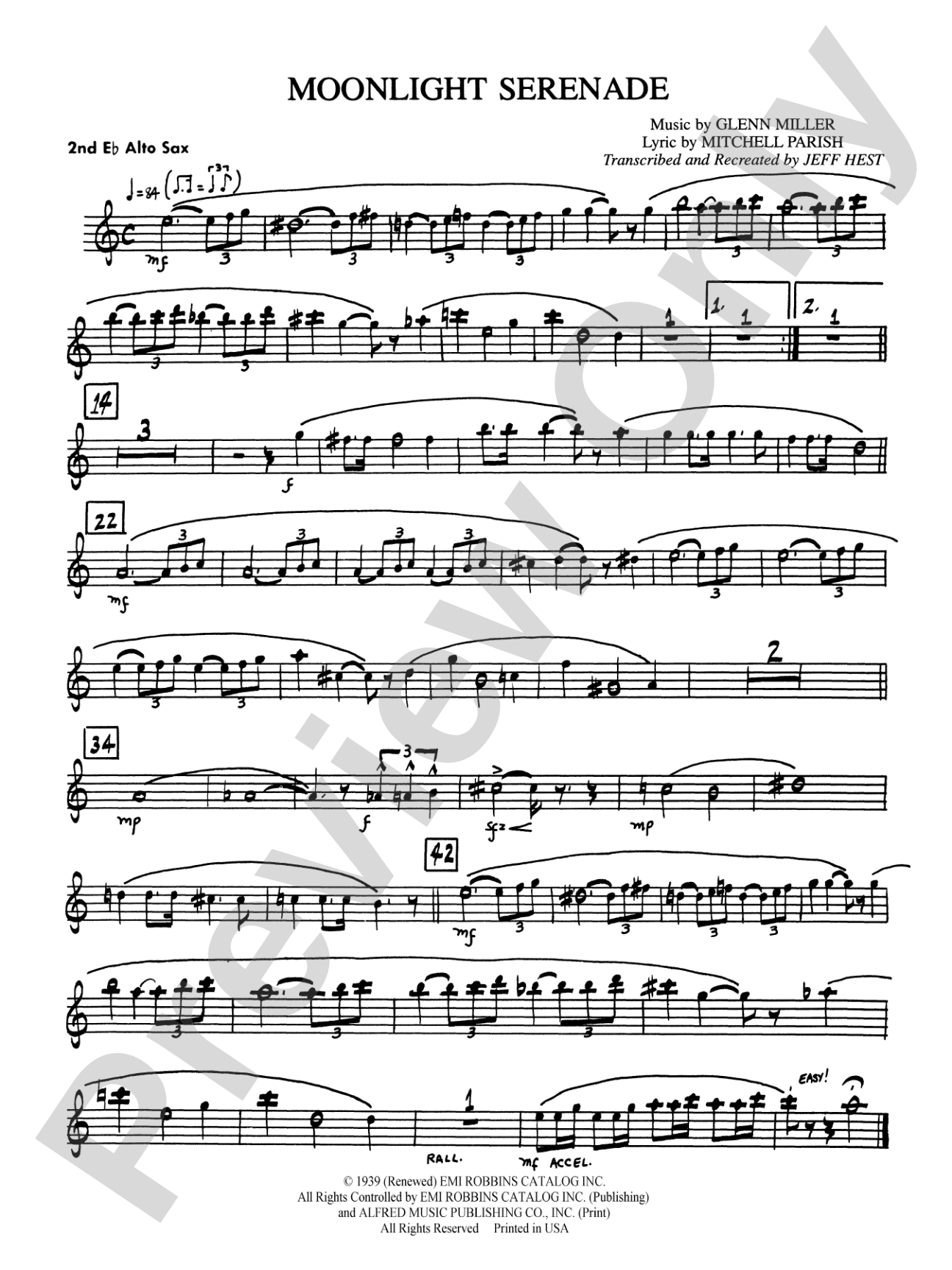

Moonlight Serenade: 2nd E-flat Alto Saxophone
Music by Glenn Miller, lyrics by Mitchell Parish / transcr. Jeff Hest
Grade: 4 (Medium Advanced / Difficult)
Item: 00-PC-0017549_AX2
$5.99
Pickup currently not available
Description
Moonlight Serenade is the Glenn Miller theme tune, and one of the best known big band tunes of all time. This is the original arrangement, transcribed by Jeff Hest, and is a completely faithful reproduction. Saxes are scored for clarinet, 2 altos and 2 tenors. The clarinet solo is fully written out and the arrangement comes with rehearsal/performance notes for the bandleader.


Don't just read it, hear it, play along with it, and watch your students grow with it. In MakeMusic Cloud, Moonlight Serenade: 2nd E-flat Alto Saxophone comes alive with professional accompaniment, adjustable tempo, and built-in practice tools that turn solo practice into real progress.
Open in the Player
Jump straight in and assign it today.
Start Your Free Trial
Open this title and explore the full library in minutes.
Sample Audio
No sample audio found.
Sample Video
No sample videos found.
Additional Details
Series:
Jazz Band Series
Publisher:
Alfred Music
Page Count:
38
SKU:
00-PC-0017549_AX2
More about this title
About the Arranger: Jeff Hest

Jeff Hest has built a career spanning three decades across New York's most demanding musical contexts. His work encompasses hundreds of national advertising campaigns, over 40 album recordings, and original scoring for Broadway productions and feature films. He has collaborated with jazz masters including Urbie Green, Eddie Daniels, and Milt Hinton, gaining the kind of real-world orchestration experience that translates directly into idiomatic writing for jazz ensembles.
Hest's contributions to music education extend beyond the commercial sphere. He currently serves as an assistant professor at the City University of New York, where he teaches music business and technology. The City University of New York recognized his sustained excellence in the field by granting him doctoral equivalency, underscoring his authority both as a creator and as an educator who understands the working musician's craft.
Why we love this
This is the definitive version. Hest's transcription captures Miller's original orchestration with meticulous attention to voicing and phrasing, yet it reads cleanly on the modern jazz ensemble setup. The clarinet solo is fully notated rather than left to improvisation, making this accessible to groups still building soloist confidence while preserving the tune's iconic character.
What to expect
Elegant and nostalgic without ever becoming precious. The melody floats over warm reed harmonies that feel both romantic and grounded, while the rhythm section propels the piece forward with the relaxed swing that defined the Miller sound. This is a tune that sounds like home to jazz audiences and players alike.
Who it's for
Jazz ensembles at the advanced high school or college level who want to tackle one of big band jazz's most recognizable standards with historical accuracy. This score demands solid section discipline, a confident clarinet soloist, and rhythm players who understand the nuances of swing-era phrasing. Conductors seeking a legitimate big band arrangement that neither simplifies nor obscures the original will find exactly what they need.
How to get the most out of it
- The saxophone section should blend the clarinet part into their sound during tutti passages; this isn't a traditional lead solo floating above the band, but an integral melodic voice that needs to sit naturally within the reed section.
- Shape the phrases with the rubato implied by the original big band recordings; Miller's band never played this metronomically, and allowing the rhythm section a touch of flexibility in the head will unlock the lyrical quality that makes this tune endure.
- Pay close attention to the rehearsal and performance notes provided with your parts; they contain bandleader guidance specific to this transcription that addresses intonation concerns and section balance points that commonly trip up ensembles.
How to use it
Pair this with other swing-era standards to build a focused set that showcases your ensemble's command of authentic big band style. It's also an ideal opener or closer for a concert featuring jazz history, as the Miller brand carries immediate recognition and warmth that engages audiences across generations. Consider programming it midway through the year when your sections have gelled and soloists are ready for the spotlight.
Skills your students will build
- Authentic swing articulation and phrasing in a notated context
- Clarinet melody integration within a five-part reed section (clarinet, 2 altos, 2 tenors)
- Recognition of big band voicing conventions and their application to modern ensemble setup
- Attention to historical style through conductor notes and part markings
- Precision ensemble playing at Grade 4 complexity with full sections moving in rhythmic unity