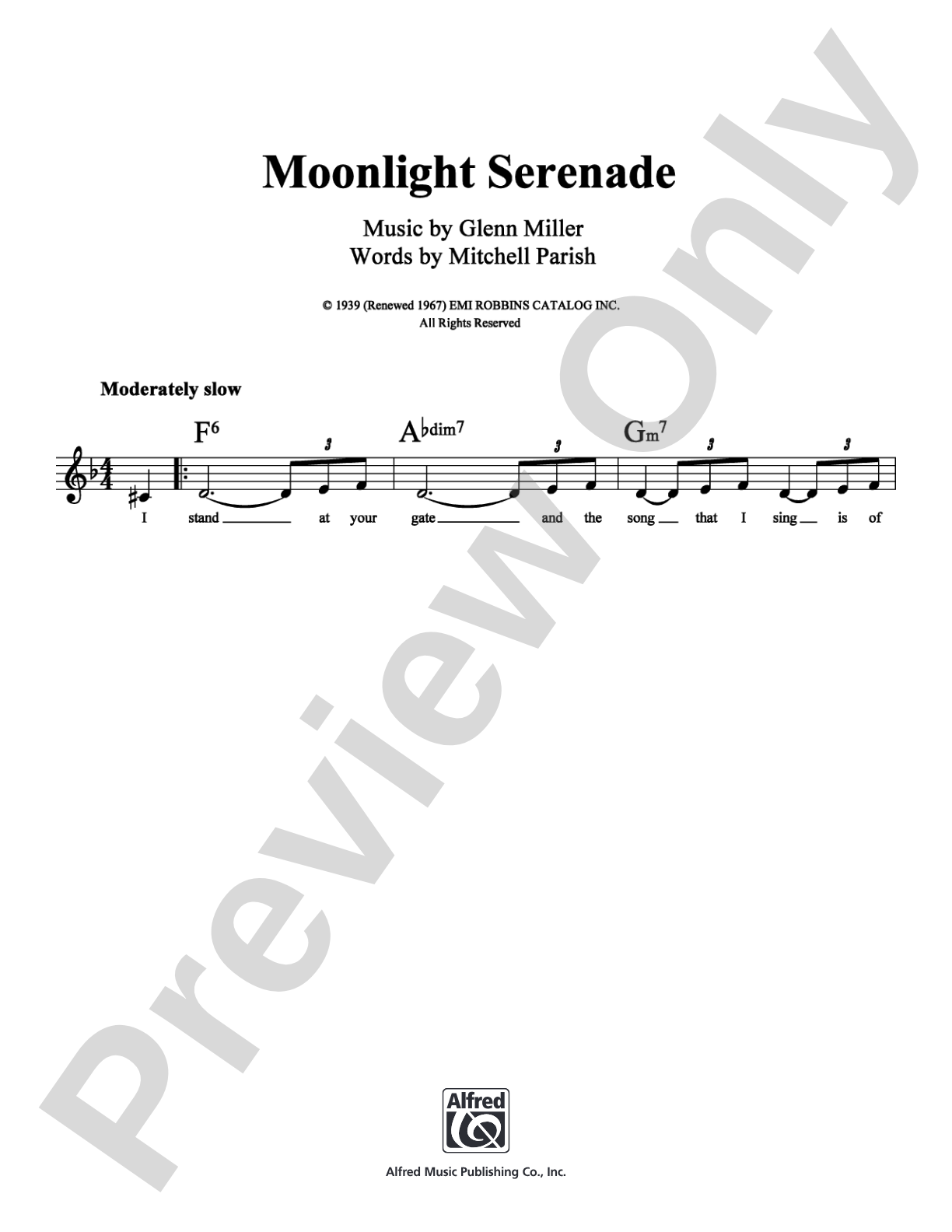
Moonlight Serenade: Lead Sheet Digital Sheet Music

Moonlight Serenade: Lead Sheet Digital Sheet Music

Glenn Miller

Item: 00-PS-0007272

Digital Download
$1.99
Description

Moonlight Serenade: Lead Sheet Digital Sheet Music isn't in MakeMusic Cloud just yet...but it could be. Let us know you'd like to see it, and you'll help shape what comes next. In the meantime, start a free trial and dive into thousands of interactive titles your students can play along with today.

Sample Audio
No sample audio found.
Sample Video
Additional Details
SKU: 00-PS-0007272

More about this title

About the Artist: Glenn Miller

Glenn Miller (1904-1944) led one of the most popular big bands of the swing era, developing a distinctive sound that defined American popular music in the early 1940s. His arranging innovations and disciplined approach to ensemble playing made his orchestra one of the most commercially successful and musically influential groups of the era.

Why we love this

This lead sheet captures one of the most recognizable melodies in American popular music, making it an ideal choice for jazz ensembles working on standard repertoire and solo reharmonization. The straightforward melodic line gives pianists, guitarists, and improvisers room to explore voicings and comping styles while maintaining the song's inherent elegance.

What to expect

Elegant and introspective, with a gentle swing feel that captures the romantic mood suggested by the title. The melody moves with a natural lyricism that feels both intimate and sophisticated.

Who it's for

Jazz students and ensemble musicians learning standard repertoire, pianists and guitarists developing their comping and solo skills, and any jazz program needing accessible material rooted in the American songbook.

How to get the most out of it

  • Pay attention to the phrase shape; the melody has a natural arc that works best when you breathe at the written section breaks rather than rushing through them.
  • Use the harmonic structure as a guide for solo development, building tension through the changes and landing on strong resolution points.
  • If you're comping, keep the voicings spacious in the head to let the melody breathe, then thicken the texture during improvisation.

How to use it

Include this in a standards-focused rehearsal block or showcase afternoon dedicated to classic big band era material. It works well as a small ensemble feature or as a vehicle for student soloists to develop their improvisational language over familiar harmonic territory.

Skills your students will build

  • Reading lead sheet notation and chord symbols
  • Improvisation over jazz standard changes
  • Phrasing and interpretation of swing-era melody
  • Harmonic analysis and reharmonization options
  • Solo comping and accompaniment voicings

You May Also Like