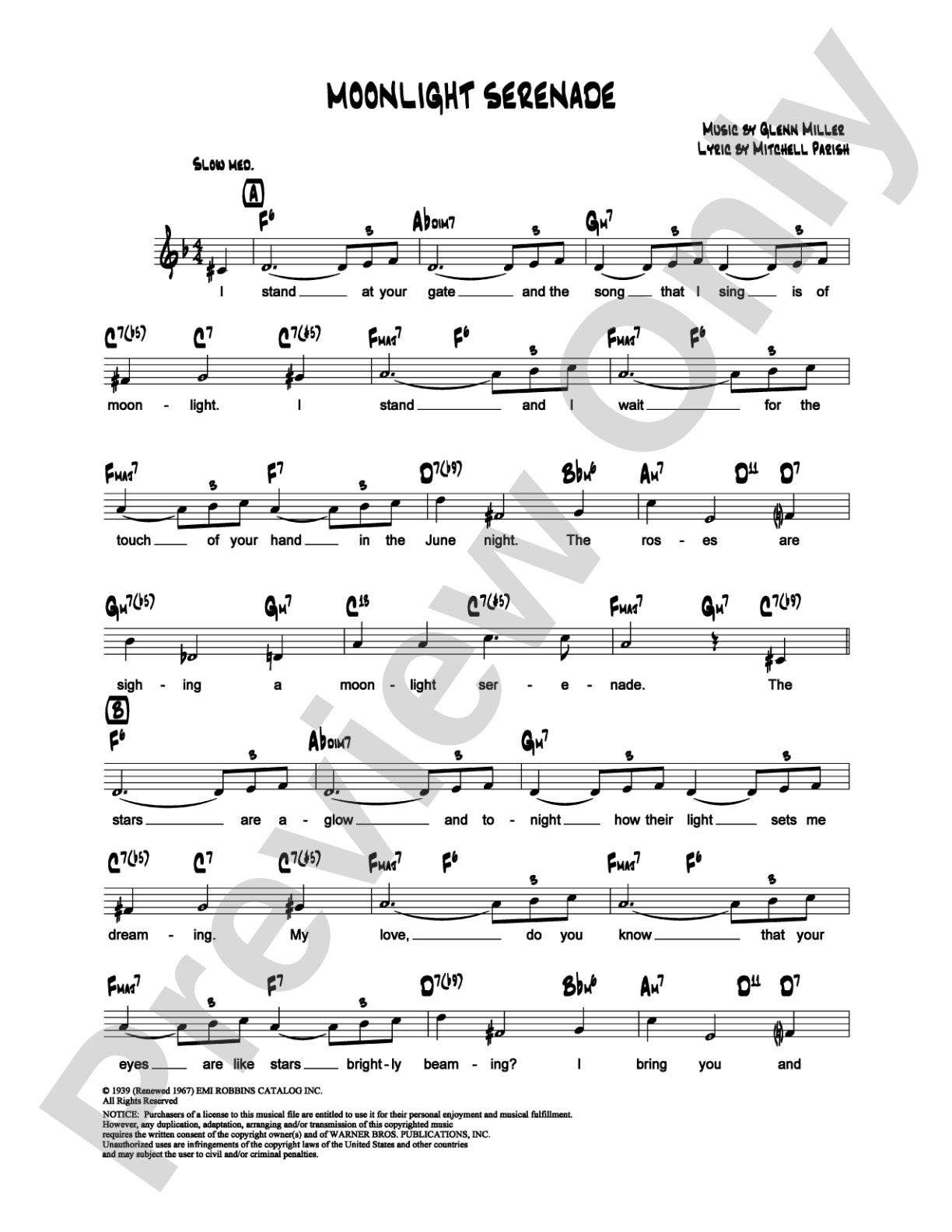
Moonlight Serenade: Lead Sheet Digital Sheet Music

Moonlight Serenade: Lead Sheet Digital Sheet Music

Glenn Miller

Item: 00-PS-0000667

Digital Download
$1.99
Description

Moonlight Serenade: Lead Sheet Digital Sheet Music isn't in MakeMusic Cloud just yet...but it could be. Let us know you'd like to see it, and you'll help shape what comes next. In the meantime, start a free trial and dive into thousands of interactive titles your students can play along with today.

Sample Audio
No sample audio found.
Sample Video
Additional Details
SKU: 00-PS-0000667

More about this title

About the Artist: Glenn Miller

Glenn Miller led the most commercially successful big band of the swing era, and his carefully arranged compositions became the sound of American popular music in the early 1940s. His approach to orchestration, particularly his signature clarinet-over-saxophone voicings, defined a clean, sophisticated aesthetic that influenced generations of jazz arrangers and bandleaders.

Why we love this

Moonlight Serenade remains one of the most instantly recognizable jazz standards, and having it as a lead sheet gives musicians the harmonic and melodic skeleton to explore comping, improvisation, and arrangement in countless directions. The tune's elegant simplicity makes it accessible for students learning to navigate jazz charts, while its harmonic sophistication rewards deeper exploration of chord substitution and reharmonization.

What to expect

Moonlight Serenade floats with a gentle, romantic quality that feels both wistful and warmly nostalgic. The melody sits comfortably in a singing register, unfolding with deliberate phrasing that invites rubato and personal interpretation, creating intimate space within a sophisticated harmonic framework.

Who it's for

Jazz musicians developing their ability to read and interpret lead sheets, from high school jazz band players to college students and working ensemble members. It also serves composers, arrangers, and keyboardists who want to create their own versions or use it as a foundation for new arrangements.

How to get the most out of it

  • Study the original Miller recording to absorb the phrasing and breath points that make the melody so singable, even when playing it on your instrument.
  • Treat the lead sheet as a starting point for your own interpretation rather than a rigid map. Jazz musicians of the swing era constantly varied the melody while keeping its essential shape intact.
  • Balance your tone between lyrical warmth and clarity so the melody cuts through without sounding stiff or overly aggressive.
  • If you're comping behind a soloist, anchor your voicings in the root position during the head before opening up into more colorful chord extensions during improvisation.

How to use it

This works beautifully as a jazz combo feature or as a solo vehicle within a big band concert, particularly paired with other swing-era standards. It's also ideal repertoire for a mixed ensemble demonstrating how a single standard can be interpreted across different instrumentation and arranging approaches.

Skills your students will build

  • Reading and interpreting jazz lead sheets with chord symbols
  • Comping with seventh chords and jazz harmonic language
  • Phrasing and interpretation in the swing idiom
  • Melody embellishment and negotiation around chord changes
  • Reharmonization and chord substitution techniques

You May Also Like