
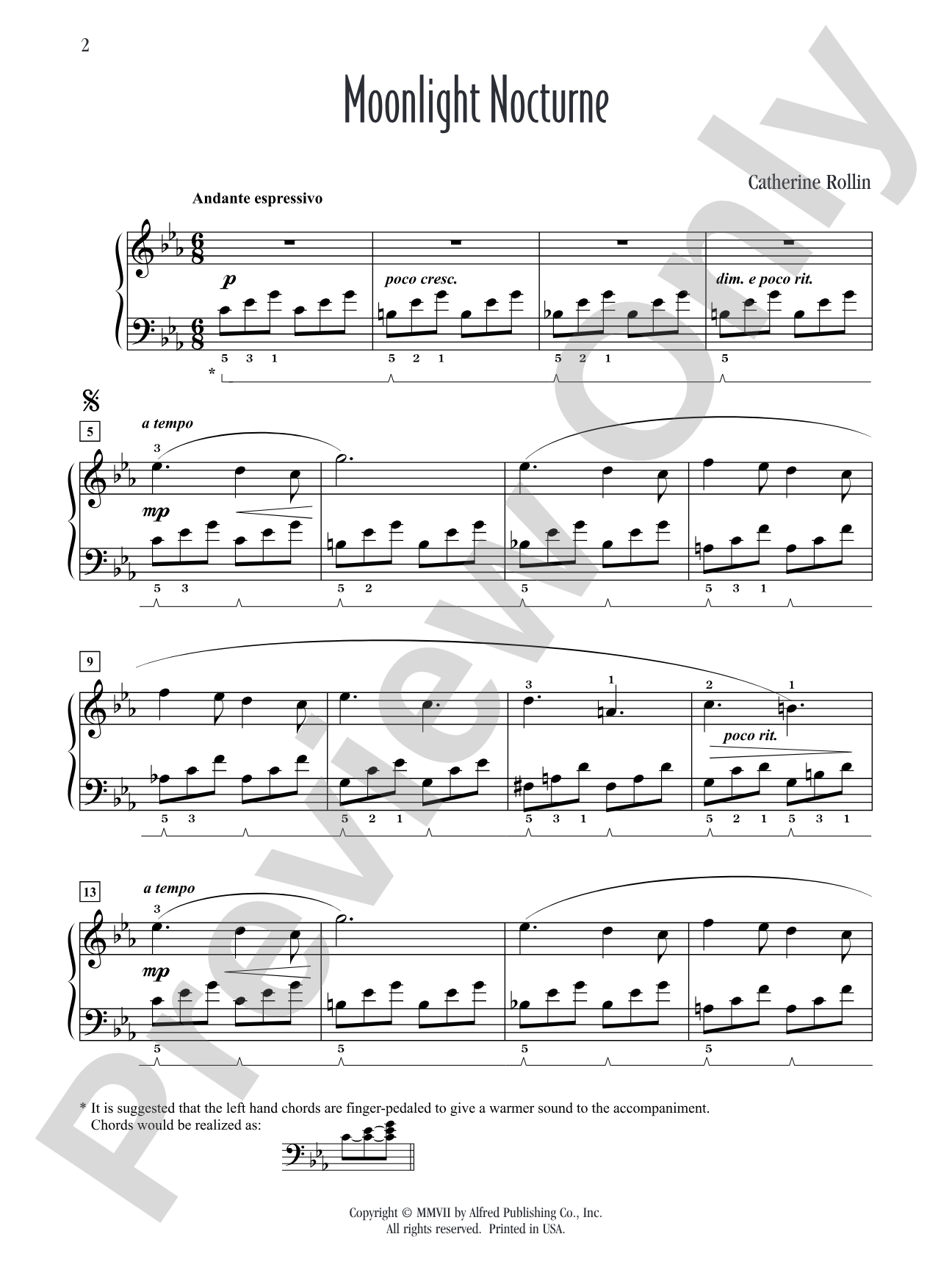

Moonlight Nocturne: Piano
By Catherine Rollin
Level: Intermediate
Item: 00-PS-0017736
$3.50
Pickup currently not available
Related Items
Moonlight Nocturne: Piano Sheet |
$3.50
|
View |
Description
This lyrical solo, written in the key of C minor and in 6/8 meter, provides an excellent opportunity for working on balance and chord analysis. The right hand melody is accompanied by broken chords in the left hand. The descending bass line adds another dimension in voicing the left hand chords.


Moonlight Nocturne: Piano isn't in MakeMusic Cloud just yet...but it could be. Let us know you'd like to see it, and you'll help shape what comes next. In the meantime, start a free trial and dive into thousands of interactive titles your students can play along with today.
Request This Title
Tell us you want it.
Start Your Free Trial
Explore everything that's ready to play right now.
Sample Audio
1
Audio File
--:--
0:00
0:00
Sample Video
No sample videos found.
Additional Details
Series:
Signature Series
Publisher:
Alfred Music
Page Count:
4
SKU:
00-PS-0017736
More about this title
About the Composer: Catherine Rollin

Catherine Rollin balances an active composing career with mentoring students who regularly win competitions and recognition. She has delivered workshops and masterclasses across the United States, Canada, Japan, and Taiwan, sharing her approach to both performance and composition. She earned her Bachelor of Musical Arts with distinction from the University of Michigan and a Master of Music degree from Oakland University School of Performing Arts.
Rollin's commissions span major music education organizations including the Music Teachers National Association (MTNA), the Michigan Music Teachers Association, and Clavier Companion magazine. Her work has been selected for the National Federation of Music Clubs Festivals Bulletin and she has judged at the national level for the MTNA Student Composition Competition and the Lynn Freeman Olson Composition Contest. Her ASCAP award-winning Museum Masterpieces series and the MTNA-commissioned trio Suite Detroit (which premiered at the 2018 MTNA national conference) demonstrate her sustained contributions to contemporary repertoire.
Why we love this
Rollin writes with genuine understanding of what intermediate pianists can accomplish. The combination of a singing right-hand melody with thoughtfully voiced left-hand broken chords creates a piece that sounds elegant without requiring advanced technique, and the descending bass line gives students real harmonic architecture to explore rather than simple accompaniment patterns.
What to expect
Moonlit and introspective, with a gentle rocking motion created by the 6/8 meter and broken chords. The descending bass line pulls the piece forward with quiet inevitability, while the melody floats above like a song remembered rather than performed.
Who it's for
Intermediate pianists ready to develop voicing awareness and interpretive independence. This piece rewards students who are comfortable with broken chord patterns and ready to shape a lyrical line with intention rather than play by habit.
How to get the most out of it
- Listen to how the broken chords in the left hand support the melody's phrasing; each gesture should breathe as a unit rather than mechanically repeating the same pattern.
- Work on balance by playing the melody and bass line at full voice while keeping the inner chord tones recessed; this creates depth and prevents the left hand from overwhelming the line.
- Map out the harmonic rhythm before focusing on tempo; understanding where chords change and resolve will anchor your interpretation.
- Experiment with subtle rubato in the right hand while maintaining a steady pulse in the left, allowing the nocturne character to unfold naturally.
How to use it
Works beautifully as a recital opening that establishes a reflective mood, or as a contrasting nocturne paired with more energetic Romantic-era pieces. Its four-page length makes it ideal for student recitals and competitions where pianists need a substantial but focused piece.
Skills your students will build
- Voicing broken chords with clear hierarchy between melody, bass line, and inner chord tones
- Balance and pedaling in accompaniment patterns that support rather than overshadow the melody
- Harmonic analysis of chord progressions and functional bass movement in C minor
- Phrasing and rubato in the context of a lyrical 6/8 meter
- Interpreting nocturne character through touch and tempo flexibility