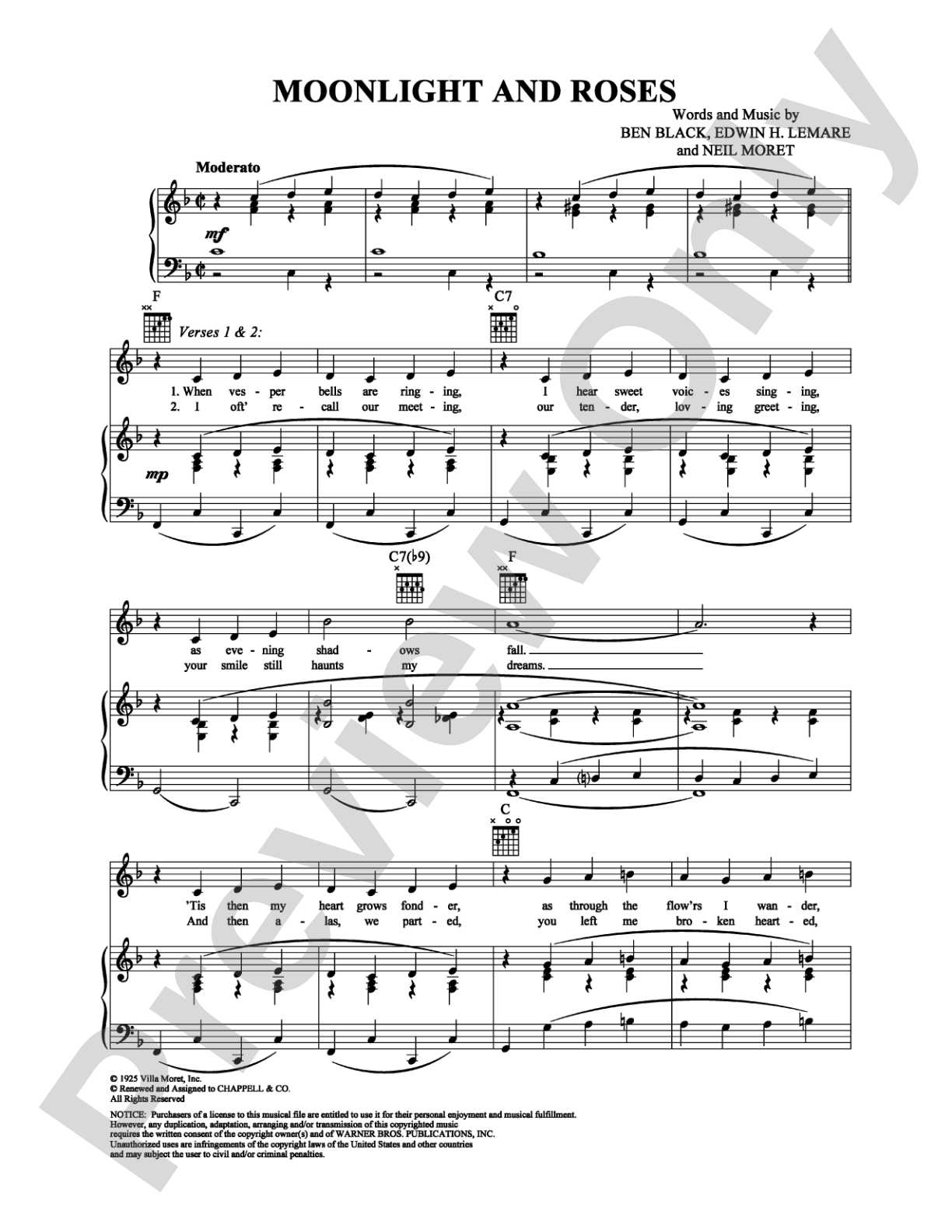
Moonlight and Roses: Piano/Vocal/Chords Digital Sheet Music

Moonlight and Roses: Piano/Vocal/Chords Digital Sheet Music

Edwin H. Lemare, Neil Moret, John McCormack, Ben Black

Item: 00-PS-0001022

Digital Download
$3.99
Description

Moonlight and Roses: Piano/Vocal/Chords Digital Sheet Music isn't in MakeMusic Cloud just yet...but it could be. Let us know you'd like to see it, and you'll help shape what comes next. In the meantime, start a free trial and dive into thousands of interactive titles your students can play along with today.

Sample Audio
No sample audio found.
Sample Video
Additional Details
SKU: 00-PS-0001022

More about this title

About the Artist: John McCormack

John McCormack (1884, 1945) was an Irish tenor whose crystalline voice and interpretive sensitivity made him one of the most recorded singers of the early 20th century. He built his reputation across opera, lieder, and popular song, bringing equal artistry to each genre and influencing generations of vocalists through his meticulous phrasing and emotional restraint.

Why we love this

This standard sits perfectly in the jazz vocal repertoire for singers building their interpretation skills. The piano/vocal/chords format gives pianists the harmonic architecture they need while vocalists work through the phrasing and emotional nuance that made McCormack's recordings timeless.

What to expect

Warm, nostalgic, and intimate. The song evokes a quieter moment of reflection with gentle romanticism, allowing singers to explore sustaining tone and pianists to discover how restraint and space can carry more weight than activity.

Who it's for

Vocalists studying jazz standards and singers expanding into American popular song repertoire will find this accessible entry point into McCormack's material. Pianists learning to accompany singers in this idiom benefit from seeing the full harmonic context and learning how to support a vocalist's interpretive choices.

How to get the most out of it

  • Let the piano set the harmonic language early. Pianists should voice the chords expressively rather than playing block triads; the rich substitutions in jazz standards reward voicing choices that sit comfortably under the vocal line.
  • Shape the melody through rubato and breath placement. Singers need room to land on emotional peaks and ease into turnarounds without rushing; this kind of control develops stronger legit technique overall.
  • Study the relationship between lyric and melody. Where does the text naturally support a held note or a subtle push? These decisions separate singers who interpret from singers who simply read.

How to use it

Include this in a recital exploring American standards or create a concert pairing classical song repertoire with early 20th-century popular vocal literature. It works equally well as a teaching piece for understanding how jazz standards developed from earlier vocal traditions.

Skills your students will build

  • Jazz chord voicing and harmonic substitution
  • Vocal phrasing and breath control in sustained melodic lines
  • Piano/voice balance and listening to the singer while accompanying
  • Interpretation of standard form (AABA or similar) through textual and musical emphasis
  • Sight-reading from leadsheet notation (chords plus melody)

You May Also Like