Moonbeam Waltz Sheet Music Preview

Moonbeam Waltz: Piano

By Martha Mier

Level: Elementary

Item: 00-PS-0017741

Digital Download
$3.50
Description
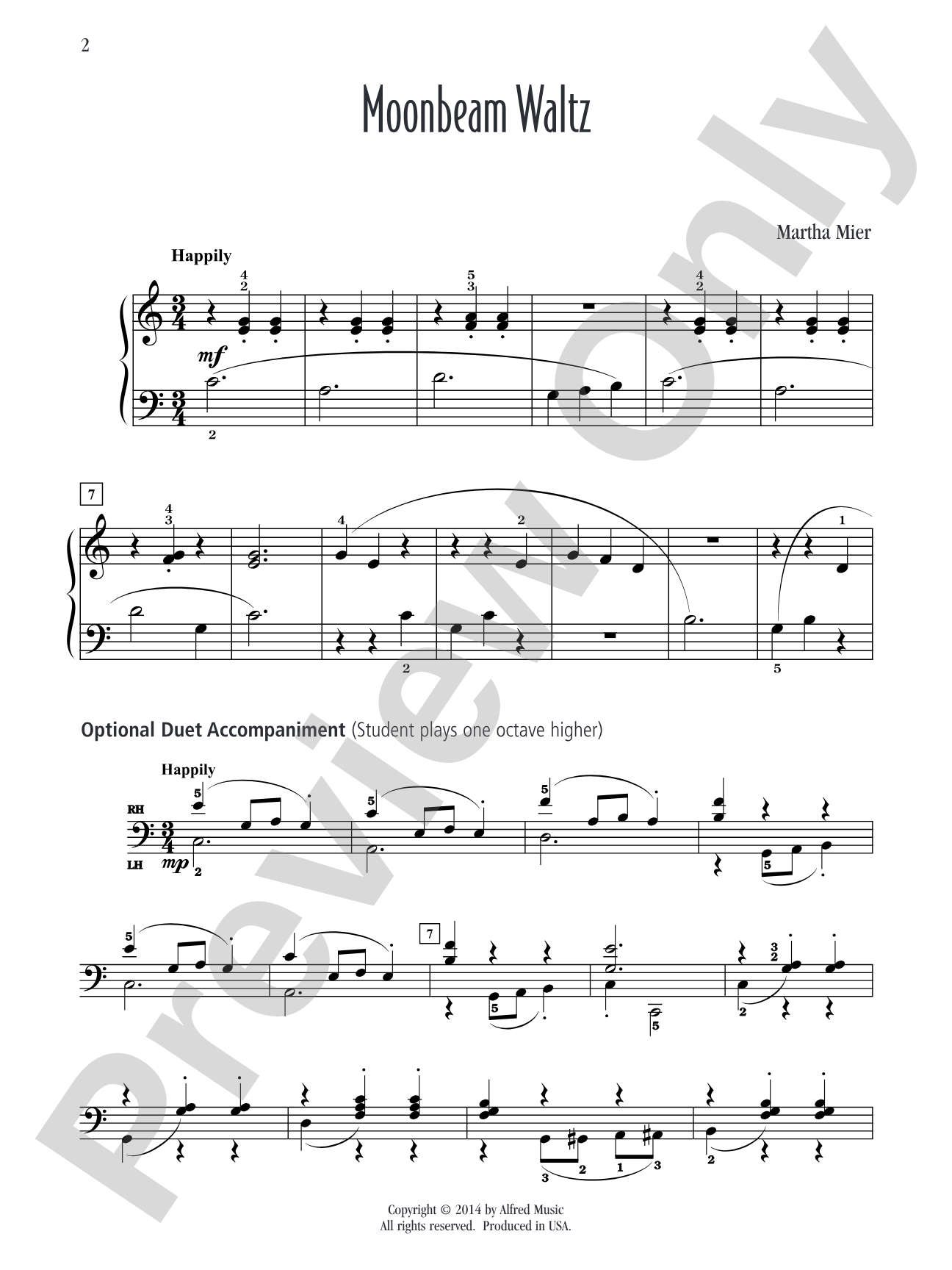
Left-hand dotted half notes with right-hand staccato intervals on beats two and three give this elementary piece in 3/4 meter a definite waltz feel. The melody is divided between the hands. Long melodic lines, comprised of skips and steps, give students opportunities to practice shaping phrases. An optional duet accompaniment provides harmonic variety and interest. A Federation Festivals 2016-2020 selection.

Moonbeam Waltz: Piano isn't in MakeMusic Cloud just yet...but it could be. Let us know you'd like to see it, and you'll help shape what comes next. In the meantime, start a free trial and dive into thousands of interactive titles your students can play along with today.

Sample Audio
No sample audio found.
Sample Video
Additional Details
Series: Signature Series
Publisher: Alfred Music
Page Count: 4
SKU: 00-PS-0017741

More about this title

About the Composer: Martha Mier

Martha Mier

Martha Mier has been composing educational piano music since joining Alfred Music Publishing in 1989, and her output has made her one of the most frequently taught composers in American piano studios. She holds national certification as a piano teacher through the Music Teachers National Association, the Florida State Music Teachers Association, and the National Guild of Piano Teachers, and has presented pedagogy workshops across the United States and internationally in Australia and New Zealand.

Mier's catalogue includes over 200 published works, among them the widely performed Jazz, Rags & Blues series and Romantic Impressions series. She holds a degree from Florida State University and maintained a private piano studio in Lake City, Florida while serving as a professional accompanist and church musician. Many of her compositions have been selected for the National Federation of Music Clubs Junior Festival Bulletin, and she is a co-author of Alfred's Premier Piano Course.

Why we love this

Mier understands exactly what elementary pianists need to build independence between the hands without overwhelming them. The rhythmic framework of the waltz feels fresh because the accompaniment lives in the left hand while the right hand gets the expressive work, and the optional duet part means you can deepen the harmonic color without asking the soloist to do more.

What to expect

Graceful and light, with the steady pulse of a waltz underpinning moments of gentle lyricism. The staccato intervals sparkle on beats two and three, while the melody floats across the keyboard in skips and steps that feel natural under the fingers.

Who it's for

Elementary pianists ready to coordinate independent rhythmic patterns between their hands while working with longer musical phrases. Students benefit from the clear waltz structure and the opportunity to shape melody across both hands, building confidence in their ability to manage multiple layers.

How to get the most out of it

  • Shape the longer melodic lines by thinking in two or four-bar phrases rather than note-to-note, especially where the melody travels between your hands. Plan your dynamic arc before you start.
  • Prepare the staccato intervals in the right hand by isolating just those beats, feeling the pulse of the waltz underneath them so they land cleanly without disrupting the meter.
  • Find the tempo where the dotted half notes in the left hand sit comfortably and allow the right hand's staccatos to feel light and articulate. Too fast and the waltz feel collapses.
  • If performing with the optional duet, let the accompaniment settle into place first during rehearsals so you can hear how the harmonic support affects your phrasing and balance.

How to use it

Program this for early spring recitals or festival performances where you want an accessible piece that sounds polished and musical. The optional duet accompaniment makes it a strong candidate for student-faculty recitals or ensemble celebrations where you want a solo to shine while building community.

Skills your students will build

  • Coordinating independent rhythmic patterns between left and right hands (dotted half notes against staccato eighths or quarters)
  • Reading and shaping longer melodic lines that span both hands
  • Playing staccato articulation with precision while maintaining a steady underlying pulse
  • Recognizing and performing the characteristic rhythm of 3/4 waltz meter
  • Understanding harmonic context through optional duet accompaniment

You May Also Like