
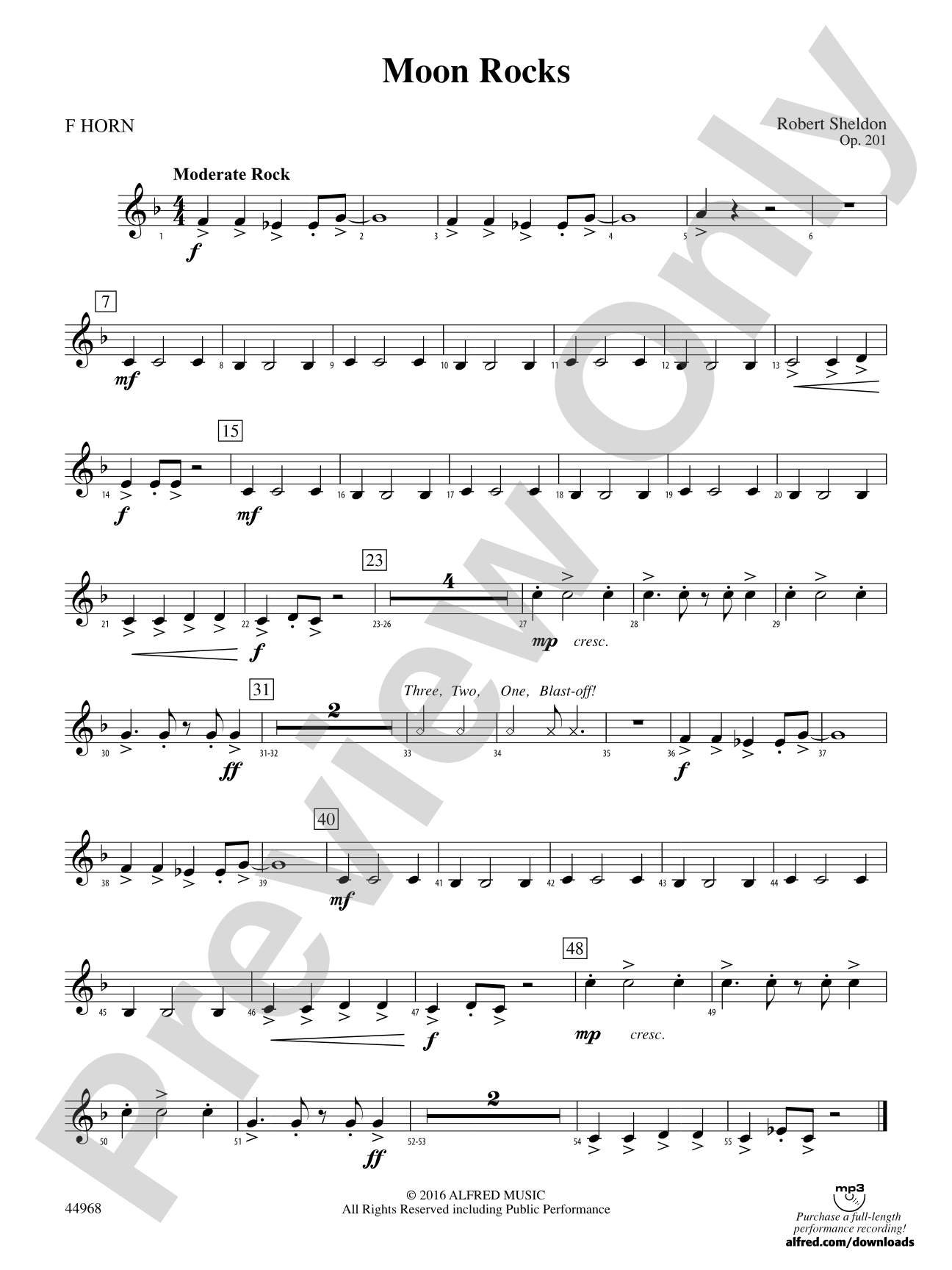

Moon Rocks: 1st F Horn
By Robert Sheldon
Grade: 1 (Very Easy)
Item: 00-PC-0017433_H1
$3.00
Pickup currently not available
Description
Three---Two---One---BLAST OFF! Rock the moon with your band on their next performance. The percussion section is featured, and even helps to provide a "lift-off" for the moon launch. Great fun for everyone, this novelty-rock piece has a tune your audience will be singing long after the concert. With one-part writing for clarinet, alto saxophone, and trumpet, and clarinets staying under the break, this is easily playable in the first year of instruction. (1:50)


Don't just read it, hear it, play along with it, and watch your students grow with it. In MakeMusic Cloud, Moon Rocks: 1st F Horn comes alive with professional accompaniment, adjustable tempo, and built-in practice tools that turn solo practice into real progress.
Open in the Player
Jump straight in and assign it today.
Start Your Free Trial
Open this title and explore the full library in minutes.
Sample Audio
1
Audio File
--:--
0:00
0:00
Sample Video
Additional Details
Series:
Sound Innovations for Concert Band
Publisher:
Alfred Music
Page Count:
134
SKU:
00-PC-0017433_H1
More about this title
About the Composer: Robert Sheldon

Robert Sheldon stands among the most frequently programmed composers in wind band literature today. His works appear on contest lists and concert stages internationally, and he receives commissions regularly for new compositions. Sheldon served as lead author of Sound Innovations for Concert Band and has earned recognition from the American School Band Director's Association, Phi Beta Mu, and ASCAP.
Beyond composing, Sheldon maintains an active schedule as guest conductor for All-State and Regional Honor Bands, clinician, and presenter at universities and state music education conferences. He has led performances at Carnegie Hall, Orchestra Hall, Boston's Symphony Hall, the Sydney Opera House, and the Kennedy Center. In 2020, VanderCook College of Music awarded him an honorary doctorate.
Why we love this
Sheldon delivers real novelty writing here without sacrificing musicality or ensemble balance. The percussion section genuinely drives the narrative instead of serving merely as accompaniment, giving drummers an active role in storytelling and making their contribution visible to the audience. Opening a concert with this energizes your band and reminds everyone why ensemble playing matters.
What to expect
Countdown energy meets rock groove. The launch sequence bristles with anticipation before settling into an infectiously catchy main theme that sticks with listeners long after the final chord. Fun without being frivolous, this piece carries genuine musical personality.
Who it's for
First-year bands ready to tackle something beyond march fundamentals. Clarinets staying under the break and one-part doubling makes this accessible, but the rock idiom and percussion writing demand ensemble musicianship, not just individual competence. This works beautifully as an early-season program piece or end-of-unit celebration.
How to get the most out of it
- Let the percussion section take ownership of the lift-off sequence. Clear communication between conductor and timpani/bass drum creates the dramatic tension that launches the piece.
- Lock the eighth-note pulse in the rock section. Even at a relaxed tempo, rhythmic precision here is what makes the groove feel intentional rather than loose.
- Keep the melodic line on clarinet, alto saxophone, and trumpet singing and connected. Sheldon's one-part writing lends itself to phrasing, not mechanical note reading.
- Push the audience reaction. The tunefulness is the whole point. Hold phrases long enough for the melody to land in listeners' ears, so they actually leave humming it.
How to use it
Open a fall concert to establish an energetic tone and signal that concert band can be joyful. Pair it with a march or lyrical piece to showcase range. At 1:50, it also fits neatly into pep assemblies or informal performance settings where you want maximum impact in minimal time.
Skills your students will build
- Playing with rock/contemporary style articulation and phrasing
- Rhythmic accuracy in syncopated, groove-based figures
- Ensemble balance with simplified one-part doubling
- Percussion integration into melodic storytelling
- Sustaining musical energy through dynamic contrast