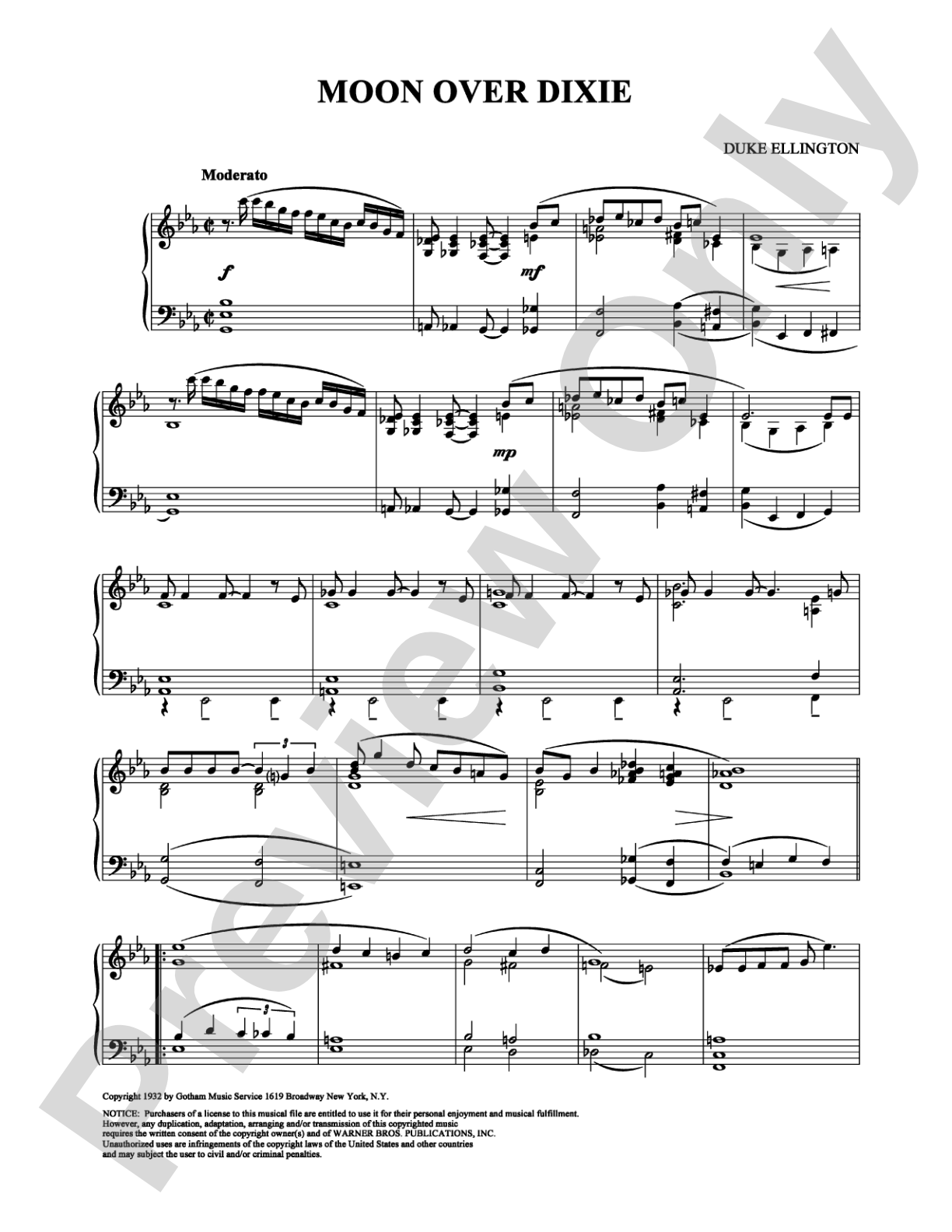
Moon Over Dixie: Piano Digital Sheet Music

Moon Over Dixie: Piano Digital Sheet Music

Duke Ellington

Item: 00-PS-0008203

Digital Download
$3.99
Description

Moon Over Dixie: Piano Digital Sheet Music isn't in MakeMusic Cloud just yet...but it could be. Let us know you'd like to see it, and you'll help shape what comes next. In the meantime, start a free trial and dive into thousands of interactive titles your students can play along with today.

Sample Audio
No sample audio found.
Sample Video
Additional Details
SKU: 00-PS-0008203

More about this title

About the Artist: Duke Ellington

Duke Ellington (1899-1974) remains one of the most significant composers in American music history. His output spanned nearly five decades and encompassed not just jazz standards but extended works, film scores, and sacred music that elevated jazz composition to the concert hall. Ellington's harmonic sophistication and orchestral sensibility fundamentally shaped how twentieth-century composers approached both jazz and classical music.

As a bandleader, pianist, and prolific composer, Ellington created a body of work that continues to define the jazz canon. His pieces are studied in music theory classes for their chromatic voice leading and sophisticated chord substitutions, yet they remain deeply playable and rewarding for musicians of all levels. For piano students, his compositions offer a direct path into understanding jazz harmony and swing feel.

Why we love this

Ellington's writing for solo piano balances accessibility with genuine musical depth. This piece shows his gift for melody and harmonic color without requiring advanced virtuosity, making it ideal for students ready to explore jazz standards seriously while still building their improvisational vocabulary.

What to expect

Sophisticated yet unhurried. Moon Over Dixie carries the reflective quality of a quiet moment in a smoky room, with elegant harmonic movement beneath a lyrical melodic line. The piece invites intimate expression rather than flashy display, rewarding careful listening and intentional phrasing.

Who it's for

Jazz pianists developing their understanding of standards and harmonic language. Advanced intermediate to early advanced students ready to move beyond lead sheets into fully notated piano arrangements. Teachers seeking authentic Ellington material that stretches students without overwhelming them.

How to get the most out of it

  • Listen carefully to recordings of Ellington himself at the piano; his touch and phrasing reveal how much space and breath he left in the music. Don't rush the accompaniment figures.
  • Experiment with swing rhythms in the accompaniment. Straight eighth notes will feel stiff; let them breathe with a light triplet feel that matches the melody's character.
  • Pay attention to Ellington's chord voicings in the left hand. They often move in close, chromatic ways that create rich color; voice them smoothly rather than jumping around the keyboard.
  • Shape the melody with dynamic contrast. Ellington's melodies are often deceptively simple on the page but require careful attention to phrasing and accent to sing properly.

How to use it

Feature this in a jazz or American standards recital where you want to showcase compositional depth alongside performance skill. It pairs well with other Ellington material or with other jazz piano classics from the 1930s-1940s era. Use it as a bridge between classical piano training and jazz exploration for students hesitant about improvisation.

Skills your students will build

  • Jazz harmonic analysis (extended chords, chromatic voice leading, substitutions)
  • Swing feel and rhythmic independence between hands
  • Melodic phrasing and rubato in jazz context
  • Interpreting Ellington's idiomatic piano voicings
  • Connecting written arrangements to recorded versions for stylistic guidance

You May Also Like