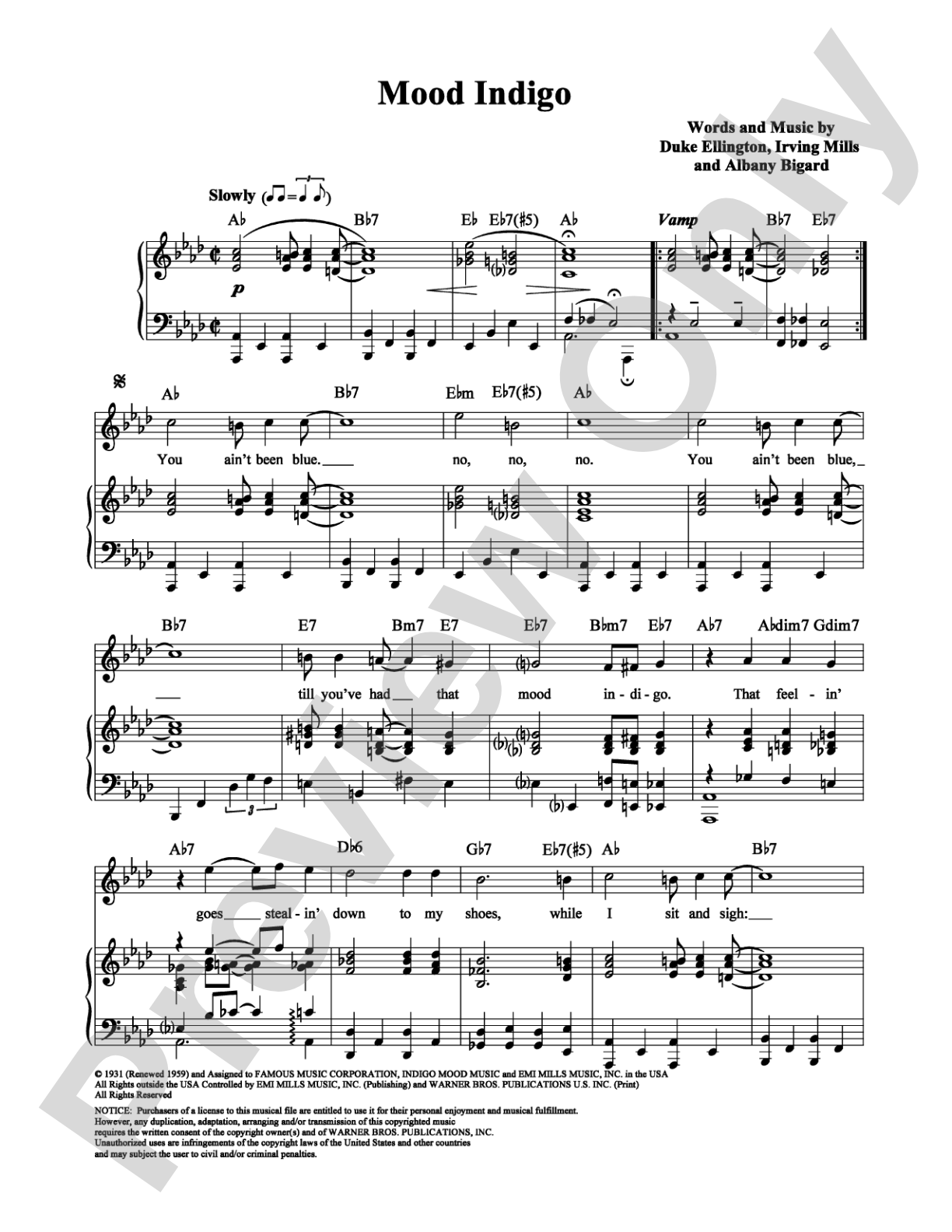
Mood Indigo: Piano/Vocal/Chords Digital Sheet Music

Mood Indigo: Piano/Vocal/Chords Digital Sheet Music

Duke Ellington, Irving Mills, Albany Bigard

Item: 00-PS-0004400

Digital Download
$3.99
Description

Mood Indigo: Piano/Vocal/Chords Digital Sheet Music isn't in MakeMusic Cloud just yet...but it could be. Let us know you'd like to see it, and you'll help shape what comes next. In the meantime, start a free trial and dive into thousands of interactive titles your students can play along with today.

Sample Audio
No sample audio found.
Sample Video
Additional Details
SKU: 00-PS-0004400

More about this title

About the Artist: Duke Ellington

Duke Ellington (1899, 1974) shaped American music across seven decades as a composer, bandleader, and pianist whose influence extends far beyond jazz. His harmonic sophistication and orchestral thinking elevated the entire genre, and his prolific output spans thousands of compositions that remain central to jazz education and performance. Ellington's approach to melody, harmony, and form offers essential study for musicians learning how jazz standards are constructed.

Why we love this

Mood Indigo is one of Ellington's most enduring compositions, and this lead sheet format makes it accessible for both classical and jazz pianists exploring the jazz standard repertoire. The harmonic language rewards careful listening and offers singers an intimate vehicle for phrasing and expression while the chord symbols support meaningful collaboration between vocalist and accompanist.

What to expect

Mood Indigo unfolds with contemplative elegance, its minor-key sensibility creating an atmosphere of quiet reflection and sophisticated melancholy. The harmonic language moves with gentle sophistication, never rushing, inviting both performer and listener into intimate musical conversation.

Who it's for

This arrangement suits singers and pianists working in jazz, American song, or popular music contexts who want to explore a standard outside the typical big band setting. It also appeals to classical pianists and vocalists curious about jazz vocabulary and the interpretive freedom that comes with lead sheet notation.

How to get the most out of it

  • Shape the melody with subtle dynamic contours rather than aggressive phrasing; this piece thrives on understatement and intimacy.
  • Treat the chord symbols as a foundation for gentle reharmonization rather than strict voicing rules. Listen to Ellington's original recording to hear how much tasteful freedom the arrangement invites.
  • Allow rubato in the piano part, particularly at phrase endings, to mirror the vocalist's natural breathing and phrasing.
  • Balance the vocal line so it floats above the piano accompaniment without either element overwhelming the other.

How to use it

This works beautifully on a recital featuring American song or jazz standards, particularly alongside other Ellington compositions or classic standards from the swing era. It can also anchor a jazz history unit in a general music course, demonstrating how Ellington's compositional mastery bridges popular, jazz, and art music traditions.

Skills your students will build

  • Reading lead sheet notation and chord symbols
  • Jazz phrasing and rubato in a vocal context
  • Harmonic analysis of chromatic voice leading
  • Collaborative listening between vocalist and accompanist
  • Interpreting and realizing jazz chord voicings on piano

You May Also Like