
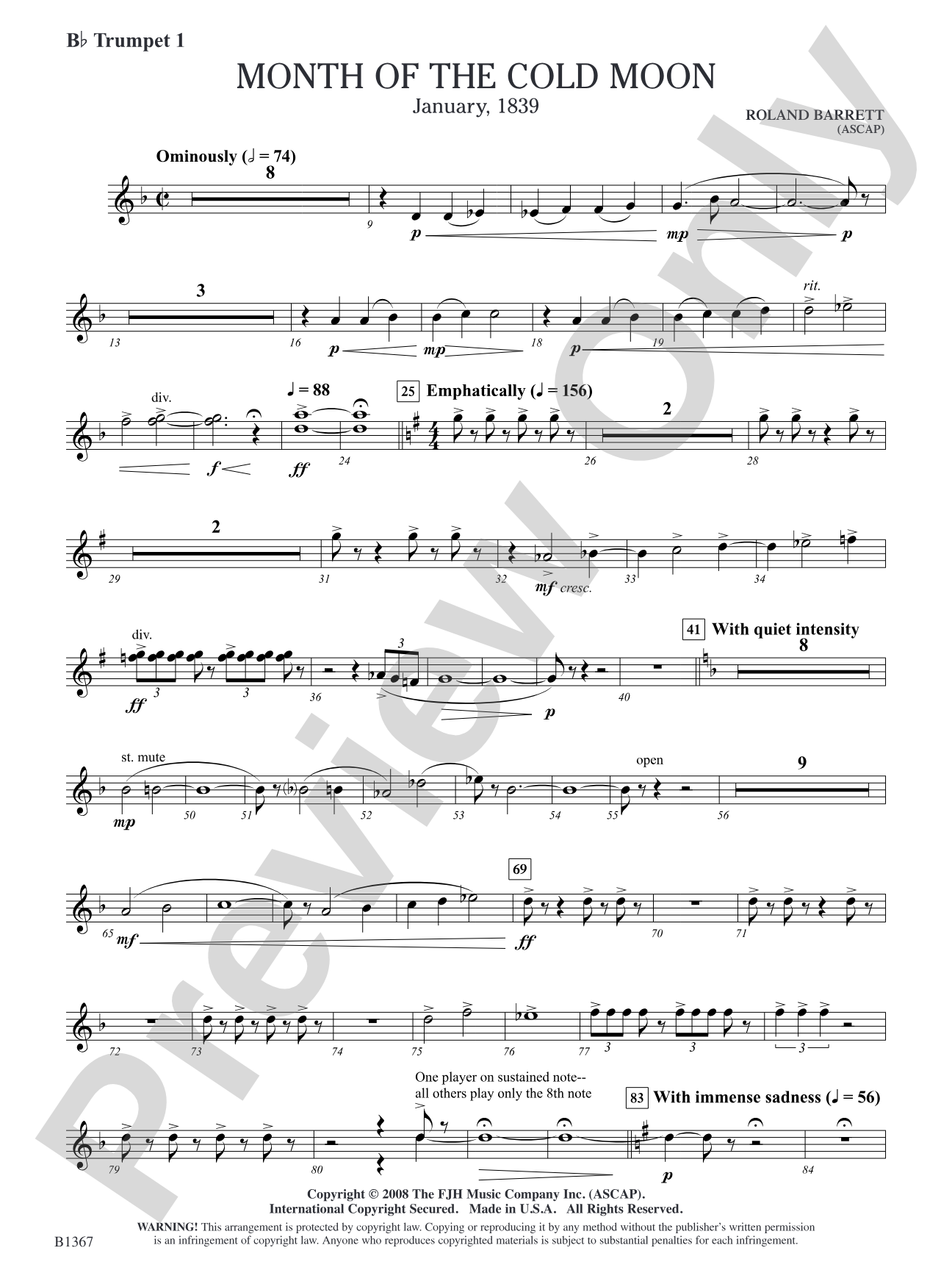

Month of the Cold Moon: B-flat Trumpet 1
By Roland Barrett
Grade: 4
Item: 98-PC-DB1367_T1
$7.00
Pickup currently not available
Description
Inspired by the tragic story of "The Trail of Tears," this work depicts the long journey made by the Cherokees when they were forced to leave their land and journey a thousand miles on foot. From shock to outrage, the opening section paints a vivid picture of chaos, depicted by forceful bass pedal points and powerful chords throughout the group. Unison ensemble hits announce the beginning of the journey. As the music builds, the unison hits continue to interject so as not to be forgotten. The middle section captures immense sadness and desperation through the use of delicate textures and lush harmonies. Previous themes all come together as the final section seeks to bring closure to this tragic event in American history. Powerful and emotional.


Month of the Cold Moon: B-flat Trumpet 1 isn't in MakeMusic Cloud just yet...but it could be. Let us know you'd like to see it, and you'll help shape what comes next. In the meantime, start a free trial and dive into thousands of interactive titles your students can play along with today.
Request This Title
Tell us you want it.
Start Your Free Trial
Explore everything that's ready to play right now.
Sample Audio
1
Audio File
--:--
0:00
0:00
Sample Video
No sample videos found.
Additional Details
Series:
FJH Symphonic Band
Publisher:
The FJH Music Company, Inc.
SKU:
98-PC-DB1367_T1
More about this title
About the Composer: Roland Barrett

Roland Barrett holds a faculty position in music theory and composition at the University of Oklahoma, where he teaches 20th-century music across undergraduate and graduate levels. He brings fifteen years of experience as Assistant Director of Bands to his current role, and continues arranging for the Pride of Oklahoma marching band while maintaining an active compositional practice.
With over two hundred published works for symphonic band, chamber groups, and marching ensembles, Barrett has established himself as a nationally recognized voice in wind music. His compositions have been commissioned and performed by the Dallas Wind Symphony, countless All-State and All-Region honor bands, and broadcast on NPR and national television. He is a multiple recipient of the ASCAP Plus award.
Why we love this
Month of the Cold Moon tackles a difficult subject with genuine compositional craft, refusing both sentimentality and oversimplification. The contrast between turbulent outer sections and the vulnerable middle passage creates a narrative arc that students internalize rather than merely read about, and the unison ensemble figures give the entire band a shared voice in telling this story.
What to expect
The piece moves like a journey itself, beginning in fractured, unsettled territory before descending into profound melancholy. There's weight to every phrase, and the combination of powerful unison statements with intimate harmonic passages creates an emotional landscape that feels earned rather than imposed.
Who it's for
Bands at the Grade 4 level ready to explore programmatic writing with historical depth. Directors looking for repertoire that meets festival standards while opening conversations about American history and the power of music to honor difficult narratives.
How to get the most out of it
- Build the initial bass pedal points with absolute rhythmic precision; any wavering undermines the shock and disorientation they're meant to convey.
- Shape the unison ensemble hits as call-and-response moments rather than mere punctuation. Let them breathe between statements so the band hears them as persistent voices.
- The middle section's delicate textures demand balance work beyond the typical rehearsal focus. Isolate the inner harmonies in sectionals to ensure lush, transparent sonorities throughout.
- Use the conductor's pacing in the final build to clarify how all previous material coalesces. The emotional impact hinges on the band understanding what each returning theme represents.
How to use it
Program this alongside other works that explore American themes or historical narratives to create a concert with thematic coherence. It works equally well as a festival selection or as the centerpiece of a program that invites audience reflection on lesser-known chapters of our nation's past.
Skills your students will build
- Sustaining and shaping extended pedal point effects
- Balancing transparent inner harmonies within full band texture
- Performing unison figures as expressive gestures rather than rhythmic markers
- Connecting musical contrast (chaos/sadness/resolution) to programmatic content
- Collaborating across sections to create cohesive ensemble sound in both tutti and chamber-like passages