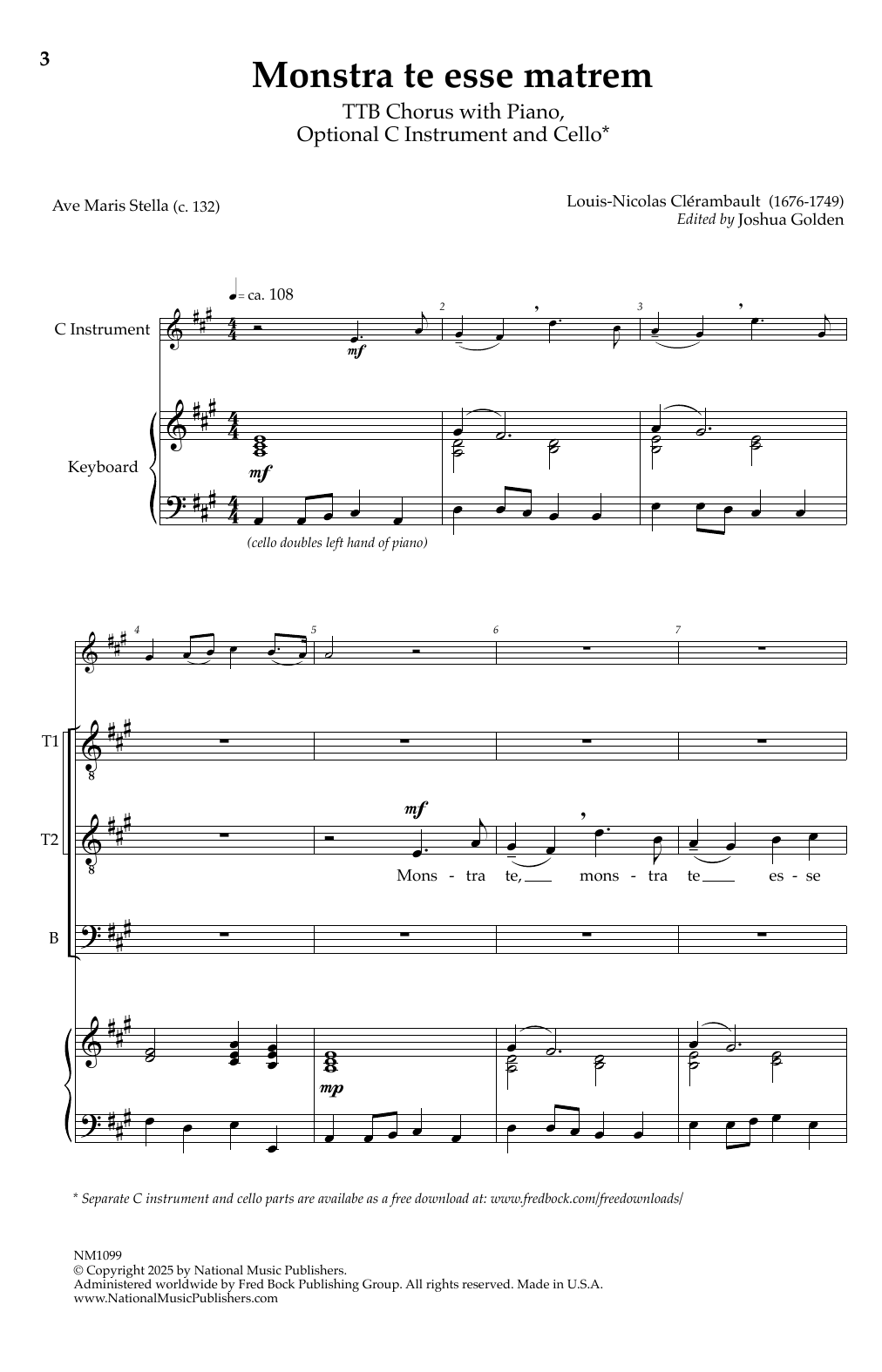
Monstra te esse matrem Sheet Music Preview

Monstra te esse matrem: TTB Choral Octavo

By Louis-Nicolas Clérambault / By Joshua Golden

Item: 35-DS01628051

Digital Download
$3.35
Description

Monstra te esse matrem: TTB Choral Octavo isn't in MakeMusic Cloud just yet...but it could be. Let us know you'd like to see it, and you'll help shape what comes next. In the meantime, start a free trial and dive into thousands of interactive titles your students can play along with today.

Sample Audio
No sample audio found.
Sample Video
Additional Details
Publisher: Hal Leonard
Page Count: 11
SKU: 35-DS01628051

More about this title

About the Composer: Louis-Nicolas Clérambault

Louis-Nicolas Clérambault (1676-1749) was a French Baroque composer and organist whose sacred and secular vocal works earned him a prominent position in Paris's musical circles. His compositional skill lay especially in cantatas and motets, where he balanced technical sophistication with expressive clarity, making his work accessible to both professional musicians and capable amateur ensembles.

Why we love this

Clérambault's setting brings genuine elegance to a Marian text without sacrificing musicality for reverence. The piece sits well for men's voices, moves at a human pace, and rewards careful ensemble work with moments of real harmonic warmth that elevate it beyond typical octavo fare.

What to expect

The music unfolds with Baroque elegance and restraint, moving through clear harmonic gestures that feel both formal and intimate. There's an almost conversational quality to the part writing; voices enter and interweave as if in dialogue, creating texture without density.

Who it's for

Intermediate to advanced men's choirs and mixed ensembles looking for repertoire with historical substance and manageable technical demands. This works equally well for college and high school programs seeking concert material that feels substantial without requiring soloists.

How to get the most out of it

  • Balance the harmonic structure by attending to the inner voices; the alto and baritone lines carry melodic weight that shouldn't disappear under the tenors.
  • Shape phrases with respect to text inflection rather than bar lines. Clérambault's phrases often cross barlines, so think in musical sentences, not measures.
  • Allow space between phrases to breathe. The piece gains dignity and clarity when you resist the urge to rush from one section to the next.

How to use it

Pair this with other Baroque sacred music for a concert exploring how different composers set devotional texts, or use it as an anchor piece in a program mixing Baroque and Renaissance repertoire. Its 11 pages make it substantial enough to stand alone as a concert centerpiece without dominating an entire program.

Skills your students will build

  • Reading and maintaining independence in four-part harmony
  • Phrasing across bar lines in Baroque contexts
  • Balancing transparency in close harmony writing
  • Sustaining text clarity while managing longer phrases

You May Also Like