Monday, Monday (arr. Val Regan) Sheet Music Preview

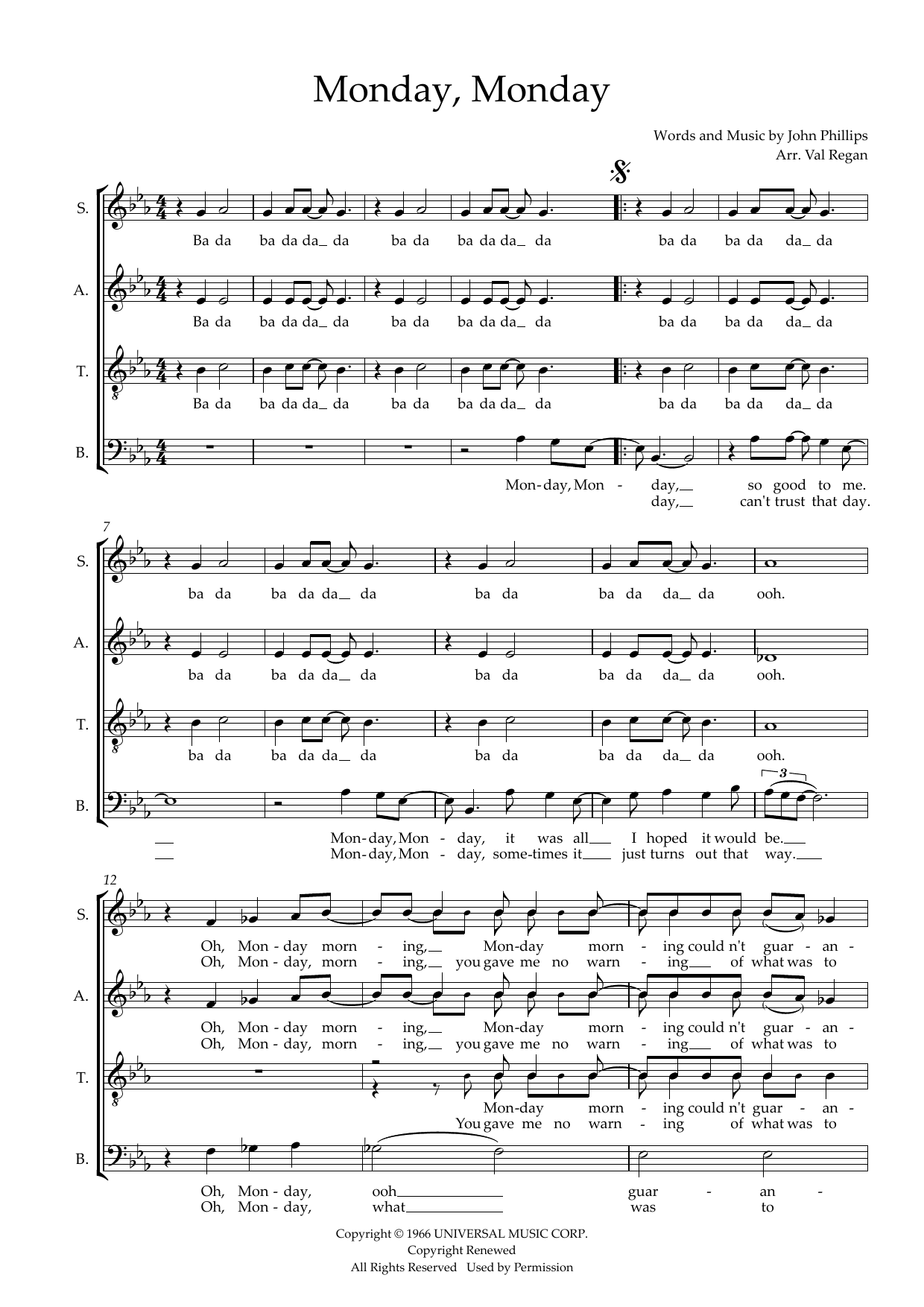
Monday, Monday (arr. Val Regan): SATB Choral Octavo

As performed by The Mamas and the Papas / Arranged by Val Regan

Item: 35-DS00462006

Digital Download
$1.99
Description

Monday, Monday (arr. Val Regan): SATB Choral Octavo isn't in MakeMusic Cloud just yet...but it could be. Let us know you'd like to see it, and you'll help shape what comes next. In the meantime, start a free trial and dive into thousands of interactive titles your students can play along with today.

Sample Audio
No sample audio found.
Sample Video
Additional Details
Publisher: Hal Leonard
Page Count: 3
SKU: 35-DS00462006

More about this title

About the Artist: The Mamas and the Papas

The Mamas and the Papas emerged from the Los Angeles folk-rock scene in the mid-1960s as one of the decade's most distinctive vocal ensembles. Built on the interplay between two couples, the group achieved their signature sound through carefully arranged harmonies and a sophisticated pop sensibility that drew from doo-wop, folk, and rock influences. Their arrangements prioritized vocal layering and blend, creating a studio-focused aesthetic that remains instructive for choral directors studying how popular music can employ genuine harmonic depth.

The group's output between 1966 and 1968 established them as hitmakers with serious musicianship. Songs like "Monday, Monday" became cultural touchstones precisely because they balanced commercial appeal with genuine compositional craft, featuring memorable melodic hooks supported by inventive voice leading. For educators, their work offers a window into how secular choral writing can combine accessibility with musical substance.

Why we love this

Val Regan's arrangement captures the pop sensibility of the original while building something choral and ensemble-focused. The adaptation respects the song's infectious energy without losing it to oversimplification; this is a chart that works equally well as a concert opener or as a teaching tool for building blend across four voices. Conductors appreciate how the piece sits comfortably for mixed choirs while remaining engaging enough to hold an audience.

What to expect

Buoyant and sophisticated. The arrangement preserves the original's Tuesday-morning irony and melodic catchiness while layering in four-part harmony that feels both natural and considered. Singing it creates the sensation of channeling 1960s studio polish without sounding stiff or nostalgic.

Who it's for

Mixed choirs at the intermediate to advanced high school level or adult community ensembles looking to program contemporary pop music with harmonic substance. Directors seeking a piece that works for both concert settings and pops concerts will find this a reliable choice.

How to get the most out of it

  • Lock the harmonic rhythm in rehearsal by isolating each chord change; this song's pop groove lives in the precision of simultaneous voice shifts, not in rubato. Drill transitions between sections to eliminate the lag that kills momentum.
  • Let the sopranos and altos anchor the melody; tenor and bass lines support rather than compete. Balance the inner voices so they color the harmony without obscuring the tune that audiences know.
  • Shape each phrase with the natural speech patterns of the lyric. Avoid clipping consonants too aggressively; let the groove breathe into the words rather than attacking them.
  • Attend to the rhythm section's role even without live drums. Tap feet as a choir during early rehearsals to establish the pulse; pop music lives or dies on rhythmic confidence.

How to use it

This works beautifully as an opening number for a spring concert devoted to pop and contemporary repertoire, immediately setting an energetic, accessible tone. It pairs well alongside lighter theatrical or swing arrangements, offering a stylistic middle ground that keeps audiences engaged through set transitions. Consider it as well for a pops concert finale or as a teaching piece mid-year when you want to reinforce blend and rhythmic precision without the demands of classical literature.

Skills your students will build

  • Voice leading across four parts within pop harmonic progressions
  • Maintaining ensemble rhythm without a metronome or click track
  • Balancing melody with supporting harmony in a secular context
  • Tuning major and minor thirds in close-voiced arrangements
  • Interpreting lyrics with conversational phrasing rather than classical diction

You May Also Like